


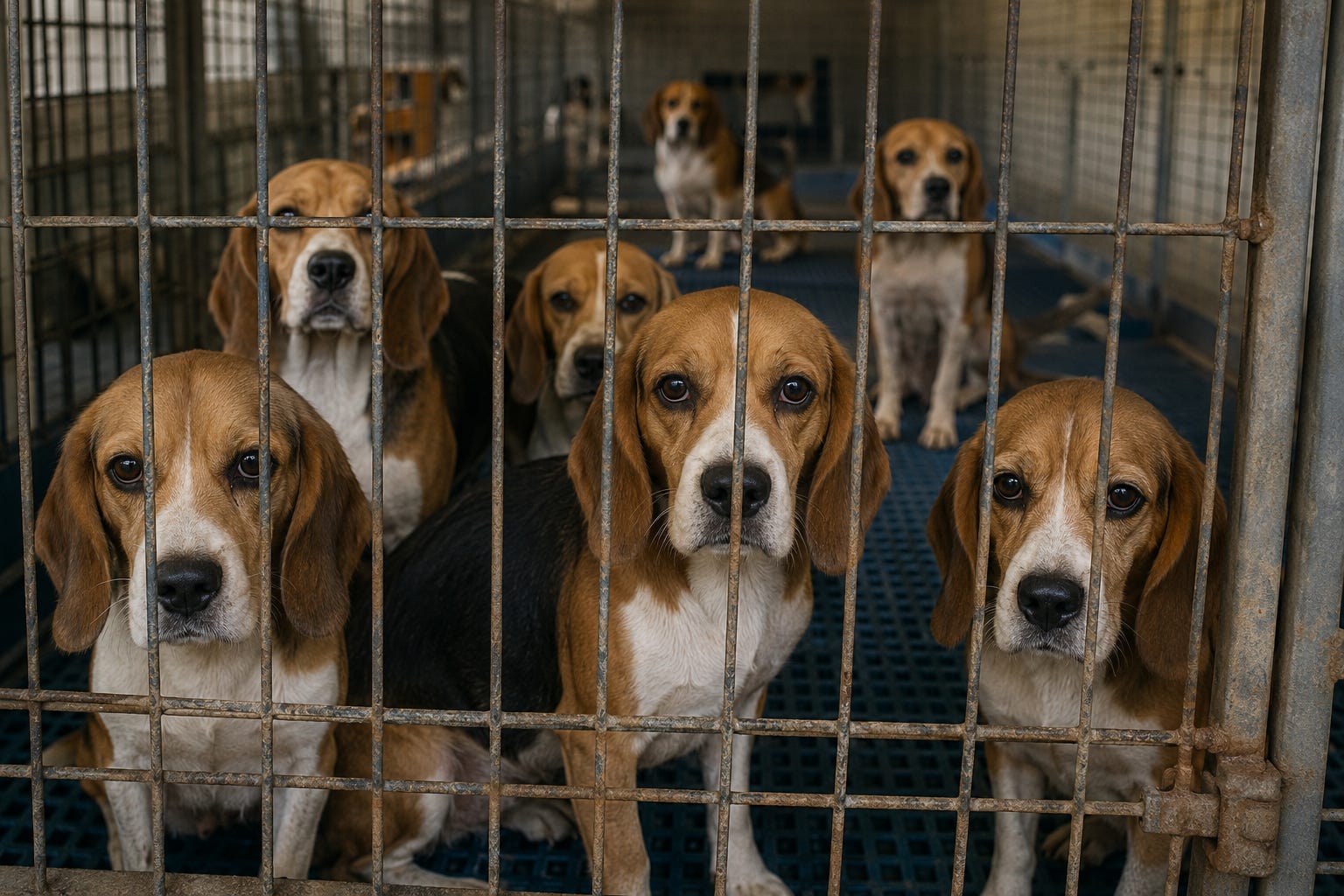
For decades, the dogs at Ridglan Farms lived largely unseen by the public. Rows of beagles bred not for homes, companionship, or ordinary life, but for laboratories.
Now, after growing public scrutiny, legal pressure, protests, and national media attention, around 1,500 beagles are finally being removed from the Wisconsin facility and transferred into rescue organisations and adoption networks across the United States.
For many people watching this unfold, the story feels almost impossible to process. Not because laboratory breeding facilities are new. But because the scale forces society to confront something it has often preferred not to think about.
Why Beagles?
Beagles have long been one of the most commonly used dogs in laboratory testing.
Not because they are aggressive, not because they are physically unusual, but because they are gentle.
They are social dogs who generally tolerate human handling well, even in stressful environments. That temperament has made them highly desirable to research facilities for decades. It is one of the cruellest ironies in animal welfare. The very traits that make beagles such beloved family dogs have also made them vulnerable to exploitation.
The Public Pressure Around Ridglan
Ridglan Farms became increasingly controversial after years of criticism from animal welfare advocates, lawsuits, investigations, and activist campaigns focused on the breeding and use of dogs for experimentation. Reports surrounding conditions at the facility and the treatment of animals intensified public attention throughout 2025 and 2026.
In April 2026, protests outside the facility escalated dramatically, with mass demonstrations, arrests, and clashes between activists and law enforcement drawing international attention.
Shortly afterwards, rescue organisations announced an agreement to remove approximately 1,500 beagles from the site.
For many observers, the moment felt historic but it also raised difficult questions. Because rescue is only one part of the story.
What Happens to Dogs Raised Inside Laboratories?
Many of these dogs have never experienced ordinary life.
Some have never walked on grass, never climbed stairs, never heard household sounds or slept in a quiet home.
Former laboratory dogs often emerge psychologically overwhelmed by the world around them. The trauma is not always loud or dramatic.
Sometimes it appears as freezing, silence, confusion. An inability to understand freedom itself. And yet, many still seek affection from humans almost immediately. That is often the hardest thing for rescuers to process. After everything, the dogs still want connection
The Language That Hides Reality
One of the reasons stories like Ridglan remain invisible for so long is because institutions rarely describe these dogs simply as dogs.
They become “research models, subjects, specimens.
Technical language creates emotional distance. But behind every institutional phrase is an individual animal capable of fear, attachment, stress, curiosity, and suffering.
The public is increasingly rejecting the idea that scientific terminology should erase moral responsibility.
A Wider Shift Is Happening
The Ridglan story arrives during a period of growing public discomfort around animal experimentation worldwide.
Advances in technology, alternative testing methods, organ-on-chip systems, AI modelling, and non-animal research techniques are changing the conversation around whether large-scale animal testing remains ethically justifiable in the way it once was.
At the same time, social media and rescue footage have made laboratory survivors visible in ways that previous generations rarely witnessed. People are no longer imagining abstract research animals. They are watching frightened beagles discover sunlight for the first time.
That changes public perception very quickly.
The Reality Behind Rescue
The removal of 1,500 dogs is undeniably significant. But the story does not end with transport vans leaving a facility.
Every dog now faces a long adjustment process involving medical care, behavioural rehabilitation, socialisation, and adaptation to ordinary life. Rescue organisations across the United States are now working to prepare the dogs for homes.
And behind the celebration remains a deeper question society still struggles to answer. How many animals suffered invisibly before the world finally paid attention?
Because facilities like Ridglan do not exist in secrecy by accident. They exist because suffering becomes easier to tolerate when it happens far away from public view.