
Every so often an official announcement contains a figure that is so large it almost loses its meaning. We read it, acknowledge it and move on, but sometimes it is worth stopping for a moment and asking ourselves what that number actually represents.
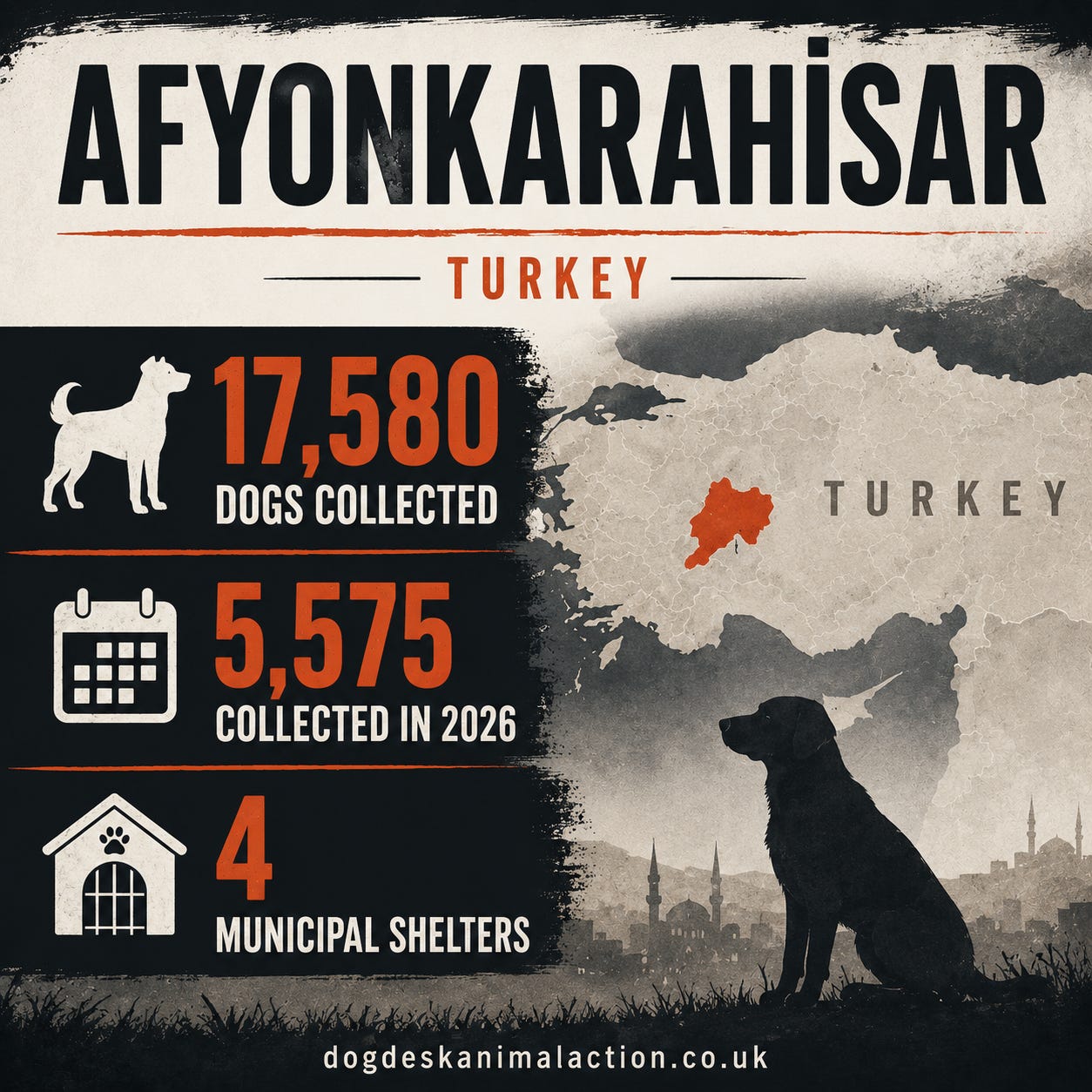
This week, the Governor of Afyonkarahisar announced that 17,580 free roaming dogs have been collected across the province since the programme began. He added that 5,575 of those dogs were collected during 2026 alone and that the province currently has four municipal shelters.
Those three figures belong together because one cannot be understood without the others.
Seventeen thousand five hundred and eighty dogs is a huge number for a single province. It is not a statistic that can be explained away as a handful of collections taking place over a few months. It represents an operation of remarkable scale, one that has required dogs to be located across towns, villages and rural communities before being captured, transported and brought into the municipal system.
At the same time, the governor speaks of four municipal shelters.
That immediately changes the way we look at the announcement. Rather than focusing solely on the number of dogs collected, attention naturally turns to the practical reality of what must have followed. Every one of those dogs had to go somewhere. Every one had to enter a facility, be recorded, receive food and water and occupy space within a system that, according to the governor’s own statement, consists of four municipal shelters.
The announcement does not tell us how many kennels those shelters contain or how many dogs they can accommodate at any one time. It does not explain how many dogs have remained in the shelters, how many have been transferred, how many have been adopted or how many have left the system for other reasons. Those details are absent, yet they become impossible to ignore once the scale of the collection programme is understood.
It is difficult to picture 17,580 dogs. We instinctively reduce large numbers into something abstract because our minds struggle to visualise them. Yet these were not numbers. They were individual animals collected from streets, industrial estates, villages, parks and neighbourhoods across the province. Each one had to be transported. Each one had to pass through the doors of the municipal system. Each one required care, however briefly or however long they remained there.
The governor’s statement also tells us that more than five thousand dogs have been collected during this year alone. That suggests the operation is continuing at a significant pace rather than slowing as time passes. It is another reminder that this is not simply a historical programme being summarised at the end of its life. It is an active one.
There is no dispute about the figures. They come directly from the governor’s announcement. What they leave behind are questions about scale and capacity. How does a province process almost eighteen thousand dogs through four municipal shelters? What level of infrastructure is required to sustain an operation of that size? How many people are involved, how many vehicles are deployed and how much space is needed to receive such an extraordinary number of animals?
These are not political questions. They are practical ones.
As more provinces publish their own collection totals, each announcement adds another piece to a much larger picture. On its own, the number 17,580 huge When it is read alongside the statement that the province has four municipal shelters, it becomes something more. It becomes a reminder that behind every large statistic lies an equally large logistical operation, one involving thousands upon thousands of living animals whose journeys did not end when they were collected from the streets.
What happened to them?


