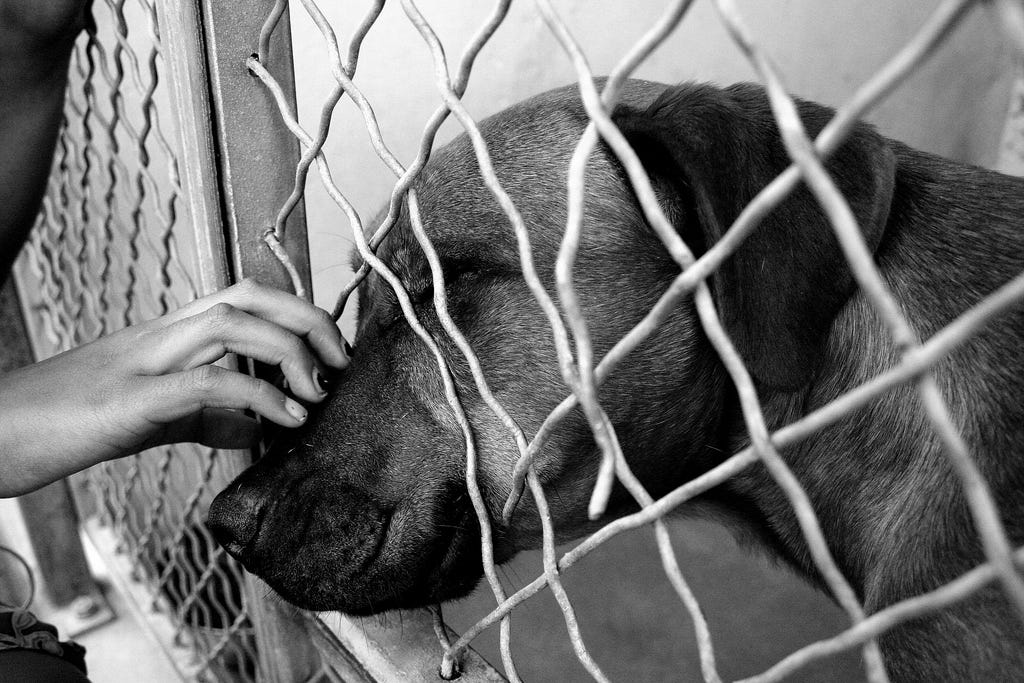
Illustrative photograph: Erick Pleitez / Wikimedia Commons, CC BY 2.0. Not an animal identified in the Miranda’s Rescue investigation.
San José Animal Care Services transferred 179 dogs to Miranda’s Rescue between 2018 and April 2026. In August, the city publicly acknowledged that it did not have complete information about what happened to every one of those animals. It also confirmed that four dogs originating from its shelter had been identified among animals recovered from a burial site at the rescue.
Their names were Zues, Arnold, Lucious and Dixie.
Four dogs whose identities could be established. Four lives that had once passed through a public animal shelter before being entrusted to another organisation.
The admission that San José could not account for the outcomes of every dog it transferred raises a question that should concern anyone responsible for public animal welfare services. What information is a county pound expected to obtain before handing over an animal, and what responsibility does it retain for checking that animal’s welfare once the transfer is complete?
The investigation into Miranda’s Rescue in Fortuna, California, has made those questions impossible to ignore. On 26 June 2026, the Humboldt County Sheriff’s Office confirmed that investigators had recovered 117 intact canine remains from two excavation sites, together with additional skulls, bones and loose microchips. Preliminary forensic examinations indicated that many of the dogs had died from gunshot wounds. More than 600 dog collars were recovered from a barn.
The criminal investigation continues, but the questions surrounding public shelter procedures do not depend on its eventual outcome. They concern decisions made by publicly funded organisations, the information used to support those decisions and the records retained afterwards.
What does California law actually require?
California’s Food and Agricultural Code, Section 32003, requires public and private animal shelters to maintain accurate individual records for animals taken up, medically treated or impounded. Those records must include relevant dates, circumstances, personnel involved, medical treatment and the animal’s final disposition. The law requires the records to be retained for three years after the animal’s impoundment ends.
This creates a clear obligation to document what happened while an animal was in the shelter’s care and how it left that care.
But there is an important distinction between recording that a dog was transferred to a rescue organisation and verifying what subsequently happened to it.
Section 32003 does not expressly establish a universal requirement for public shelters to obtain continuing reports about every animal after transfer, inspect every receiving rescue or independently verify every adoption claimed by that rescue.
That leaves an important question about the procedures adopted by individual public authorities.
A county may comply with its statutory record keeping obligations by documenting an animal’s transfer while still having no complete account of its later life. Whether the receiving organisation must provide further information may depend on local policies, rescue partner agreements and the arrangements made between the organisations involved.
The difference between minimum legal compliance and meaningful due diligence is therefore central to this investigation.
What did the shelters check?
Public animal shelters regularly rely on rescue organisations to accept dogs that are difficult to rehome, require specialist care or cannot remain indefinitely in overcrowded kennels.
These transfers can save lives. They can also involve animals whose needs make them particularly dependent on the competence and resources of the organisation receiving them.
Before approving a rescue partner, a public shelter could reasonably be expected to examine its legal status, facilities, capacity, veterinary arrangements, animal care procedures and history of compliance. It might seek references, conduct inspections or require written agreements specifying standards of care.
But what did the California shelters transferring dogs to Miranda’s Rescue actually require?
Did they conduct physical inspections, or were assessments based on documents and references? Were rescue partners periodically reassessed? Did shelters require evidence that dogs had been adopted or remained in appropriate care? Were there procedures for investigating complaints, unusual mortality figures or a failure to provide requested information?
Those are not allegations that individual authorities failed to carry out checks. They are questions that can be answered through their own policies, agreements and administrative records.
And the answers may differ considerably between authorities.
San José’s 179 dogs
San José’s published response provides an unusually clear example of why those questions need to be asked.
The city has confirmed that 179 dogs were transferred to Miranda’s Rescue over approximately eight years. It subsequently ended its relationship with the organisation and retrieved the dogs it identified as remaining there in June.
Yet its official public statement also acknowledges that it does not have complete outcome information for every dog transferred during that period.
This does not mean that all the other dogs are missing or that they died at Miranda’s Rescue. Some may have been adopted, transferred elsewhere or remained in care. The city’s statement does not establish their individual fates.
What it does establish is that the sending authority cannot presently provide a complete account of the outcomes of all 179 dogs.
That raises questions about the information required from Miranda’s Rescue throughout the relationship. Were adoption confirmations routinely supplied? Were records requested only when concerns emerged? Did the city have a system for reconciling individual animals against the receiving organisation’s reported outcomes?
San José has also published an important distinction in its explanation of rescue only placements. When a dog is transferred to a rescue organisation, the rescue becomes the primary organisation responsible for the animal’s care and placement.
That explains the transfer of immediate responsibility. It does not tell us what oversight the public shelter maintains afterwards.
Napa County and the decisions behind a transfer
Napa County Animal Shelter presents another part of the picture.
In May 2026, the county confirmed that it had suspended transfers to Miranda’s Rescue after learning of the criminal investigation. It also announced that it was reviewing rescue partner agreements and evaluation procedures, while considering options to support dogs previously transferred there.
Napa County explained that the number of animals entering its shelter frequently exceeded the number being adopted and that limited local rescue capacity made regional partnerships necessary.
That is a legitimate operational challenge, but it makes the quality of rescue partner assessments particularly important.
When a shelter needs to create space urgently, what prevents pressure on capacity from influencing the standard of checks applied to an external organisation? Is there a documented approval process that must be completed regardless of how urgently a placement is needed? Who has authority to approve an exception, and how is that decision recorded?
Napa County’s public statement does not establish what checks were undertaken before transfers to Miranda’s Rescue, whether those checks changed over time or what follow-up information the shelter received.
Its announcement that agreements and evaluation processes were being updated makes the earlier arrangements especially relevant. We need to understand what those arrangements required and whether they were consistently applied.
The problem of transfers through third parties
There is another dimension to the Miranda’s Rescue investigation that deserves attention.
Sacramento County Animal Services reported that three dogs had been transferred to Miranda’s Rescue through third party rescue organisations after the county had ended its direct relationship with the facility in March 2025. The county said those transfers occurred without its knowledge or authorisation and sought the animals’ return.
This exposes a separate issue with the chain of custody.
A public shelter may assess and approve one rescue organisation, only for an animal subsequently to be moved to another. If the original shelter has no effective means of tracking onward transfers, its initial due diligence may offer little protection once the dog leaves the approved organisation.
What restrictions, if any, do public shelter agreements place on onward transfers? Must the original shelter be notified or give permission? Does the receiving rescue have to retain records identifying the next organisation, and can the shelter obtain those records when concerns arise?
These are particularly important questions for animals transferred because of complex medical or behavioural needs. A receiving organisation’s suitability may have been assessed for those particular circumstances, while a subsequent organisation may not have undergone the same scrutiny.
An approved destination should not become an unrestricted route into a network of unverified placements.
What records should be available now?
The investigation has already demonstrated the value of individual identification records. Microchip information has helped investigators connect recovered remains with animals previously held by public shelters.
But forensic identification after death is not an adequate substitute for a reliable record of an animal’s movements while alive.
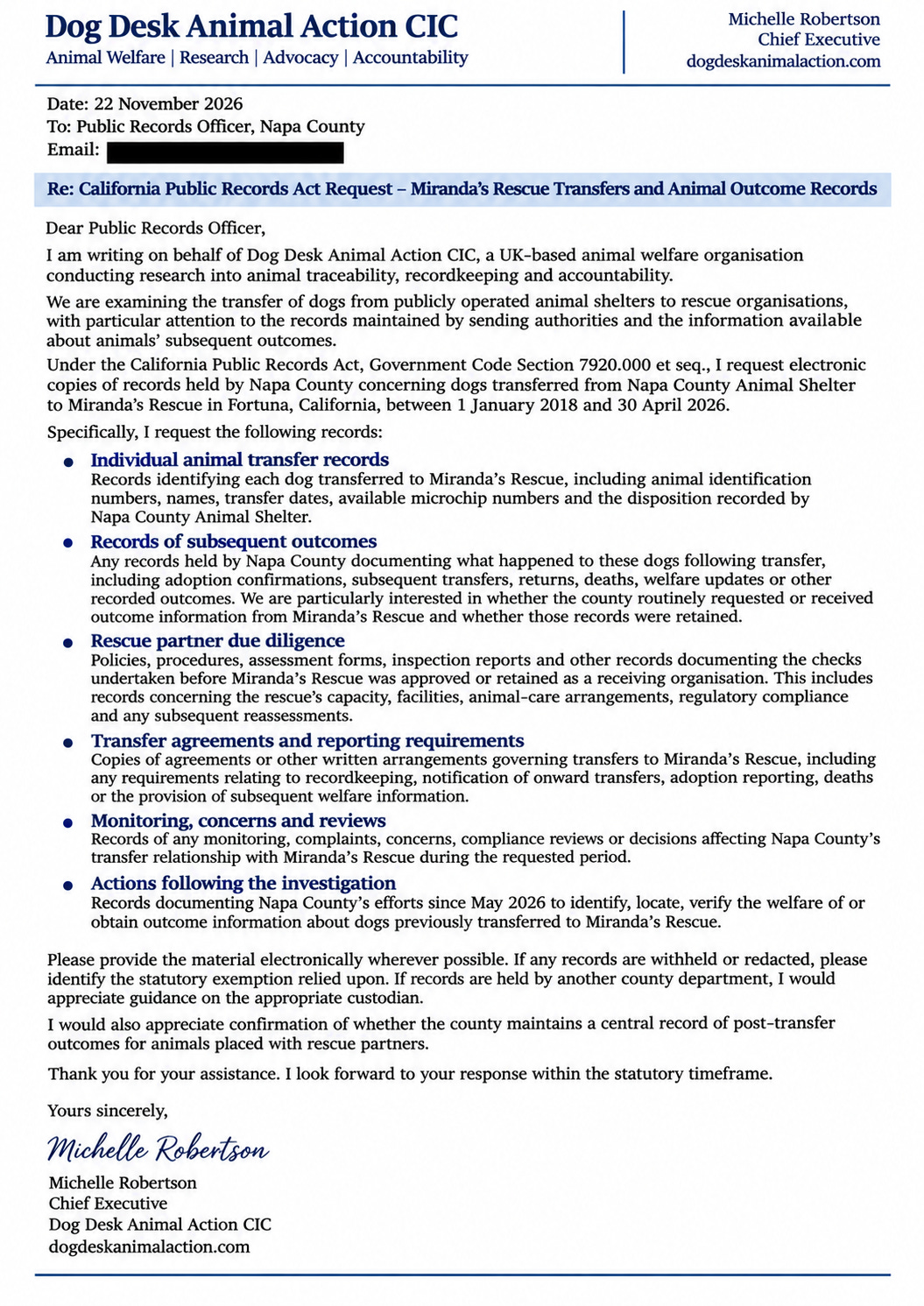
Dog Desk Animal Action CIC has prepared a California Public Records Act request to Napa County seeking individual transfer records, rescue partner agreements, evaluation procedures and information held about subsequent outcomes for dogs sent to Miranda’s Rescue.
Our examination will concentrate on the due diligence carried out by the sending authority. We want to establish what checks were required, who performed them, how frequently they were reviewed and what information the county expected to receive after an animal was transferred.
We also want to understand what happened when concerns arose. Were existing agreements reviewed? Were records reconciled? Did the county have the information necessary to identify animals still in the receiving organisation’s care?
The purpose is not to assume wrongdoing by the shelters involved. It is to determine whether their systems were capable of demonstrating that appropriate decisions had been made and that those decisions could be reviewed when something went wrong.
Who is responsible for the final outcome?
The Miranda’s Rescue investigation has exposed a distinction that deserves much greater attention in public animal welfare policy.
A shelter may fulfil its immediate responsibility by transferring a dog to an approved rescue. The receiving organisation then assumes responsibility for the animal’s care. Yet the sending authority may remain the only public body holding the dog’s original identification and transfer records.
If the receiving rescue subsequently fails, closes, loses contact with the shelter or becomes the subject of an investigation, those original records may be essential to reconstructing what happened.
That creates a strong argument for more consistent standards governing public shelter transfers.
Not every sending shelter can reasonably monitor an adopted animal throughout its entire life, and the law should not be misrepresented as requiring that. But public authorities should be able to demonstrate that receiving organisations were appropriately assessed, that transfers were documented, that onward movements were subject to clear arrangements and that concerns could trigger an effective review.
Without those safeguards, an animal can move through several organisations while each retains only a fragment of its history.
The investigation into Miranda’s Rescue has revealed what can happen when those fragments must be assembled after a crisis.
For San José, the public record already establishes that complete outcome information is unavailable for every dog transferred. For Napa County, the underlying due diligence and follow-up records remain to be examined. Sacramento County’s experience raises the additional question of how animals can reach an organisation through intermediaries even after direct transfers have stopped.
These are three distinct issues, but together they point towards the same need for scrutiny of public shelter transfer procedures.
When a county pound sends a dog to a rescue, what exactly has it checked, what evidence does it retain, and how would it know if that dog was subsequently moved somewhere it had never approved?
The answers should not have to wait until investigators are examining microchips recovered from a burial site.
They should already exist in the records.
Primary sources
City of San José Animal Care Services and Miranda’s Rescue FAQ
https://www.sanjoseca.gov/your-government/departments-offices/animal-care-services/about-us/miranda-s-faq
California Food and Agricultural Code, Section 32003
https://leginfo.legislature.ca.gov/faces/codes_displaySection.xhtml?sectionNum=32003.&lawCode=FAC
California Veterinary Medical Board Animal Shelter FAQs
https://www.vmb.ca.gov/inspections/shelter_faqs.shtml
Napa County Animal Shelter Seeks Community Support, 21 May 2026
https://www.napacounty.gov/m/newsflash?cat=17%2C25%2C31%2C7
Humboldt County Sheriff’s Office Investigation Update, 26 June 2026
https://humboldtgov.org/m/newsflash/home/detail/6261