


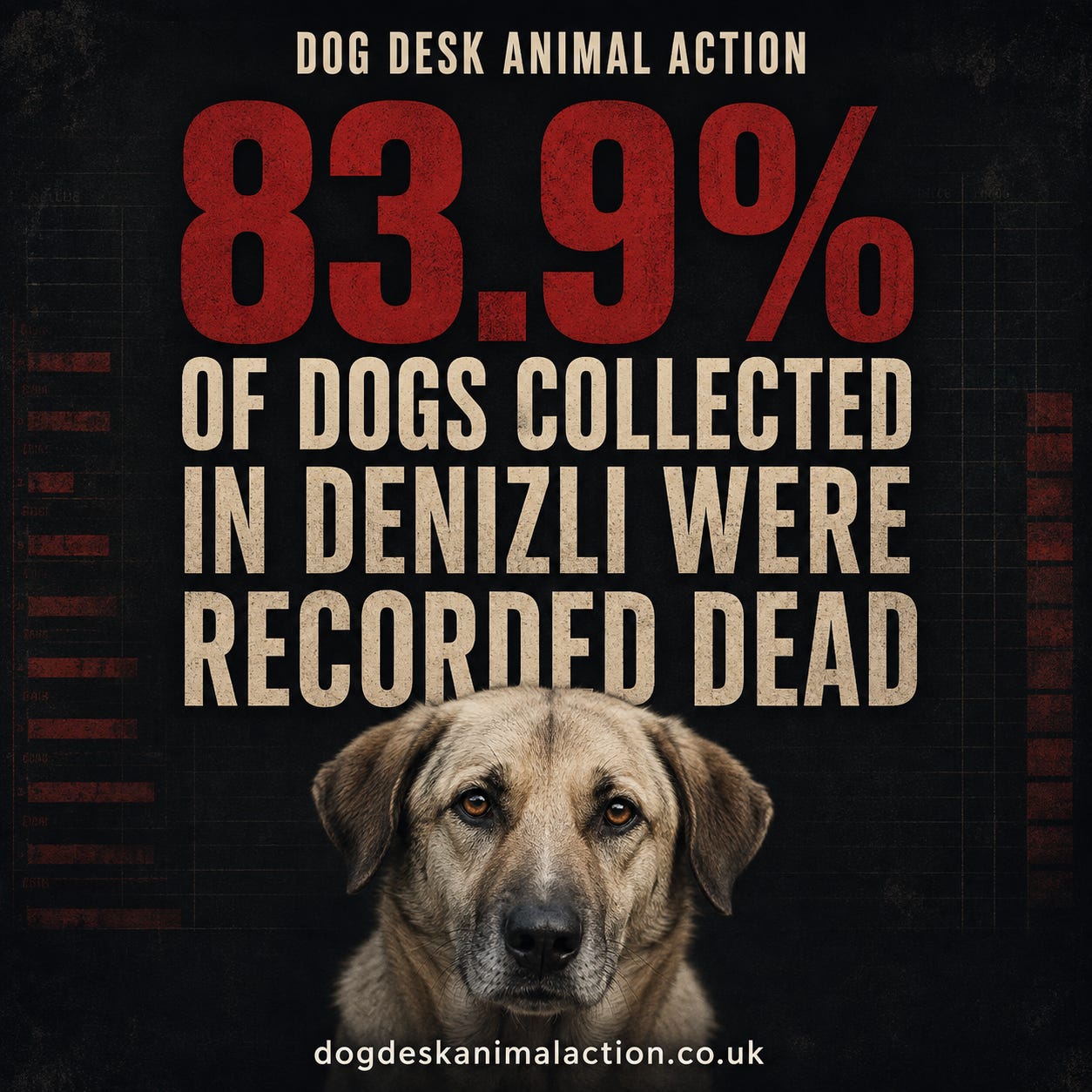
Between 1 January 2025 and 3 August 2026, 13,481 dogs were reportedly collected and taken into Denizli Metropolitan Municipality’s shelter system.
The outcome figures attributed to the municipality’s own monitoring table record 1,553 dogs as adopted, 735 as euthanised, 10,580 as having died from natural causes and 613 as remaining in the shelter.
Those figures account for all 13,481 dogs. They also mean that 11,315 of the dogs collected, 83.9% were recorded dead.
The largest category by far is not euthanasia. It is natural death.
According to the figures presented in a formal application requesting an investigation, 10,580 dogs collected by the municipality died naturally within a period of approximately 19 months. That would represent more than 18 recorded natural deaths every day.
Natural causes is not an explanation for mortality on this scale. It is an outcome category, and one that now requires complete medical evidence.
The figures were reportedly contained in a stray animal monitoring table presented at the Denizli Provincial Animal Protection Board meeting on 6 August 2026. The Denizli Governorate’s official account of that meeting confirms that the board examined the latest monitoring tables in detail.
The Governorate also confirms that 613 dogs were receiving care and rehabilitation at that time. This is the same figure recorded as the remaining shelter population in the outcome table reproduced in local reports.
However, the Governorate’s public announcement does not disclose how many dogs had been collected, how many had died naturally or how many had been euthanised.
Instead, it concentrates on further collection, expanding shelter capacity, building natural living areas and increasing coordination between municipalities. It instructs authorities to continue collecting, vaccinating and sterilising dogs without interruption. Dogs on university campuses, roads, petrol stations, rest areas and junctions are to be taken to shelters.
Those instructions carry far greater significance if the reported outcome figures are accurate. Before more dogs are collected, the public must be told what happened to the 11,315 dogs already recorded dead.
The local report setting out the investigation request attributes the figures to the official monitoring table considered at the 6 August meeting. It records 735 dogs as having been subjected to a euthanasia decision under Article 13 of Türkiye’s Animal Protection Law and 10,580 as natural deaths.
If 735 deaths were authorised as euthanasia, the remaining 10,580 cannot simply be absorbed into a vague mortality category and left unexplained. Each should be connected to an individual animal record containing its date of admission, condition on arrival, diagnosis, treatment, date and cause of death and veterinary authorisation.
There should also be records capable of showing whether those dogs died from infectious disease, untreated illness, injury, malnutrition, complications following surgery, conflict within the shelter, environmental exposure or another cause.
If a major disease outbreak occurred, where is the outbreak report? What infection was identified? When was it detected? What isolation and treatment measures were introduced? Which authority was notified? How many dogs were affected, and how many survived?
If the dogs arrived critically ill or injured, where are the intake assessments demonstrating this?
If natural death is being used as a broad administrative category covering many different causes, the municipality should publish the breakdown.
The figures themselves do not tell us how each dog died. They do establish that the mortality level is unprecedented and that a general assurance of legal compliance is not an adequate response.
Denizli Metropolitan Municipality has rejected allegations of mistreatment. It says the facility was inspected on 12 August by representatives of Denizli’s provincial and district agriculture authorities and the Directorate of Nature Conservation and National Parks. According to the municipality, those inspections determined that the centre was operating in accordance with the law and that allegations circulating publicly did not reflect the truth.
The municipality has also stated that the facility is open to public visits and inspection. But legal compliance during an inspection does not explain the retrospective outcome figures.
A facility can appear compliant on the day inspectors attend while historic mortality records still require examination. A visit on 12 August cannot, by itself, establish why 10,580 dogs were reportedly recorded as dying naturally between January 2025 and August 2026.
The inspection report should therefore be published. It should show what records were examined, whether individual death files were audited, whether medicines and euthanasia drugs were reconciled, whether carcass disposal records were checked and whether the 10,580 natural-death entries were independently verified.
Without that information, the public has been given a conclusion without the evidence supporting it.
The municipality’s assertion that it operates lawfully must be considered alongside the outcome data attributed to the municipality itself. Both cannot simply be announced and then separated from one another.
If the mortality figures are accurate, they indicate a catastrophic loss of life after collection. If they are inaccurate, Denizli has a catastrophic problem with official animal records.
Either possibility requires an investigation.
The monitoring figures reportedly show that 13,095 dogs were vaccinated and 5,743 sterilised during the same period. Those procedures involve veterinary work, medicines and public expenditure. They should be linked to identifiable animals and traceable outcomes.
How many of the 13,095 vaccinated dogs are among the 10,580 recorded natural deaths? How many sterilised dogs subsequently died? How long did they survive after treatment? Were payments or government support claimed for procedures involving dogs that were later recorded dead? Were all procedures supported by clinical records?
These questions do not accuse every veterinary worker or shelter employee of wrongdoing. They examine whether a publicly funded system can prove what it says it did.
That is the standard that should apply whenever authorities collect animals in the name of public safety and place them beyond ordinary public view.
The Governorate says 700 dogs have been adopted since January 2026. Adoption is a positive outcome, but it cannot be used to distract from the scale of the recorded deaths. Across the longer reporting period, the monitoring table reportedly records 1,553 adoptions against 11,315 deaths.
For every dog recorded as adopted, more than seven were recorded dead.
Meanwhile, the provincial board has ordered collection activity to continue and shelter infrastructure to expand. It has also instructed authorities to prepare annual, five year and ten year strategies for managing the dog population.
No credible strategy can be built on unexplained mortality.
Before authorities increase intake, they must establish whether the existing system can keep collected dogs alive. Before additional shelters are built, they must explain the outcomes in the facilities already operating. Before more public money is committed, they must show that expenditure can be traced from collection to final outcome.
Türkiye’s national policy has made collection central to its response to free roaming dogs. Municipalities are expected to remove animals from public places and place them in shelters or designated living areas. That policy transfers complete control over each dog’s survival to public institutions.
It also transfers complete responsibility.
Once a municipality removes a dog from the street, it controls where that animal is taken, who can see it, what treatment it receives, how it is recorded and whether it survives. The authority cannot demand the power to collect dogs while resisting scrutiny of what happens afterwards.
A figure of 10,580 natural deaths cannot be allowed to sit unexplained in a monitoring table.
The full table considered by the Provincial Animal Protection Board should be published. The individual mortality records should be independently audited. The 12 August inspection report should be released. The causes and dates of death should be aggregated and disclosed, along with treatment, euthanasia and carcass-disposal records.
The investigation already requested should be allowed to examine the evidence without interference, and its findings should be made public.
Until then, Denizli’s figures remain a warning about the consequences of measuring collection without accounting for survival.
The authorities know how many dogs entered the system, they say they know how many died. Now they must explain why.