


On 17 August 2026, an incident was reported from Chak 72/4-R in Sahiwal, Punjab, where a Sahiwal District Council employee was carrying out a stray dog culling drive. By the time local residents confronted him, two dogs had reportedly already been killed. What happened afterwards became a criminal matter. The employee was allegedly kidnapped and assaulted, police intervened, arrests were made and a case was registered. Violence against a council employee is not animal protection and opposition to dog culling does not justify attacking another person, but neither should the alleged assault be allowed to bury another important part of this story. A District Council employee was out killing dogs as part of a culling operation in Punjab in August 2026.
We want to know why.
According to the reporting, council worker Fida Hussain was carrying out the cull when residents confronted him because they objected to the dogs being killed. Their opposition is noteworthy, not because of the violence that allegedly followed, but because it challenges the idea that communities necessarily support lethal dog control. People living alongside street dogs do not all hold the same view. Some are frightened of dogs, some demand their removal, some care for them and some strongly oppose killing them. Public authorities cannot simply assume that culling represents what a community wants.
This incident becomes considerably more important when we look back only four months. In April, there was another case in the Sahiwal area involving a Chichawatni Municipal Committee employee who had reportedly been sent to kill stray dogs on the orders of the Assistant Commissioner. In that case, poison was reportedly being used. A privately owned dog was also killed and its owner subsequently allegedly kidnapped and assaulted the municipal employee. Again, the violence was unacceptable, but underneath that criminal incident was exactly the same question we are asking now. Why were local government employees being sent out to kill dogs?
Two incidents within four months begin to tell us something very different from a single isolated event. In April, a municipal employee was reportedly instructed to kill stray dogs and was using poison. In August, a District Council employee was reportedly carrying out another culling drive and had already killed two dogs. The question is no longer simply whether dog culling is still happening in this part of Punjab. Contemporary reporting indicates that it is. The question is how extensive the practice is, who is authorising it and why it continues.
That is very important because Punjab already has an Animal Birth Control Policy. During proceedings before the Lahore High Court earlier this year, the Punjab government assured the court that action would not be taken in deviation from the Punjab Animal (Dogs) Birth Control Policy 2021. The proceedings followed allegations that municipal authorities were continuing to kill street dogs rather than implementing sterilisation and vaccination. Further undertakings were subsequently given concerning implementation of the policy.
Against that background, an employee of Sahiwal District Council carrying out a culling drive in August deserves scrutiny.
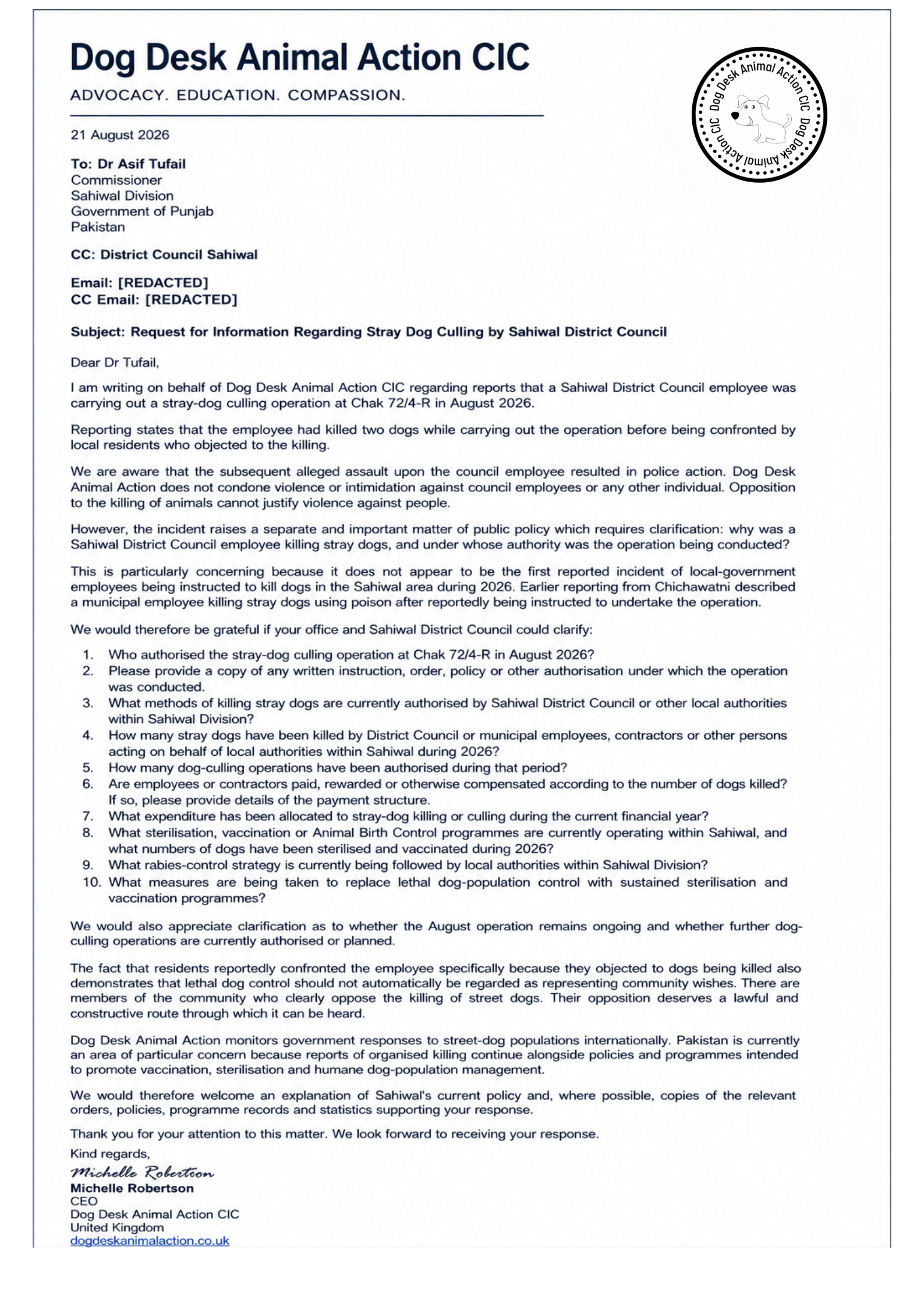
Dog Desk Animal Action has now written to Dr Asif Tufail, Commissioner of Sahiwal Division, and copied Sahiwal District Council. We have asked who authorised the operation at Chak 72/4-R and requested the written instruction, order or policy under which the employee was acting. We want to know what methods of killing are currently authorised by local authorities in Sahiwal, how many dogs have been killed during 2026 and how many culling operations have taken place.
We have also asked whether employees or contractors are paid, rewarded or otherwise compensated according to the number of dogs they kill. Whenever public authorities organise the collection or killing of dogs, the financial structure surrounding that activity deserves examination. If public money is being spent on culling, there should be a clear record of how much is being spent, who is receiving that money, what they are being instructed to do and how the work is monitored.
But we are not only asking about killing. We have asked what is being done instead. We want the figures for dogs sterilised and vaccinated in Sahiwal during 2026, details of the Animal Birth Control programmes currently operating and an explanation of the area’s rabies-control strategy. If Punjab’s policy is intended to move dog population management towards sustained sterilisation and vaccination, we need to understand why local government employees are still appearing in reports about organised culling.
The August incident also exposes another problem. Residents apparently felt strongly enough about dogs being killed to confront the person carrying out the cull. What allegedly happened afterwards crossed the line into criminal behaviour, but people should not have to confront council workers in the street to have their objections to animal killing heard. Authorities need lawful, transparent ways for communities to challenge how street dogs are managed and to understand what their councils are doing.
Public safety and animal welfare do not need to be opposing objectives. Rabies prevention matters. Dog bites matter. Communities have a right to expect authorities to manage genuine risks. But killing dogs cannot become the default response to failures in population management, vaccination, waste management, responsible ownership and abandonment prevention.
Nor should responsibility for controversial policies be allowed to stop with the employee carrying them out.
Our concern is not with vilifying a council worker who appears to have been performing work on behalf of a public authority. The responsibility for explaining this sits with those who authorised the operation.
Who sent him to kill the dogs? What instructions was he given? What method was he expected to use? How many other employees have been sent out to do the same thing? How many dogs have already been killed? How much public money has been spent doing it? And if Punjab has a policy intended to manage dog populations through sterilisation and vaccination, why was a District Council employee still carrying out a dog cull in August 2026?
Those are questions Sahiwal’s authorities should be able to answer.
Can someone cull council workers who murder dogs?