


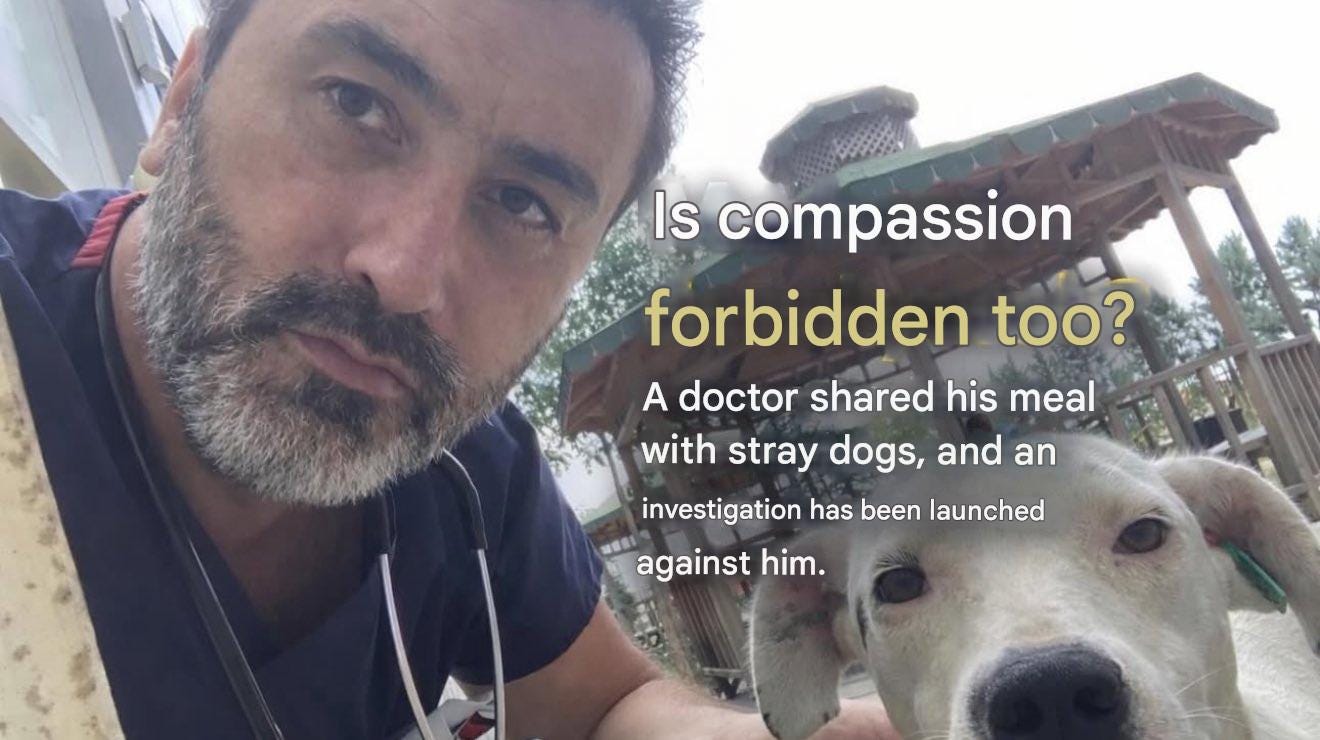
On 9 February 2026, a photo began circulating on social media in Turkey. It showed a doctor smiling gently beside a street dog. The caption that followed was what sparked outrage:
“Is compassion forbidden too? A doctor shared his food with street dogs, and a report was filed against him.”
The doctor was Dr. Özgür Ocak, an emergency medicine specialist working at Sinop Atatürk Devlet Hastanesi.
The allegation: that he had shared his own food with stray dogs on hospital grounds and that this act led to an official tutanak (formal report) and an internal administrative investigation.
For many, the question was immediate and painful: How did an act of kindness become a disciplinary matter?
What Actually Happened
Based on local news reporting and official statements, the sequence of events is now clearer.
Hospital security staff observed Dr. Ocak feeding stray dogs in the hospital grounds. This was reportedly documented via security camera footage and recorded in an internal report. Following standard procedures, hospital administration initiated an administrative review.
As the story spread on X (Twitter), Instagram, and Facebook, it was framed widely as a doctor being punished for compassion. The image resonated deeply in a country where millions of street animals depend on human kindness to survive.
Local news outlets later published responses from Öz Sağlık-İş Sendikası, whose Sinop branch stated that:
Security staff were following institutional instructions
No personal complaint or malice was directed at the doctor
The issue related to hospital procedures and hygiene rules, not hostility toward animals
This added nuance did little to calm public anger because the emotional core of the story remained unchanged.
Why This Struck a Nerve
Turkey is living through an intensely polarised moment when it comes to street animals.
On one side are citizens, volunteers, and professionals who see feeding street dogs as basic human decency in a system that has failed to protect animals.
On the other are institutions citing hygiene, public order, and risk management especially in spaces like hospitals.
But what made this case explode was symbolism.
A doctor someone whose profession is literally about preserving life sharing his meal with a hungry animal. And for that, facing scrutiny.
For many people, it felt like a line had been crossed.
Compassion Versus Procedure
Hospitals do have rules. Infection control, sanitation, and safety matter. These concerns should not be dismissed.
But there is also a deeper question this case forces us to confront:
When procedures are applied without humanity, what do we lose?
If compassion is treated as a violation rather than a value, we risk creating environments that are technically compliant but morally hollow.
No evidence has been made public that Dr. Ocak endangered patients, acted aggressively, or behaved irresponsibly. What is visible is a photograph that moved thousands of people precisely because it reflected something increasingly rare: kindness without calculation.
Where Things Stand Now
As of now:
The matter remains a local administrative issue
No disciplinary outcome has been publicly announced
No national ministry statement has been issued
Coverage remains limited to regional media and social platforms
Yet the conversation it sparked has spread far beyond Sinop.
A Moment That Says More Than It Should Have To
This was never just about one doctor, one dog, or one hospital.
It became a mirror reflecting how strained the relationship has become between rules and compassion, between institutions and conscience.
In a country grappling with how it treats its most vulnerable human and animal alike the image of a doctor sharing his meal should not feel radical.
And yet, here we are.
Nasıl bir zamanda yaşıyoruz?
What kind of time are we living in when kindness needs defending?