


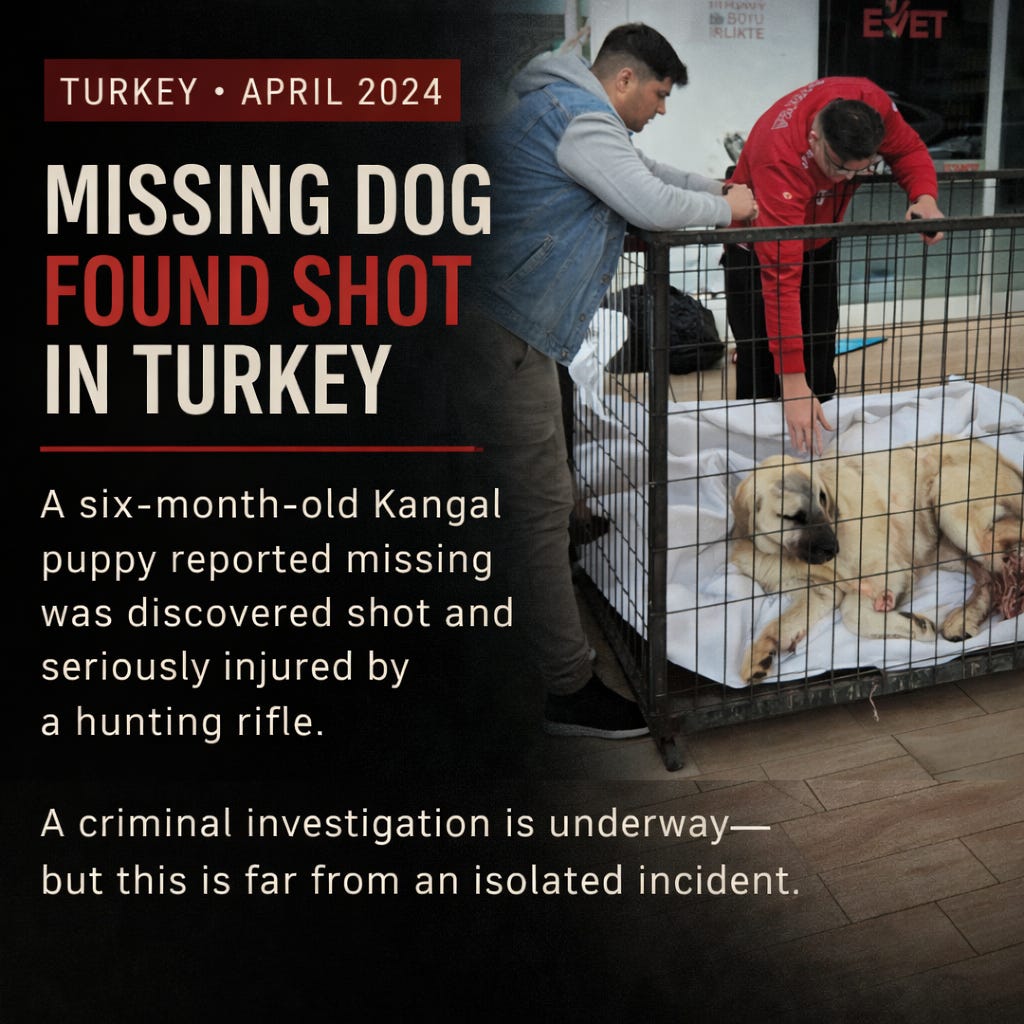
A six-month-old puppy went missing from his home. His family searched. They posted. They waited. Then came the call. He had been found. Not wandering.
Not stolen.
Shot.
What Happened
In Zonguldak Ereğli, a young Kangal named Korsan disappeared from his home.
His owner did what anyone would do, turned to social media, asking for help, hoping for a sighting, a lead, a safe return. Instead, he was led to his dog lying injured.
Korsan had been shot with a hunting rifle. The pellets struck his front and back legs, leaving him seriously wounded and in need of urgent veterinary care.
He is six months old. A puppy.
The suspected attacker was quickly identified, arrested, and remanded in custody under animal protection laws.
This Is Not an Isolated Incident
There is a tendency to treat cases like this as individual acts of cruelty.
One person. One dog. One moment of violence.
But that framing is misleading. Because these cases are not rare. They are just unevenly reported.
The Normalisation of Violence
What stands out in this case is not just the act itself. It is how familiar it feels.
A dog disappears. A dog is found injured or dead. A weapon is involved. And then brief attention.
Unless it reaches social media, unless it gains traction, unless someone pushes it forward, it disappears just as quickly. This is what normalisation looks like.
Not acceptance. But repetition without consequence.
The Role of Visibility
This case reached the press. That is why it exists in the public record.
But many do not. Across Turkey, reports of:
Dogs being poisoned
Dogs being shot
Dogs being removed and never seen again
circulate daily within smaller networks, local pages, rescue groups, direct messages.
Most never become news. That matters.
Because visibility is now doing the work that enforcement should be doing.
Accountability But Only After the Fact
In this case, the suspect was arrested. That is important.
But it also highlights a wider problem:
Action comes after harm not before it.
There was no prevention. No deterrence strong enough to stop it happening. Only response. And response, by definition, comes too late for the animal.
A Six-Month-Old Puppy
It is easy, in policy discussions, to lose sight of the individual. So bring it back.
Six months old. Young. Described as calm and gentle by the attending veterinarian. Shot multiple times.
There is no complexity here. No ambiguity.
The Wider Question
If a dog can be:
Taken from a home
Shot with a firearm
Found by its owner
then the question is not just about one perpetrator. It is about environment. What enables this? What allows it to happen often enough that it feels familiar?
What systems are missing or failing that make this possible?
Where This Leaves Us
This case will likely follow a predictable path:
Initial outrage
Media coverage
Legal process
Gradual disappearance from public attention
And then another case will take its place. Unless something changes.
Final Thought
A missing dog should end in relief. A reunion. A return home.
Not a veterinary emergency. Not a criminal investigation. And not a headline like this.
Because if this continues to happen and it does then the issue is no longer individual cruelty.
It is systemic failure.