

A Museum Found Space for a Stray Dog Why Can’t Cities?

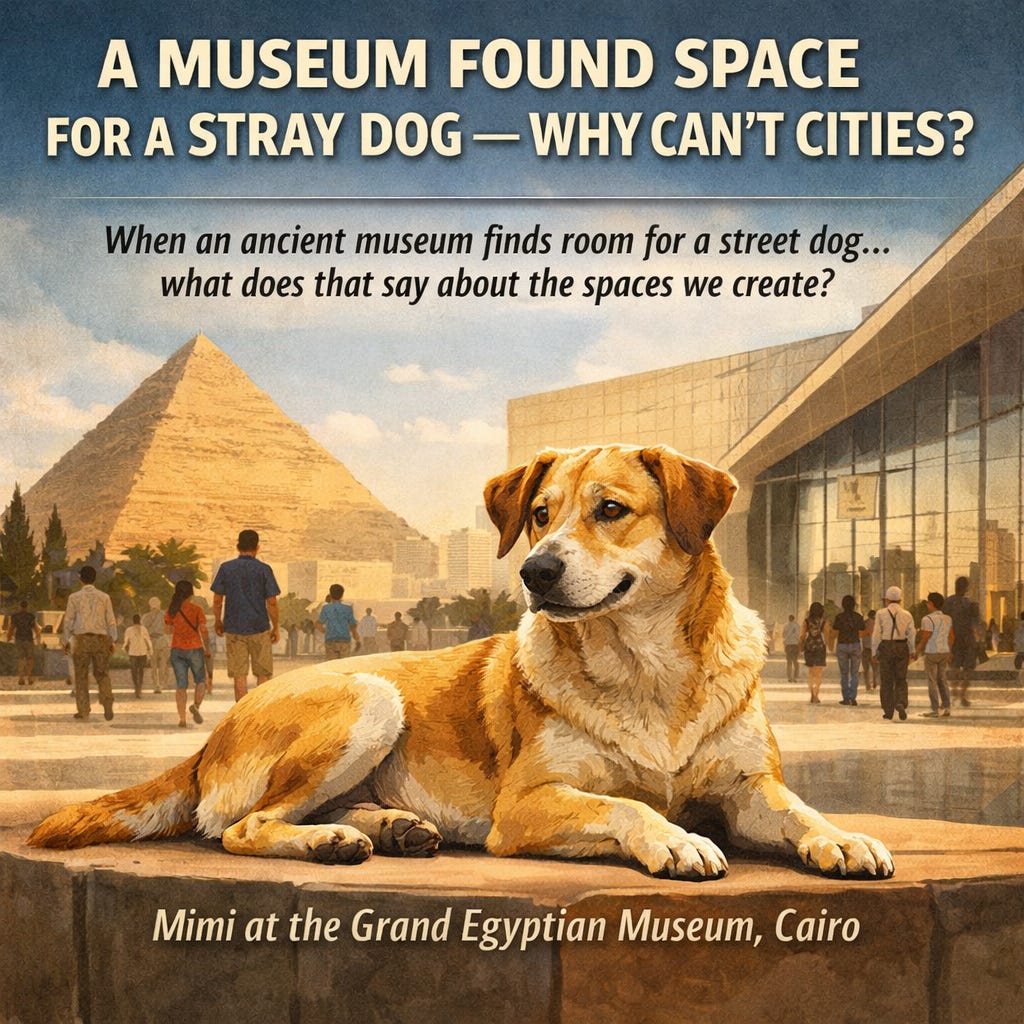
In one of the most controlled environments imaginable, a multi-billion-dollar cultural institution designed to preserve history a street dog has made herself at home.
Her name is Mimi.
She moves freely through the grounds of the Grand Egyptian Museum in Cairo. She greets visitors. She rests where she chooses. She exists, without permission, in a space that was never designed for her.
And she has not been removed.
What Mimi disrupts
Mimi’s presence is not remarkable because she is unusual. It is remarkable because she has been allowed to remain. Across cities, the dominant response to stray dogs is predictable:
remove
relocate
contain
or eliminate
Public space is treated as something that must be controlled, sanitised, and kept exclusively human. Yet here, in a place built to showcase civilisation at its most refined, a different decision has quietly been made.
No visible enforcement. No urgent removal. No narrative of threat. Just tolerance.
Behaviour, not assumption
Mimi does not behave like the version of a stray dog often presented in policy discussions.
She is calm. She is socially aware. She navigates crowds without conflict.
This is not unusual for street-born dogs. What is unusual is that her behaviour has been allowed to speak for itself.
In many systems, behaviour is never observed long enough to matter. The label comes first. The outcome follows.
Mimi disrupts that sequence.
A question of space
If a museum with its security, its standards, its international visibility can accommodate a street dog without incident, then the argument that dogs cannot exist in public spaces begins to weaken.
Not collapse. But weaken. Because the question shifts.
It is no longer:
Can dogs exist here?
It becomes:
Why are they not allowed to exist here?
Cities are not inherently incompatible with dogs. They are structured to exclude them.
The selective nature of tolerance
It would be easy to turn Mimi into a symbol of progress. But her story sits alongside a much larger, more uncomfortable reality.
Across the same region:
dogs are still rounded up
shelters remain overcrowded
public pressure to remove dogs persists
Mimi is not the system. She is an exception within it.
And exceptions can do two things:
they can open the door to change
or they can be used to suggest that change is already happening
The difference lies in how we interpret them.
What Mimi quietly demonstrates
Without policy, without strategy, without formal intervention, Mimi shows something simple:
Coexistence is not always engineered. Sometimes it is permitted. A dog is allowed to stay. People adjust. The environment absorbs her presence.
And nothing breaks.
Where this leaves us
For those working in dog welfare, Mimi’s story is not a solution. It is a signal.
It asks whether the systems we have built are shaped by necessity or by assumption.
It asks whether removal is always required or simply routine.
And it asks, quietly but persistently:
If space can be found here, in one of the most controlled environments in the world,
why is it so rarely found anywhere else?
A closing thought
Stories like Mimi’s do not need to be amplified into something they are not. They are most useful when they are observed carefully. Because sometimes, change does not begin with policy.
It begins with a small shift in what is tolerated.
If you’ve seen something similar, a place where dogs are not managed out of sight, but allowed to exist it’s worth paying attention to it.
Those moments often tell us more about what is possible than any strategy ever could.