


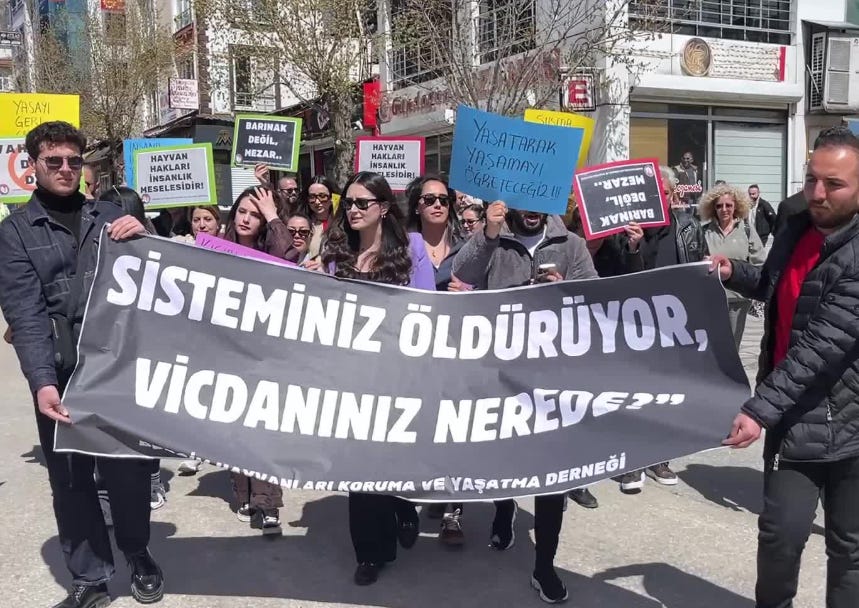
In Dersim, a protest took place that cuts directly to the centre of what is happening to dogs across Türkiye.
It was not framed as a local issue. It was framed as a question of national policy.
The Message
The demonstration was organised by the Dersim Animal Protection and Life Association. Their message was direct:
This is not neglect. This is a policy.
Not a failure of individual shelters. Not a temporary breakdown.
A system producing outcomes that can no longer be explained as accidental.
The Numbers Do Not Align
The figures presented at the protest are not disputed in principle:
Estimated dog population: approximately 4 million
Reported number collected: approximately 3 million
Total shelter capacity: approximately 89,000 - 100,000
This is not a small gap. It is a structural impossibility. Even if every available space were used, the system could only accommodate a fraction of the dogs being removed.
So the question becomes unavoidable, Where are the rest?
Capacity Without Transparency
When a system operates at this scale, outcomes should be visible. They should be documented, monitored, and accountable.
But what is being described both in this protest and in multiple recent cases is a lack of clarity around:
where dogs are being taken
what conditions they are held in
what happens to them after collection
Without transparency, there is no way to assess whether welfare standards are being met. And without that, there is no meaningful oversight.
What Is Being Reported
Protesters are not describing isolated incidents. They are describing a pattern:
dogs collected in large numbers
shelters unable to cope with intake
animals left without adequate food, care, or space
increasing reports of injury and death within facilities
Recent incidents cited by campaigners including cases where dogs have been harmed within shelters are being used to illustrate what happens when capacity is exceeded.
Not as exceptions. As indicators.
The Shift in Approach
For years, the framework around free-roaming dogs in Türkiye was built on:
sterilisation
return to territory
community coexistence
What is now being described is a rapid shift away from that model.
Towards:
immediate collection
accelerated removal from streets
enforcement without matching infrastructure
When policy moves faster than capacity, the outcome is predictable. Animals are absorbed into a system that cannot hold them.
Responsibility
There is a tendency to place responsibility at the point of failure, at the shelter, at the worker, at the visible outcome.
But the protest in Dersim directs responsibility elsewhere. To the structure itself.
Years of insufficient sterilisation
Lack of investment in infrastructure
Sudden enforcement of large-scale collection
This is not being framed as a single mistake. It is being framed as a sequence of decisions.
The Core Question
The protest does not rely on emotional argument. It relies on a simple calculation.
If millions of dogs are being removed and shelters can only hold tens of thousands then the outcome is not unclear.
It is undefined. And that absence of definition is where the concern sits.
What Is Being Asked
The position from campaigners is consistent:
prioritise sterilisation
invest in sustainable infrastructure
maintain community-based care models
ensure transparency at every stage of the system
As operational necessity.
One Question Remains
The protest in Dersim has done something simple but necessary. It has taken what is happening at scale and reduced it to a single, unavoidable question.
Not emotional. Not speculative. Practical.
Where are the dogs?