


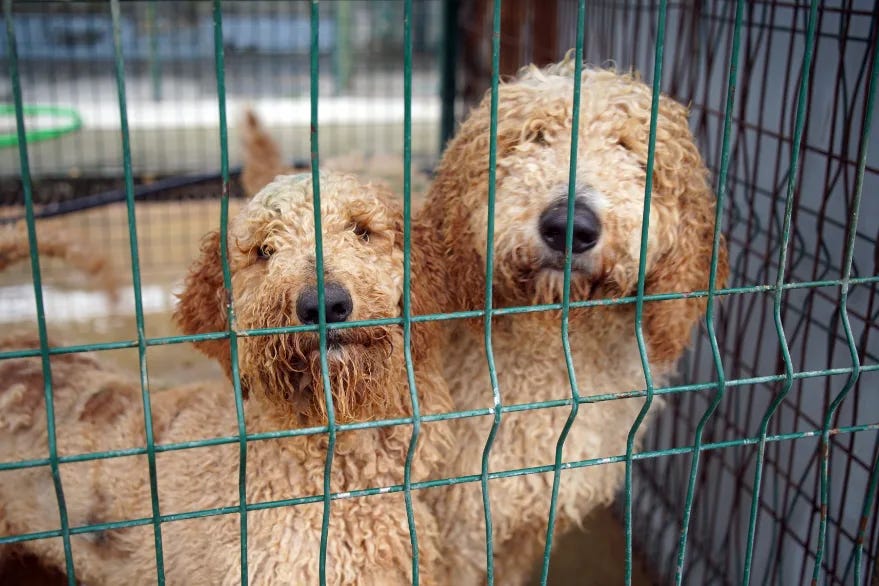
On 12 March 2026, authorities in Edirne carried out a raid on an illegal dog breeding facility.
What they found was not unusual. What followed might be.
A total of 2,144,000 Turkish lira in fines was issued against the operator covering illegal construction, unauthorised breeding, and per-animal penalties.
At first glance, this looks like progress. A significant penalty. A visible enforcement action. A case that reached the public.
But when we step back, the question is not whether this case matters. It is whether it changes anything.
What Happened in Edirne
The operation took place in the Lalapaşa district following a report of illegal activity.
Authorities found:
A facility operating without legal permission
Evidence of forced breeding practices
Allegations of mistreatment and abuse
Dozens of dogs held within the system
In total:
88 dogs were seized and transferred to a municipal shelter for care and treatment
Around 40 dogs were subject to additional administrative action due to welfare concerns
The operator faced multiple charges, including illegal construction and unlawful breeding
The fine itself was calculated in part per dog approximately 13,000 TL per animal.
This is what accountability looks like on paper.
The System Behind the Case
Illegal breeding facilities do not exist in isolation.
They sit within a wider ecosystem:
Demand for puppies, often driven by aesthetics rather than welfare
Weak enforcement until cases become visible
A lack of consistent oversight across regions
Financial incentives that outweigh the perceived risk of being caught
This case was not discovered through routine inspection.
It followed a report. That distinction matters.
Because it tells us something fundamental, the system is still reactive, not preventative.
A Contradiction at the Heart of Policy
This is where the Edirne case becomes more significant.
Turkey is currently engaged in one of the most aggressive state-led dog collection programmes in recent history.
At the same time:
Illegal breeding continues
Commercial production of dogs persists
Enforcement appears selective and inconsistent
On one side, dogs are being removed from the streets. On the other, they are still being produced unregulated, unmonitored, and in some cases, abused.
You cannot reduce a population while allowing it to be continuously replenished.
This is not a welfare strategy. It is a contradiction.
What Happens to the Dogs
The seized dogs were transferred to a municipal facility. That is standard procedure.
But it raises a difficult and often unspoken question:
What happens next?
Because removal is not resolution.
Are these dogs rehabilitated?
Are they rehomed?
Do they remain in long-term confinement?
Do they disappear into a system with no transparency?
Without visibility, seizure becomes a moment not a solution.
The Meaning of a Record Fine
A fine of over 2 million TL sounds substantial.
But its impact depends on three things:
Consistency – Will similar facilities face the same consequences?
Enforcement – Will the operator be prevented from restarting elsewhere?
Deterrence – Does this change behaviour across the sector?
If the answer to any of these is no, then the fine is symbolic.
And symbolism does not protect dogs.
The Bigger Picture
This case matters.
Illegal breeding, forced reproduction, and poor welfare conditions are not rare incidents.
They are structural problems.
And structural problems require structural solutions:
Licensing that is enforced not just issued
Breeding that is regulated not ignored
Transparency in what happens after seizures
A coherent policy that addresses both supply and suffering
Where This Leaves Us
The Edirne case shows that enforcement is possible.
It proves that action can be taken. That penalties can be applied. That operations can be shut down.
But it also exposes the gaps:
Why was this facility operating in the first place?
How many others remain undiscovered?
And why does intervention still rely on exposure rather than oversight?
Until those questions are answered, nothing fundamental changes.
Final Thought
A record fine is not a turning point. It is a signal.
Whether it becomes something more depends on what follows.
Because if illegal breeding continues and it will unless addressed at scale then this case is not an outlier. It is a glimpse into a system that still allows it to happen.