


What happened
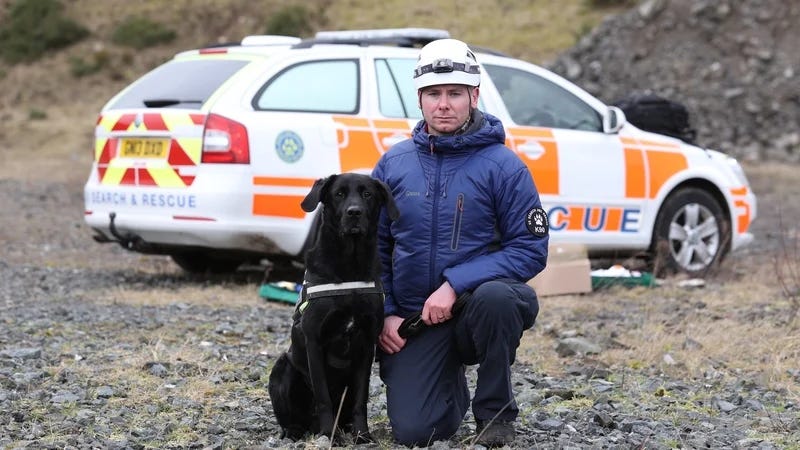
In a deeply troubling incident a trained search and rescue dog and its handler were assaulted in Bangor, County Down. The victim, identified as Ryan Gray founder of a volunteer K9 search and rescue organisation was attacked by a group of youths while walking his dog.
Reports indicate that the man was punched repeatedly, while the dog, a working search and rescue animal was kicked during the attack.
Four teenagers have since been charged with offences including assault and causing unnecessary suffering to an animal.
This was not an isolated altercation. It was a targeted act of violence against both a person and a dog whose role is to save lives.
The Search & Rescue Dog
Search and rescue dogs are not pets in the conventional sense. They are highly trained working animals, often deployed in some of the most critical and emotionally charged situations locating missing persons, recovering victims, and supporting emergency services.
The dog involved in this incident was part of a volunteer-led search and rescue effort, the kind of work that fills the gaps when formal systems are stretched or time is critical.
These dogs:
Work in disaster zones
Search for missing children and vulnerable adults
Assist after major incidents, including international deployments
To assault one is not simply an act of cruelty it is an attack on a public service.
A broader issue
There is a tendency in reporting to separate animal cruelty from serious crime. That distinction is misleading.
Violence against a dog, particularly a working dog reflects:
A willingness to harm without consequence
A disregard for public safety systems
A normalisation of aggression in public spaces
In this case, the attack took place in a public high street, involving a group dynamic. That matters. Group violence against a person and an animal speaks to something beyond impulse, it reflects a culture where such behaviour is not immediately checked.
The legal framing and its limits
Charges in this case include causing unnecessary suffering to an animal. That is important, but it often understates the reality. A search and rescue dog is:
A trained operational asset
A member of an emergency response capability
A force multiplier in time-critical situations
In other contexts, interference with emergency services carries significant penalties. The question is whether the law consistently recognises the status of working animals in the same way.
The overlooked reality
Search and rescue teams across Ireland, many of them volunteer-led operate quietly, often without recognition.
Organisations linked to national rescue frameworks rely on trained dogs to cover terrain and scenarios where human searchers cannot be as effective.
When these dogs are attacked, the impact extends beyond the individual animal:
Operations can be disrupted
Training investment is compromised
Public trust in safety infrastructure is weakened
A line that should not be crossed
There are many forms of animal cruelty reported each year. But this case sits in a different category.
This was:
A deliberate assault
On a trained working dog
While with its handler
In a public setting
That combination matters. Because if a search and rescue dog is not protected visibly and unequivocally then the boundary of what is acceptable behaviour has already shifted.
Final reflection
We often say that dogs give everything they have. In search and rescue work, that is not a metaphor it is literal.
They search in conditions we would not enter. They stay focused where we would falter. They go where we cannot.
And yet, in this case, one of them was kicked in the street.
Not during a rescue. Not in chaos. But while simply existing in public with the person it works alongside.
That should concern all of us not just because a dog was harmed, but because of what it says about the space we are creating around them.