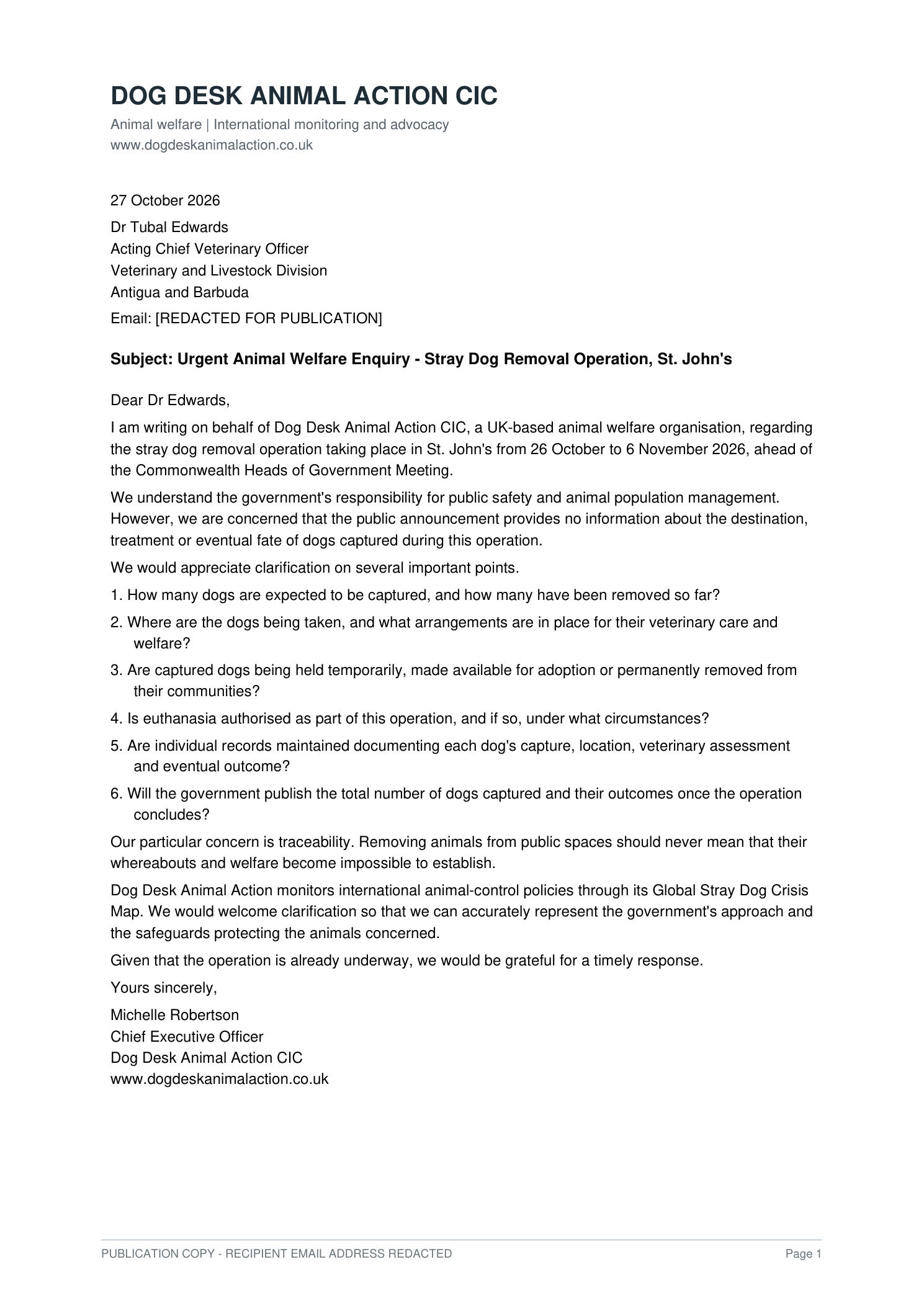
As Antigua and Barbuda prepares to welcome Commonwealth leaders, the government has announced an operation to remove stray dogs from its capital. What has not been made clear is what will happen to those animals once they are captured.
On 26 October 2026, Antigua and Barbuda’s Veterinary and Livestock Division announced a stray-dog removal operation in St. John’s, scheduled to continue until 6 November.
The operation coincides with preparations for the Commonwealth Heads of Government Meeting (CHOGM), taking place from 1–4 November.
According to the announcement, authorities intend to remove all stray dogs from the capital. Residents have been encouraged to report dogs roaming in public areas.
There is nothing unusual about governments wanting their streets to appear clean, safe and orderly when international visitors arrive. But when that preparation involves removing living animals, the question cannot be whether the streets have been cleared.
It must be what happens to the animals afterwards.
A Removal Operation Without Published Outcomes
The government’s announcement raises several important questions.
How many dogs are expected to be captured? Where will they be taken? What facilities are available to accommodate them? Will they receive veterinary examinations? Can owners reclaim dogs caught during the operation? And will animals be returned to their communities once the Commonwealth meeting has ended?
These are not minor administrative details. They determine whether the operation represents temporary, humane animal management or the permanent disappearance of dogs from the streets.
Antigua and Barbuda already has arrangements for dealing with roaming dogs, including impoundment and provisions for adoption after a holding period.
However, the announcement does not establish whether those existing arrangements will apply to this particular operation.
Nor does it provide a publicly documented system for tracking each captured animal through admission, confinement and eventual outcome.
International Events Become a Reason to Remove Animals
The timing of this operation deserves scrutiny.
The Commonwealth meeting brings international attention to Antigua and Barbuda. World leaders, delegations and media representatives will be visiting the country.
But the presence of international visitors should not alter the fundamental welfare protections afforded to animals living in its communities.
Across the world, major political gatherings, sporting events and international summits have sometimes been accompanied by intensified efforts to remove free-roaming animals from public spaces.
The justification is frequently public safety, disease prevention or the presentation of an orderly city.
Those concerns can be legitimate. Free-roaming dog populations require responsible management, and rabies prevention is a serious public-health responsibility.
But removing dogs from sight is not, by itself, evidence of successful population management.
A meaningful programme needs clear objectives, humane procedures, veterinary oversight and records demonstrating what happened to the animals involved.
Without those safeguards, the number of dogs removed risks becoming the measure of success, while their welfare and eventual fate remain invisible.
Capture Is an Activity. Welfare Is an Outcome.
This distinction is central to Dog Desk Animal Action’s international monitoring.
A government can report that hundreds of dogs have been captured without establishing whether those dogs are safer.
A municipality can announce that its streets are free of stray animals without explaining whether the animals were adopted, transferred, confined indefinitely, returned or euthanised.
The operation in St. John’s presents precisely this accountability challenge.
If dogs are captured, there should be a record of each animal. If they enter a shelter, their admission and eventual departure should be documented. If they are transferred elsewhere, their destination should be identifiable. If an animal dies or is euthanised, that outcome should be recorded accurately.
These are basic expectations of responsible animal management, not unreasonable demands.
And they are particularly important when an operation is announced with the intention of removing all stray dogs from a defined area.
What Dog Desk Animal Action Is Recording
Dog Desk Animal Action is adding Antigua and Barbuda to the Watchlist on its Global Stray Dog Crisis Map.
The decision reflects the announcement of a government-authorised removal operation and the lack of publicly established information about the animals’ destinations and outcomes.
It is not an allegation that dogs have been killed, nor is it evidence that the authorities are operating unlawful or inhumane facilities.
At this stage, those claims would go beyond the available evidence.
Our concern is that an operation of this scale should be accompanied by transparent arrangements for the animals it affects.
We will continue examining publicly available information to establish whether capture figures, shelter arrangements, veterinary provisions and final outcomes are reported.
When the Delegations Leave, the Dogs Still Count
The Commonwealth meeting will last four days. The removal operation is scheduled to continue beyond it.
The international delegations will depart. The cameras will move elsewhere. Public attention will turn to the next event.
But the responsibility for every dog taken from the streets will remain.
The success of this operation should not be judged by how few dogs visiting leaders encounter.
It should be judged by what happens to those dogs, whether their welfare is protected and whether the authorities can account for them.
When the Commonwealth leaders leave Antigua, where will the dogs be?
That is the question Dog Desk Animal Action will be following.