The Commonwealth leaders have departed. The international gathering has concluded, and the government-organised operation to remove stray dogs from the streets of St John’s, Antigua and Barbuda, has reached its scheduled end. But while the preparations for the Commonwealth Heads of Government Meeting may now be over, the responsibility for the animals removed during those preparations has not ended with them.
How many dogs were taken, where were they taken, and what has happened to them?
For almost two weeks, Dog Desk Animal Action has been investigating the collection of street dogs in Antigua and Barbuda. The operation began on 26 October and was scheduled to continue until 6 November 2026, coinciding with preparations for the Commonwealth gathering. The authorities publicly announced their intention to remove roaming dogs from the capital, and subsequent statements from the Veterinary Authority offered assurances about humane handling, veterinary care and the arrangements intended to protect animals entering custody.
Those assurances were important, particularly as concerns grew about the fate of dogs being removed from familiar streets and communities. However, three days after the scheduled conclusion of the operation, we have still been unable to establish how many dogs were collected, how many remain in care, how many have been reclaimed or rehomed, or whether any have died. We have not located a complete public record identifying the animals removed and accounting for their subsequent outcomes.
On 2 November, Agriculture Minister Anthony Smith publicly rejected suggestions that collected dogs would be euthanised because they remained unclaimed. He identified the Antigua and Barbuda Humane Society as a receiving facility and indicated that efforts would be made to find homes for the animals. Veterinarian Dr Chere Kellman also described taking dogs directly to the Humane Society, where food, water and veterinary assistance were available.
We welcome those statements. We have no verified evidence that the operation involved mass euthanasia, and we are not suggesting that the Humane Society has mistreated animals in its care. But there is a fundamental difference between assuring the public that animals are safe and providing the records necessary to demonstrate what happened to them. The first asks people to trust an account of events. The second allows that account to be independently examined.
When public authorities organise the collection and detention of animals, there should be a documented chain of responsibility from the moment each animal is taken into custody. That means recording where the animal was collected, when it entered a facility, who assumed responsibility for its care and what eventually happened to it. If an animal is reclaimed, adopted or transferred, that outcome should be recorded. If an animal remains in custody, its location and welfare arrangements should be known. If an animal dies, that too should be documented.
These are not unreasonable expectations. They are basic principles of traceability and accountability, and they are particularly important when the animals concerned cannot speak for themselves.
One of the most significant commitments made during our earlier correspondence with the Veterinary Authority concerned photographic identification. The Authority explained that photographs of impounded dogs would be taken and shared publicly for two working days to assist owners in identifying and reclaiming their animals. This was an important safeguard because a dog found roaming in a public street is not necessarily abandoned. It may be lost, may have escaped from a home or may be a familiar community animal whose welfare is supported by local residents.
Yet we have been unable to locate a complete, publicly accessible photographic record covering the operation. This does not establish that photographs were never taken or published. They may have appeared through channels that are not readily searchable or accessible from outside Antigua. Nevertheless, if photographic identification formed part of the procedure intended to protect owners’ rights and assist reunification, it should be possible to establish where those notices appeared and which animals they covered.
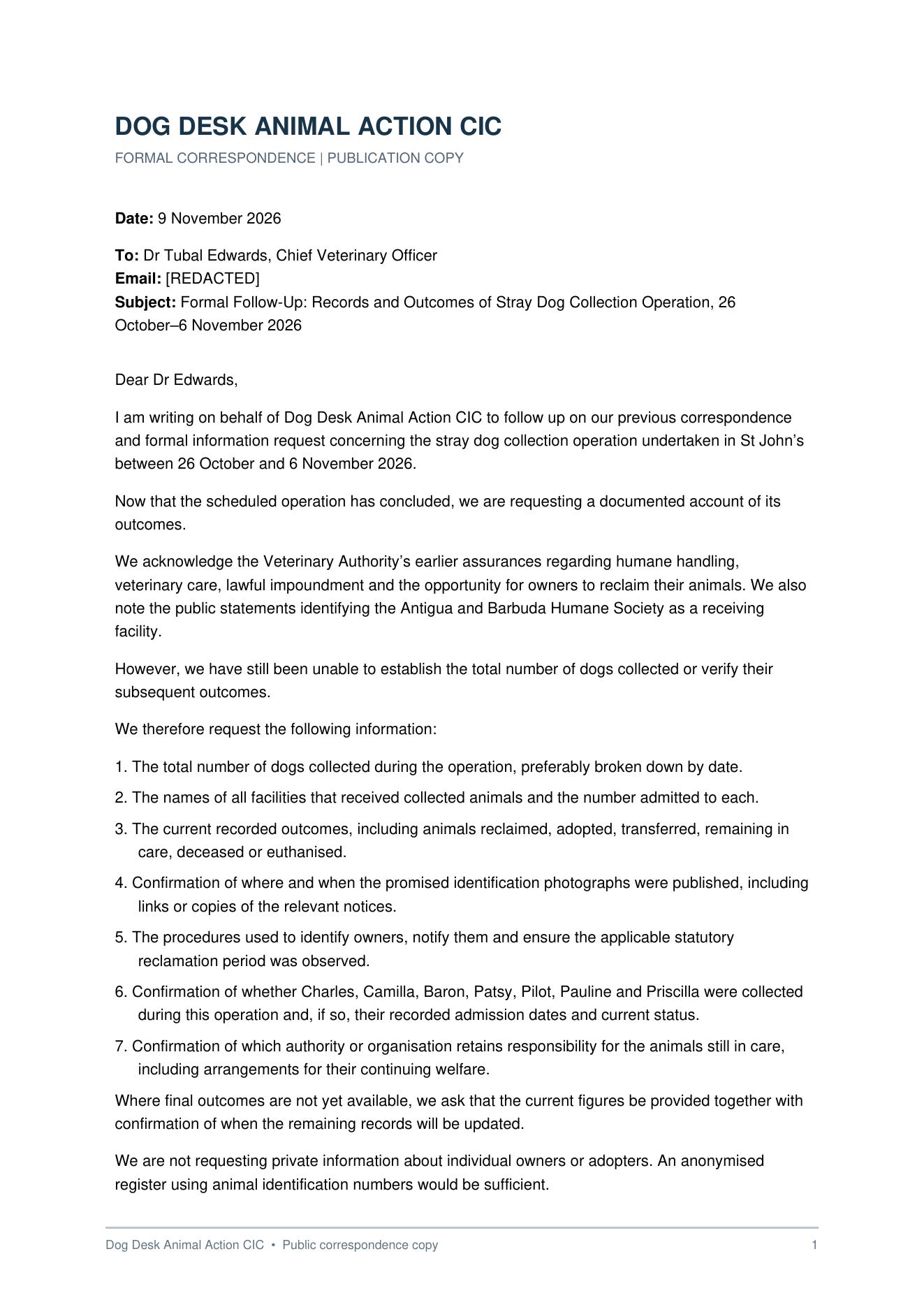
We have therefore asked the Veterinary Authority to clarify when and where the promised photographs were published and how the public was informed that the animals were available for identification and reclamation.
Another development has raised further questions. On 6 November, an appeal emerged identifying seven dogs reportedly collected from the streets by a government agency and being offered for adoption. They were named Charles, Camilla, Baron, Patsy, Pilot, Pauline and Priscilla. It is encouraging to see individual animals identified and efforts being made to secure homes for them. However, we have not independently established whether all seven were collected as part of the Commonwealth operation, when they entered custody, whether the relevant reclamation procedures had been completed or what their subsequent outcomes have been.
We also have no way of knowing whether these seven animals represent a small proportion of those collected or a substantial part of the operation. Without the overall figures, even apparently positive individual developments cannot provide a reliable picture of what happened to the wider population of dogs removed from the streets.
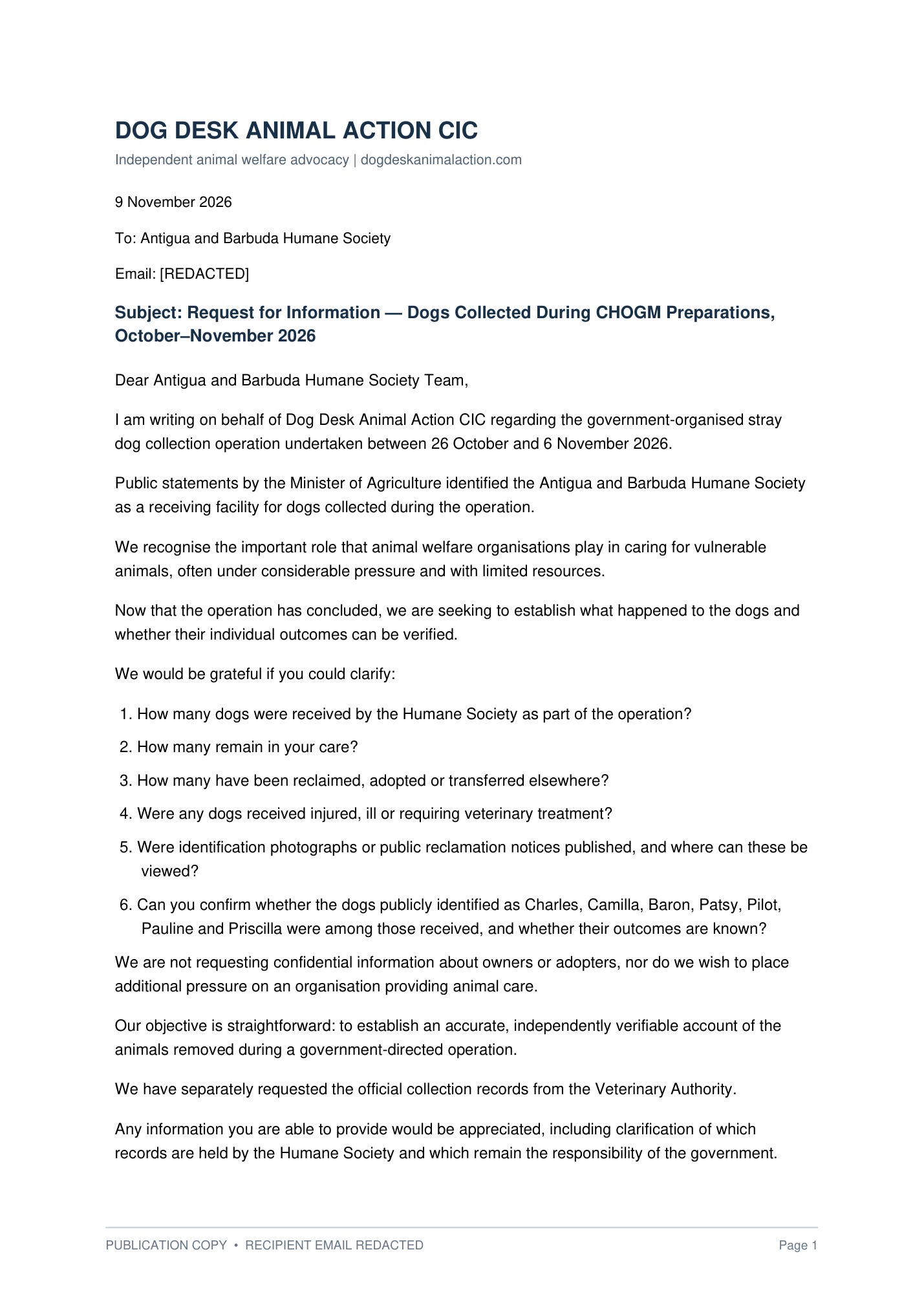
Dog Desk Animal Action has now prepared further written enquiries to both the Veterinary Authority and the Antigua and Barbuda Humane Society. These enquiries serve different purposes because the responsibilities of the two organisations are not identical. The Veterinary Authority is the public body from which we are seeking an official account of the operation, including its authorisation, collection procedures, receiving facilities and recorded outcomes. The Humane Society, having been publicly identified as a receiving facility, may be able to clarify how many animals entered its care, what arrangements were made for them and whether their subsequent outcomes have been recorded. However it is important to note that when previously asked by a local they declined to comment.
We recognise that animal welfare organisations frequently work under considerable pressure, often with limited financial resources and substantial demands on their staff and volunteers. Our enquiry to the Humane Society is not an accusation, nor are we suggesting that it is responsible for the absence of a publicly accessible government report. Its records may help establish that the animals were safely received, appropriately cared for and responsibly rehomed. That information would be valuable, and we would welcome the opportunity to report it.
Nevertheless, responsibility for accounting for a government-directed collection operation cannot be transferred to an animal welfare organisation because that organisation agreed to receive animals. The authorities that organised the removals must remain answerable for the operation and for the records generated through it.
There is a wider issue here that extends far beyond Antigua and Barbuda. When countries prepare to host major international events, attention naturally turns to security, infrastructure, public presentation and the experience of visiting delegations. Animals living in public spaces can become part of those preparations, particularly where governments regard roaming dogs as a public safety concern or an obstacle to the image they wish to present.
But removing dogs from streets does not resolve the underlying causes of free-roaming dog populations. It does not, by itself, address abandonment, inadequate access to sterilisation, insufficient veterinary services, irresponsible ownership or the long-term need for humane population management. It changes where the animals are located, and potentially places responsibility for their continuing care on facilities that must have the space, resources and expertise to accommodate them.
A street may appear different once its dogs have been removed, but the welfare needs of those animals have not disappeared. They still require food, water, shelter, veterinary attention and appropriate opportunities for reunification or rehoming. If they are held for extended periods, their continuing welfare must be considered. If they are transferred between facilities, their movements should remain traceable.
The Commonwealth meeting concluded on 4 November, and the dog collection operation was scheduled to finish two days later. The departure of visiting delegations should not mean that the animals removed during the preparations cease to be a matter of public concern.
Throughout this investigation, we have also encountered resistance to questions about the operation, including suggestions that an organisation based outside Antigua and Barbuda has no reason to become involved. We do not accept that public accountability is determined by geographical proximity. The operation was publicly announced, undertaken by government authorities and connected to an international event. Its outcomes are a legitimate subject of scrutiny, particularly where animal welfare assurances have been offered in response to public concern.
That does not mean we claim authority over local organisations or the people caring for animals in Antigua. Nor does it mean we presume that wrongdoing has occurred. Our interest is in the evidence. If the records demonstrate that the dogs were safely collected, properly housed, reunited with their owners or responsibly rehomed, those findings should be published and acknowledged. Transparency is not inherently hostile to the authorities or organisations involved. On the contrary, accurate records can protect them against unfounded allegations while allowing genuine problems to be identified and addressed.
What creates uncertainty is the absence of information that would allow the public to distinguish between assurances, allegations and documented outcomes.
Our original formal information request remains outstanding, and we are now seeking a substantive post-operation account. We want to know the total number of dogs collected between 26 October and 6 November, which facilities received them, how they were identified, what opportunities existed for owners to reclaim them and how many have subsequently been adopted, transferred, retained in care or recorded as deceased.
We are not requesting confidential personal information about owners, adopters or private individuals. An anonymised record identifying each animal and its documented outcome would provide a meaningful basis for independent scrutiny. Where outcomes remain unresolved, we would expect the authorities to explain how those animals are being monitored and when updated information will become available.
This investigation is also part of a broader concern that Dog Desk Animal Action has been examining internationally. When dogs are removed from public spaces under the authority of governments or municipalities, the public is frequently told why they must be collected. Far less attention is sometimes given to what happens after collection. Shelter admissions, transfers, deaths and long-term outcomes can become difficult to trace, leaving communities unable to establish what became of animals they once knew.
The circumstances differ between countries, and no two operations should be treated as identical without evidence. But the principle of accountability remains the same. An animal entering public custody should not become untraceable simply because it has been removed from public view.
Antigua and Barbuda now has an opportunity to demonstrate that its collection operation was accompanied by transparent recordkeeping and continuing welfare oversight. The authorities have already made public assurances about the treatment of the dogs. Publishing a reconciled account of their collection and outcomes would provide the evidence needed to assess those assurances.
Until that happens, the central question remains unresolved.
The Commonwealth leaders have departed. The international event has ended. The operation has reached its scheduled conclusion. But the dogs have not ceased to exist simply because the streets have been cleared and the cameras have moved elsewhere.
Every dog removed under public authority should have a recorded destination and a traceable outcome.
The operation is over. The responsibility to account for the dogs is not.
Dog Desk Animal Action CIC continues to investigate the removal of street dogs in Antigua and Barbuda. Our enquiries seek verifiable records and do not presume that animals have been harmed or that any individual or organisation has acted unlawfully.
Support our public accountability campaign: Where Are the Dogs? Demand Transparency Over Antigua’s Street Dog Removals.