
The Commonwealth Heads of Government Meeting is over. The delegates have left Antigua and Barbuda. The streets have returned to their usual routines.
But the dogs removed ahead of the meeting remain unaccounted for in any comprehensive public record we have been able to find.
Between 26 October and 6 November 2026, Antigua and Barbuda’s Veterinary and Livestock Division carried out an operation to remove roaming dogs from public areas. It was part of the preparations for an international gathering attended by some of the world’s most senior political figures.
The authorities announced the operation, explained its purpose and assured the public that animals would be treated humanely.
What they have not published is the information that would allow anyone to follow those animals from the streets into custody and establish what happened next.
How many dogs were collected? Where were they taken? How many were reunited with owners, adopted or transferred? How many remain in care?
These are the records Dog Desk Animal Action has been seeking since the operation began.
A Government Operation Without a Published Final Count
The removal exercise began on 26 October and was scheduled to end on 6 November.
It was an organised government operation, carried out under the authority of the Veterinary and Livestock Division. Dogs were to be collected, transported and held under arrangements established for the exercise.
An operation of that nature generates information at every stage. Collection teams need to know where animals have been picked up. Receiving facilities need to know how many are arriving. Veterinary personnel need to identify animals requiring treatment. Anyone responsible for transferring or releasing an animal needs to know which animal is involved.
Yet more than a week after the scheduled conclusion, we have found no published final count.
There is no comprehensive public register identifying the collected dogs, their collection locations, their receiving facilities and their recorded outcomes.
The absence of that information has made it impossible to establish the scale of the operation or follow the animals through the system.
The government has explained why the dogs were removed. It has not provided a corresponding public account of what happened after their removal.
The Photographs That Were Promised
One of the assurances given to Dog Desk Animal Action by the Veterinary Authority concerned photographs of impounded dogs.
We were told that identification photographs would be made publicly available, allowing owners to recognise and reclaim their animals.
That commitment was important because a roaming dog is not necessarily an abandoned dog. Animals escape from homes, become separated from their owners and move between communities where they may be recognised and cared for.
A public photographic register provides an essential link between an animal’s removal and the people who may be searching for it.
We have looked for the promised photographs.
We have not located a publicly accessible register documenting the dogs collected during the Commonwealth operation.
Nor have we received the publication details that would establish when and where owners could view those images.
The question is now straightforward: where was the identification register published, and can the authorities provide it?
The Humane Society Received Dogs. Where Is the Intake Record?
On 2 November, Agriculture Minister Anthony Smith responded publicly to concerns about the operation.
He stated that the dogs would be sheltered rather than killed merely because they remained unclaimed. The Antigua and Barbuda Humane Society was identified as a receiving organisation.
Veterinarian Dr Chere Kellman also described transporting collected dogs directly to the Humane Society, where they would receive food, water and veterinary attention.
These statements established that the Humane Society was part of the receiving arrangements.
They did not establish how many dogs arrived there.
An intake record would answer that question. It would also show when animals entered the facility, whether they arrived through the government operation and what subsequently happened to them.
Dog Desk Animal Action contacted the Humane Society seeking clarification. Our enquiries have not produced the figures necessary to reconcile the animals collected with those received.
If the Humane Society received dogs under a government directed operation, the public authorities should be able to account for those transfers.
The chain of responsibility cannot end at the shelter gate.
Seven Names, but No Complete List
During the operation, seven dogs appeared in an adoption appeal in a facebook page by a group not associated with The Humane Society: Charles, Camilla, Baron, Patsy, Pilot, Pauline and Priscilla.
Their names provided something the wider operation had been missing: individual animals that members of the public could recognise and follow.
But seven named dogs do not constitute a complete record of an operation whose total remains unpublished.
Were these seven collected specifically for the Commonwealth exercise? When were they taken into care? Were they subsequently adopted? How many other dogs entered the same system?
We have not been able to establish those details from a complete official register.
Each animal collected should have a recorded journey, from the location where it was found to the place where it was held and the decision made about its future.
Without that information, the public is left with fragments of an operation rather than an account of its results.
What Antigua and Barbuda’s Law Requires
The Dog Registration and Control Act 2006 provides the legal framework for the seizure and impoundment of dogs.
Section 31 establishes a minimum holding period of two working days and contains provisions governing the handling of unclaimed animals.
The legislation also allows decisions about adoption or euthanasia after the applicable legal requirements have been met.
The Veterinary Authority referred to these arrangements in its correspondence with Dog Desk Animal Action.
Separately, government information concerning the Humane Society describes a seven day holding arrangement.
The records from this particular operation should establish which holding procedures were applied, how owners were notified and how the animals were managed once the relevant periods expired.
Minister Smith’s public assurances about the treatment of the dogs are part of the official record. The operational records should now show how those assurances were implemented.
That means collection records, transfer records, veterinary records and final outcomes.
We Have Requested the Records Under the Freedom of Information Act
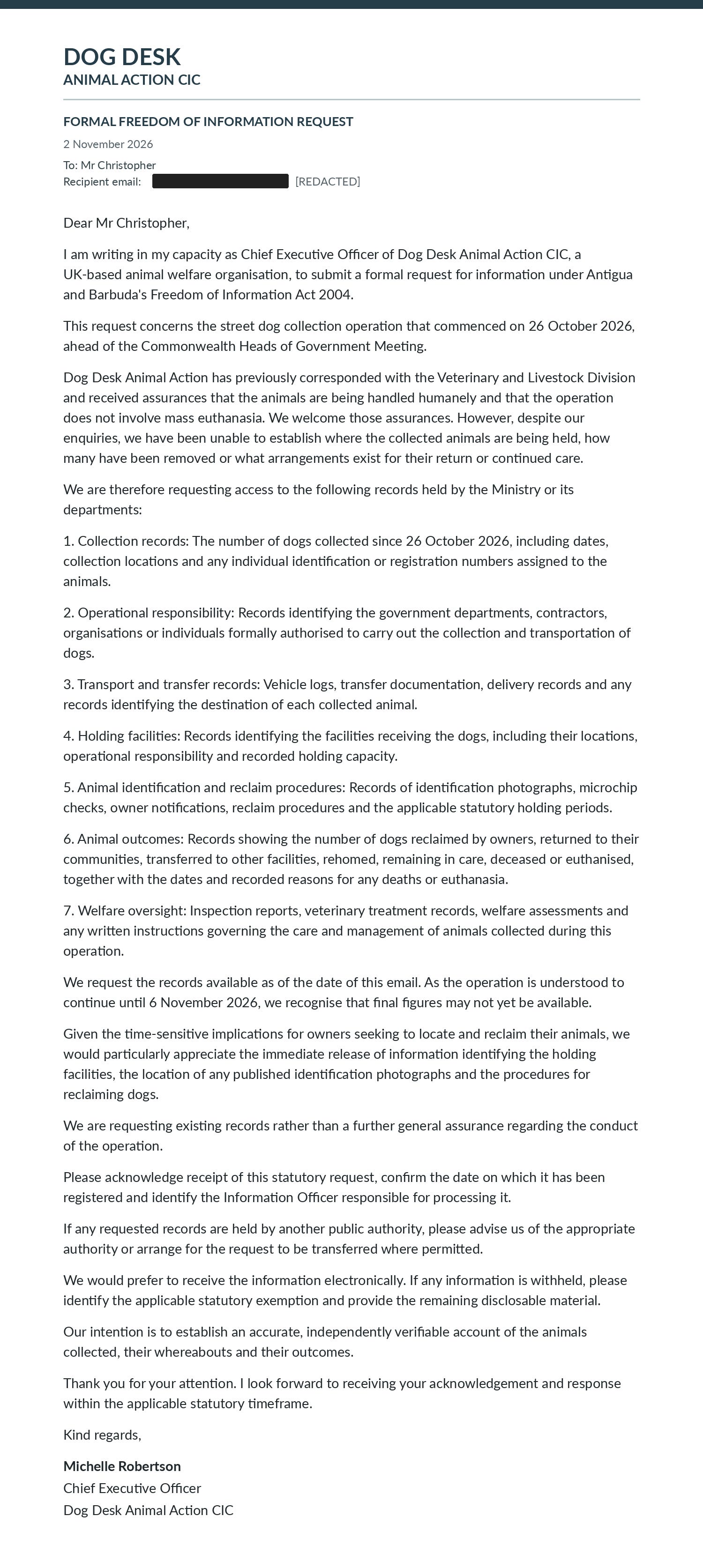
On 2 November 2026, Dog Desk Animal Action submitted a formal information request under Antigua and Barbuda’s Freedom of Information Act 2004.
The request was made while the Commonwealth related dog collection operation was still underway.
We requested seven categories of records covering the collection, transportation, identification, housing, veterinary care and eventual outcomes of the animals.
These include collection logs, vehicle and transfer records, the locations and capacities of receiving facilities, identification photographs, microchip checks, owner notifications and veterinary inspection reports.
We also requested records showing how many dogs had been reclaimed, returned to their communities, rehomed, transferred, remained in care, died or been euthanised.
The request specifically sought existing government records rather than another general assurance about the treatment of the animals.
We asked for acknowledgement of the request, confirmation of its registration date and identification of the Information Officer responsible for processing it.
Thirteen days have now passed since the request was sent. The operation has ended, but the records needed to establish the whereabouts and outcomes of the collected dogs have not yet been provided to us.
The Commonwealth Was the Reason. It Cannot Be the End of the Story.
Major international events bring intense preparation. Public spaces are cleaned, security arrangements are introduced and governments work to present their countries to visiting leaders and the world’s media.
In Antigua and Barbuda, those preparations included removing dogs from the streets.
The animals were affected by a decision made for the event. Their welfare and whereabouts remain the responsibility of the organisations and authorities involved long after the event has ended.
A government capable of organising a collection operation should be capable of accounting for its results.
The number of dogs removed should not be a mystery. Their receiving facilities should not be difficult to establish. Their outcomes should not depend on piecing together scattered social media posts and incomplete public statements.
Antigua and Barbuda has had the opportunity to explain the purpose of the operation and reassure the public about its intentions.
Now the records are needed.
Dog Desk Animal Action will continue pursuing those records and will report on the information obtained.
The Commonwealth leaders have gone home. The dogs taken from Antigua’s streets deserve to be accounted for.
The question remains: where are they?