


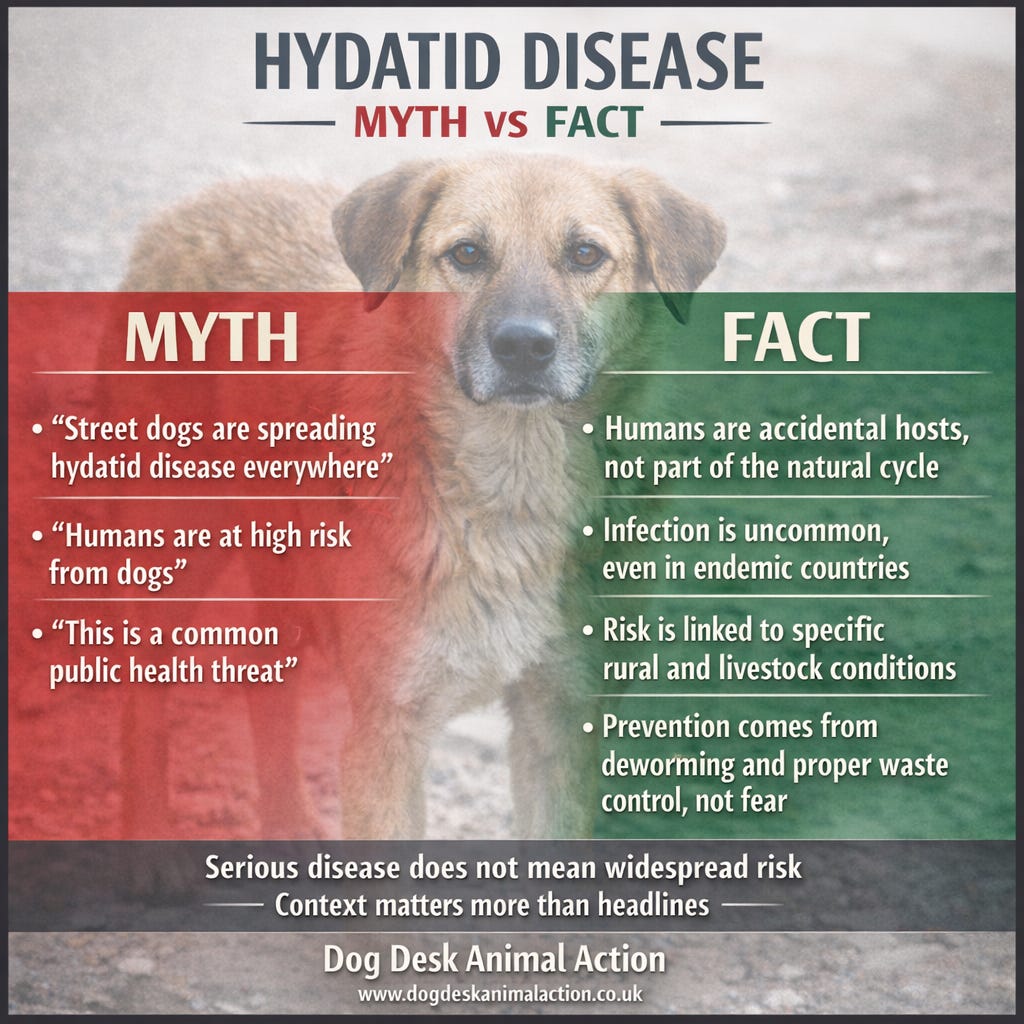
In recent weeks, articles have circulated warning about hydatid cyst disease in the context of dogs in Turkey. The tone is often urgent, sometimes alarming, and in places it leaves readers with the impression that human infection is both common and imminent.
It is important to step back from that framing and look at what the evidence actually shows.
The nature of the disease
Hydatid disease (echinococcosis) is a parasitic infection involving a cycle between animals, typically dogs and livestock.
Humans are not part of that natural cycle.
We become infected accidentally, through ingestion of parasite eggs usually via contaminated food, water, or close contact in specific conditions.
This distinction matters. It places humans outside the intended transmission pathway, not at the centre of it.
How common is it in Turkey
Turkey is considered an endemic country, meaning the parasite exists within animal populations.
However, when we look at human infection rates, the picture becomes much clearer:
Estimated incidence: around 3–5 cases per 100,000 people per year
Approximate annual cases: 2,000–2,500 diagnosed cases in a population of over 80 million
Put simply this is not a common disease for the general population.
Even within Turkey, risk is not evenly distributed:
Higher in rural areas
Linked to livestock farming
Associated with untreated working dogs and slaughter practices
This is a very specific risk profile not a generalised urban threat.
What about globally
Globally, hydatid disease exists in regions where:
Livestock farming is common
Dogs have access to infected animal organs
But even in endemic countries:
Infection is sporadic, not universal
Many cases remain asymptomatic for years
Detection is often incidental
Severity versus likelihood
This is where public messaging often becomes distorted.
Hydatid disease can be serious. In some cases, it requires surgery.
But two things can be true at once:
It is medically significant
It is relatively uncommon in humans
When severity is presented without context, it creates fear rather than understanding.
What actually drives transmission
The key drivers are not simply dogs.
They are:
Lack of regular deworming
Dogs consuming infected offal
Poor slaughterhouse controls
Limited public health education
Close contact between livestock, dogs, and humans
This is why the highest risk groups are consistently identified as people involved in animal husbandry and rural agricultural life.
Where public messaging goes wrong
When complex zoonotic diseases are reduced to headlines, nuance is lost.
Three common problems appear:
Conflating possibility with probability
Yes, transmission is possible. No, that does not mean it is likely for the average person.
Removing environmental context
Risk is tied to specific conditions, not simply the presence of dogs.
Amplifying fear without solutions
Fear-based messaging rarely explains prevention.
A more accurate public understanding
A responsible summary would be:
Hydatid disease is real
It is linked to specific environmental and agricultural conditions
Humans are accidental hosts
The overall risk to the general public is low, particularly outside high-risk settings
Why this matters
Public perception shapes policy. When disease is presented without context:
It can fuel fear of animals rather than focus on prevention
It risks misdirecting attention away from real solutions
It can justify responses that are disproportionate to the actual risk
Accurate information does not minimise risk. It allows it to be managed properly.
Hydatid disease should be taken seriously but seriousness is not the same as widespread danger.
The public deserves clarity over alarm, context over headlines, and solutions over fear.