

As Antigua & Barbuda prepares to welcome King Charles III and the Commonwealth’s leaders, dogs are being removed from the streets of St John’s. The authorities say they are safe. But where are they, and what will happen to them when the international visitors have gone?
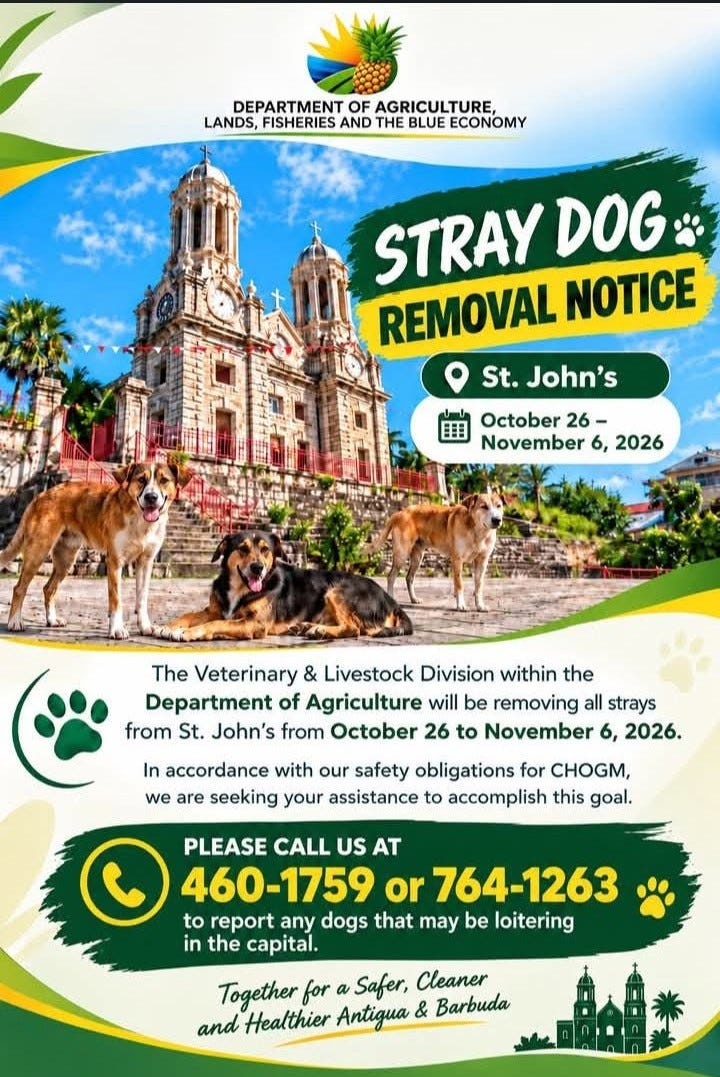
On 26 October 2026, an operation to remove stray animals began in St John’s, Antigua & Barbuda, ahead of the Commonwealth Heads of Government Meeting. King Charles III and Queen Camilla are expected to visit the island as part of the Commonwealth gathering, bringing international attention to a country preparing to welcome some of the world’s most prominent political figures.
For the government, this is an opportunity to showcase Antigua & Barbuda on the international stage. For the dogs who have lived on its streets, many of them familiar to the people who feed and care for them, the preparations have brought something very different. They are being collected and taken away.
The Veterinary Authority has responded to public concern by assuring residents that the operation is not a mass euthanasia exercise and that the animals will be handled humanely and responsibly. It has described arrangements for impoundment, veterinary attention, public identification and opportunities for animals to be reclaimed or rehomed. Those assurances are welcome, but they cannot replace the basic information needed to establish what is actually happening to the dogs.
How many have been collected? Where have they been taken? Where can owners and community carers find their photographs? And what will happen to those who are not reclaimed?
These are not unreasonable questions to ask.
A street dog may not have a registered owner, but that does not mean it has no relationship with the people around it. Across the world, community dogs are fed, monitored and cared for by residents who know them individually. Some have lived in the same neighbourhoods for years. Others may be owned animals that have escaped or become separated from their families. When they are taken away, the people who know them need a reliable way to find them.
The Veterinary Authority has said that photographs of impounded animals will be made publicly available for two working days. Yet we have been unable to establish where those photographs can be viewed. Nor have we been able to verify which facilities are receiving the dogs collected during this operation. Without that information, the promise of an opportunity to reclaim an animal becomes difficult to exercise in practice. An owner cannot identify a missing dog from photographs they cannot find, and a community carer cannot establish an animal’s safety without knowing where it has been taken.
There is also an apparent discrepancy in the government’s own published information. The Veterinary Authority’s recent notice describes a minimum holding period of two working days, excluding the day of impoundment and days when facilities are closed. However, the government’s Dog Registration & Control Authority webpage describes a seven day holding arrangement at the Antigua & Barbuda Humane Society in Bethesda. The older information does not establish what applies to the current operation, and we cannot assume that the Humane Society is receiving these dogs. But the difference is significant. For someone trying to recover an animal, the distinction between two working days and seven days could determine whether that opportunity is lost.
Dog Desk Animal Action has already written to the relevant veterinary authorities seeking clarification and followed up on 28 October. We have asked how many animals have been collected, where they are being held, how members of the public can identify them, what care is being provided and what records will be kept of their eventual outcomes. At the time of writing, we have not received a substantive response answering those questions.
We are not suggesting that the dogs have been killed. The authorities have specifically stated that this is not a mass euthanasia exercise, and we have no verified evidence establishing that the collected animals have been harmed. But neither can we independently confirm their whereabouts or what arrangements have been made for their future. Public assurances are not the same as publicly accessible records, and asking for those records should not be treated as an accusation.
The timing of this operation makes those questions particularly important. Antigua & Barbuda is preparing to welcome the King, Commonwealth leaders and international media. Streets are being prepared, security arrangements made and the country presented to visitors from around the world. Yet the animals who ordinarily occupy those same streets are being removed as part of those preparations. Whatever the stated reasons for collection, their welfare cannot become a secondary consideration because an international event is taking place.
King Charles III has long been associated with environmental protection and conservation. There is no suggestion that he has directed, authorised or been involved in Antigua’s street animal operation. But his visit creates an international spotlight, and that spotlight should not fall exclusively on the official ceremonies, receptions and carefully prepared images of the host country. It should also illuminate how vulnerable animals are treated when their presence is considered incompatible with the occasion.
This is not a question unique to Antigua. Across the world, major sporting events, political summits and international gatherings have been accompanied by efforts to remove free-roaming animals from public spaces. The language may be public safety, sanitation, animal welfare or responsible management, and those concerns can be legitimate. But removing animals is not, by itself, evidence that their welfare has improved. What happens after collection is what determines whether the intervention has protected them or simply moved them out of sight.
That distinction is central to our work at Dog Desk Animal Action. An animal entering a shelter, pound or municipal collection system must remain identifiable and accountable throughout its time in custody. Its admission should be recorded, its location known, its care documented and its eventual outcome established. Whether an animal is reclaimed, returned, rehomed, transferred, dies or is euthanised, there should be a record. Without those records, neither the public nor independent observers can properly assess what has happened.
The Veterinary Authority has indicated that the current operation will continue through 6 November. But what happens when the Commonwealth gathering is over? Will dogs that have not been reclaimed remain in holding facilities? Will they be offered for adoption, transferred elsewhere or returned to their communities? What capacity exists to accommodate them, and who will be responsible for their ongoing care? These are questions that deserve answers before the international visitors depart, not weeks or months afterwards when public attention has moved on.
We are therefore launching a public letter writing campaign asking Antigua & Barbuda’s responsible authorities to publish clear information about the operation. We want to know how many dogs have been collected, where they are being held, where their identification photographs can be found, which holding period applies and what arrangements exist to safeguard their welfare. Most importantly, we want to know how every animal’s eventual outcome will be recorded and made available for scrutiny.
SEND A LETTER - ASK WHERE ANTIGUA'S DOGS ARE BEING HELD.
We are asking supporters to write respectfully and focus on verifiable information. There is no need for speculation, inflammatory allegations or hostility towards the people carrying out the operation. The questions are serious enough without any of those things.
Antigua & Barbuda has told the public that the dogs are being treated humanely. Providing accessible information about their whereabouts and outcomes would allow those assurances to be tested and would help owners and carers locate animals who may be missing.
When the King and the Commonwealth leaders leave, the ceremonies will end, the cameras will move elsewhere and international attention will fade. But the dogs will still exist, somewhere, in somebody’s care or under somebody’s responsibility. Their lives do not become less important when the visitors have gone.
The question is not how many dogs Antigua can remove from its streets before the Commonwealth arrives. It is whether the country can account for what happens to them afterwards.
And until that information is available, we will continue asking.
Where are the dogs?