


Thirty-five years after Britain introduced the Dangerous Dogs Act, the evidence raises serious questions about whether banning dogs because of their appearance has made the public safer.
In 1991, following a series of horrific dog attacks that attracted intense media attention, the British government introduced legislation that would change the lives of thousands of dogs and their owners.
The Dangerous Dogs Act was presented as an urgent response to a serious public safety problem. Certain dogs were considered sufficiently dangerous to justify prohibition, regardless of whether an individual animal had ever shown aggression.
The original legislation identified four prohibited types: the Pit Bull Terrier, Japanese Tosa, Dogo Argentino and Fila Brasileiro. More than three decades later, the American XL Bully was added to the list.
The principle underpinning these restrictions was straightforward. By removing dogs considered inherently dangerous, the government hoped to reduce the risk of serious attacks on people.
It was an approach that appeared decisive. But decisive legislation is not necessarily effective legislation, and thirty-five years later, there is remarkably little evidence that banning dogs by breed or type has delivered the public safety benefits used to justify it.
When appearance becomes a criminal offence
One of the most troubling aspects of the Dangerous Dogs Act is that a dog does not need to have attacked anybody, threatened anybody or displayed aggressive behaviour to fall within its restrictions.
Under Section 1, the legislation applies to prohibited types of dog, rather than exclusively to animals with a documented pedigree. Physical characteristics are used to determine whether a dog falls within a prohibited category.
This means that a dog of uncertain ancestry can be classified as a prohibited type because of its appearance.
A dog may be seized and held in kennels while its legal status is determined. Depending on the circumstances, it may eventually be returned under strict exemption conditions or face destruction.
The legislation therefore creates an extraordinary distinction between dogs. One animal may be subject to seizure because its physical characteristics resemble a prohibited type, despite having lived peacefully with its family. Another, outside the prohibited categories, may have displayed concerning behaviour but will not be subject to the same automatic breed-based restrictions.
The law has provisions for dealing with dogs that are dangerously out of control, regardless of breed. Yet Section 1 operates on an entirely different premise: that certain dogs warrant restrictions because of what they are considered to be, rather than what they have done.
For a policy intended to prevent dangerous behaviour, that distinction demands particularly strong scientific justification.
Thirty-five years of legislation. What happened to dog bites?
The government’s own figures provide an uncomfortable starting point.
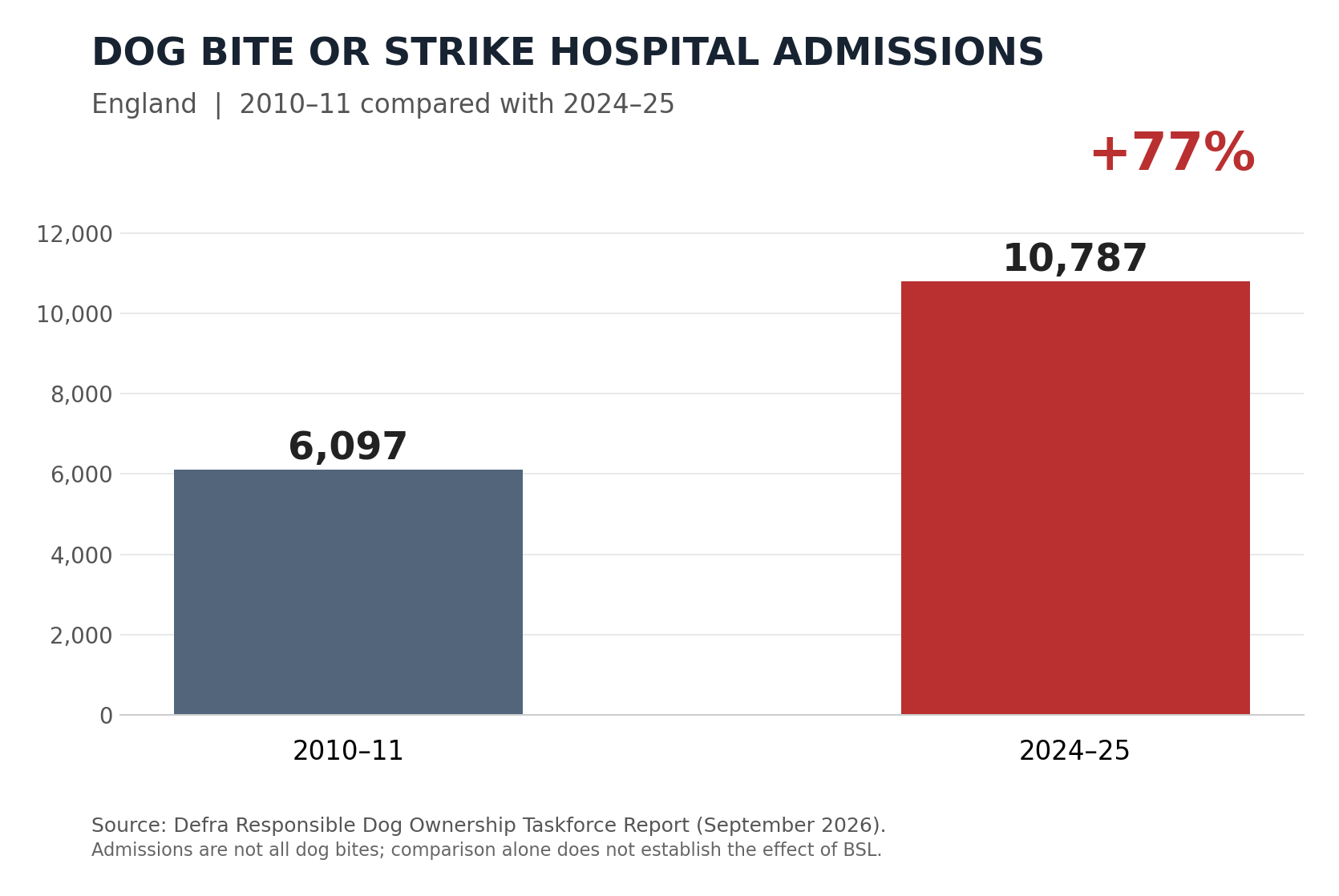
According to the Responsible Dog Ownership Taskforce report published by Defra in September 2026, hospital admissions for dog bites or strikes in England increased from 6,097 in 2010–11 to 10,787 in 2024–25.
That represents an increase of approximately 77%.
The taskforce acknowledged that dog ownership had increased during this period, but reported that recorded bites and strikes had risen faster than dog ownership.
These figures cannot establish what would have happened in the absence of breed-specific legislation. Population changes, reporting practices, dog ownership patterns and other factors complicate comparisons. Hospital admissions also represent only a proportion of dog-bite incidents.
Nevertheless, they demonstrate that serious dog-related injuries remain a substantial public health problem despite decades of breed-specific restrictions.
This was not an entirely unexpected development.
An assessment conducted five years after the Dangerous Dogs Act was introduced found no significant reduction in dog bites attributable to the legislation.
That early finding should have prompted a fundamental examination of whether the policy was addressing the causes of dangerous behaviour. Instead, the central principle of prohibiting dogs by type has survived successive governments and has recently been extended.
What does the research actually show?
Britain is not the only country to have adopted breed-specific legislation, and international research provides valuable opportunities to examine its effectiveness.
A systematic review published in Injury Prevention in 2022 examined 43 studies investigating interventions intended to reduce dog bites and aggression.
The researchers found evidence that dog-control legislation could contribute to reducing biting incidents, but breed-specific restrictions demonstrated less effect. The findings supported broader approaches to dog control rather than reliance on breed-based restrictions.
This distinction is important. Questioning breed-specific legislation does not mean opposing the regulation of dogs or suggesting that governments should ignore dangerous behaviour. It means examining which interventions are most likely to prevent injuries.
Denmark provides one example.
In 2010, the country introduced restrictions affecting 13 breeds and types of dog. Researchers subsequently examined hospital-treated dog bites in Odense to assess whether the legislation had produced measurable improvements.
Their study, published in PLOS ONE in 2018, found that the restrictions had a highly limited effect on overall dog-bite injuries. The researchers recommended considering alternatives to breed-specific legislation as the primary means of preventing injuries.
Ireland offers another comparison, although its restricted-breed system differs from Britain’s prohibition model.
A study examining dog-bite hospitalisations between 1998 and 2013 identified 3,164 admissions and found that the incidence increased over the period. The researchers concluded that Ireland’s breed-specific approach was not effective as a dog-bite prevention strategy.
These studies do not prove that every breed restriction, in every circumstance, has no effect. Research designs, enforcement practices and local conditions differ, and isolating the impact of legislation can be difficult.
What they do establish is that the evidence for breed-specific restrictions as an effective primary prevention strategy is weak.
For legislation with such serious consequences for animals and their owners, that is a significant problem.
Are some dogs more dangerous than others?
Discussions about breed-specific legislation frequently become polarised because two different questions are treated as though they are the same.
The first concerns a dog’s physical capacity to cause injury. The second concerns the likelihood that an individual dog will behave aggressively towards a person.
They are not interchangeable.
Dogs vary considerably in size, strength and physical characteristics. Those differences can influence the severity of injuries when an attack occurs. It would be unreasonable to pretend that a large, powerful dog presents exactly the same physical risks as a very small one.
But physical capacity alone does not establish how an individual animal will behave.
Canine aggression is influenced by genetics, early experiences, socialisation, training, health, environmental conditions and human management. Behaviour can vary substantially between dogs that share similar physical characteristics.
The RSPCA and other animal welfare organisations have repeatedly challenged the assumption that prohibited types are inherently more aggressive towards people.
This is the weakness at the heart of breed-specific legislation. A dog’s appearance is being used as a substitute for an individual assessment of risk, even though the relationship between physical type and dangerous behaviour is far more complicated.
It also creates the possibility of misplaced confidence. A dog outside the prohibited categories is not necessarily safe simply because it belongs to a different breed.
Effective prevention requires attention to behaviour and circumstances across the entire dog population.
The XL Bully ban and the consequences of hurried legislation
The addition of the American XL Bully to the prohibited list followed a series of serious and fatal attacks that caused widespread public concern.
The suffering experienced by victims and their families must never be minimised. Governments have a responsibility to protect people, and serious incidents require an effective response.
But the urgency of a situation does not remove the obligation to examine the likely consequences of a proposed policy.
In November 2025, the government’s independent Animal Sentience Committee published an assessment of the XL Bully ban that raised substantial concerns about the evidence used to inform the decision and the welfare consequences that followed.
The committee reported that the government had initially estimated the UK XL Bully population at approximately 10,000 dogs. More than 50,000 had been registered by the time the policy decision was made.
This considerable discrepancy meant that the number of animals affected was far greater than originally anticipated.
The committee identified welfare concerns arising from seizures, kennelling, restrictions on normal behaviour and the destruction of dogs. It also questioned whether resources devoted to implementing the ban might have achieved greater benefits if directed towards other interventions.
In March 2026, the government responded to the committee’s findings. It defended the ban as an important public safety measure while acknowledging limitations in the original population estimates.
By then, more than 57,000 owners had registered XL Bully-type dogs under the exemption arrangements.
The government also reported compensation claims relating to 406 dogs euthanised under the voluntary compensation scheme. That figure does not account for every dog euthanised following the introduction of the restrictions.
The full welfare consequences are therefore considerably wider than any single compensation figure suggests.
The question is whether those consequences have produced a corresponding improvement in public safety.
A reduction in the number of prohibited dogs living without exemptions is evidence that the law is being enforced. It is not, by itself, evidence that fewer people are being injured.
The dogs who have done nothing wrong
Behind the legal terminology are individual animals whose lives can be profoundly affected by a classification they cannot understand.
A dog that has lived peacefully in a family home may be removed because its physical characteristics meet the prohibited-type definition. It may spend weeks or months in kennels while proceedings take place, separated from familiar people, routines and surroundings.
, particularly when prolonged or when opportunities for normal activity and social contact are limited.
Even where an animal is eventually returned, the consequences do not necessarily end.
Exempted dogs face lifelong restrictions, including requirements concerning muzzling, leads, insurance and secure containment. These conditions may be necessary to comply with the law, but they can affect normal exercise, social interaction and everyday life.
For rescue organisations, breed-specific restrictions create further difficulties. Dogs that might otherwise be assessed and rehomed cannot simply be placed with suitable families through ordinary adoption arrangements.
The September 2026 Responsible Dog Ownership Taskforce report acknowledged the additional pressures that the XL Bully ban had placed on rescue and rehoming organisations.
These consequences should not be dismissed as unavoidable collateral damage.
Animal welfare legislation routinely requires decision-makers to consider whether harm to animals is necessary and proportionate. Breed-specific legislation should be subject to equally rigorous scrutiny.
If a dog is to lose its home, its freedom or its life because of its appearance, there must be compelling evidence that doing so provides a genuine public safety benefit.
A government that still does not have the information it needs
Perhaps the most revealing aspect of the recent official assessments is the extent of the gaps in Britain’s understanding of dog attacks.
The Animal Sentience Committee identified serious deficiencies in the information available to policymakers. Records of incidents are fragmented, and hospital data often lack the detail needed to understand the circumstances surrounding an attack.
Breed identification can be uncertain, particularly where dogs have no verified pedigree. Reliable information about the number of dogs of different types in the population is also essential if claims about disproportionate risk are to be assessed properly.
Without accurate population figures, incident records and contextual information, it becomes difficult to establish whether a particular type of dog presents an elevated risk, or whether changes in attack numbers are attributable to legislation.
The Responsible Dog Ownership Taskforce subsequently recommended improvements to recording, research, education and enforcement.
Yet its September 2026 report confirmed that consideration of breed-specific legislation itself had been excluded from the taskforce’s remit.
That decision is difficult to reconcile with the government’s stated commitment to evidence-based prevention.
If Britain is undertaking a serious examination of responsible dog ownership and the prevention of attacks, surely the effectiveness of the legislation that has defined its approach for thirty-five years should be central to that work.
Excluding it leaves one of the most consequential elements of dog-control policy largely untouched.
What would a better approach look like?
Preventing dog attacks requires understanding why they happen and identifying opportunities to intervene before somebody is injured.
That means looking beyond breed labels.
Responsible breeding, appropriate socialisation, owner education, early identification of concerning behaviour and effective enforcement all have roles to play. So do better public understanding of canine behaviour and appropriate supervision of children around dogs.
Owners who repeatedly fail to control their animals should face meaningful intervention, regardless of the breed involved.
Police forces and local authorities need clear powers, consistent procedures and sufficient resources to respond to credible risks. Veterinary professionals and qualified behaviour specialists can contribute expertise where individual assessments are necessary.
Better incident reporting is equally important. Without reliable information about the circumstances of attacks, governments cannot confidently identify which interventions are effective.
Not every proposed prevention measure has equally strong supporting evidence, and no realistic programme can guarantee that serious attacks will never happen.
But a system that identifies risks through behaviour, management and circumstances has the potential to address dangerous situations involving any dog, rather than concentrating primarily on a limited number of prohibited types.
The objective should be to prevent injuries, not simply to increase the number of animals brought within a prohibition.
Has breed-specific legislation worked?
After thirty-five years, the evidence does not provide a convincing case that banning dogs by breed or type has been an effective primary strategy for reducing dog-bite injuries.
That is not the same as proving that every restriction has been entirely without effect. It means that the claimed public safety benefits have not been demonstrated with the strength of evidence that such far-reaching legislation should require.
The government has continued to defend breed-specific restrictions, most recently in relation to the American XL Bully, while its own advisers have identified weaknesses in the available data and substantial animal welfare consequences.
Meanwhile, serious dog-related injuries continue.
There is something profoundly troubling about a legal system that can impose lifelong restrictions on an animal that has never demonstrated dangerous behaviour, while the effectiveness of those restrictions remains insufficiently established.
The families of people killed or seriously injured by dogs deserve more than legislation that creates the appearance of decisive action. They deserve policies supported by reliable evidence, capable of identifying genuine risks and preventing avoidable tragedies.
Dogs deserve not to be condemned solely because of their physical appearance.
These objectives are entirely compatible.
An independent, comprehensive review of breed-specific legislation is long overdue. It should examine injury outcomes, the reliability of breed identification, enforcement costs, animal welfare consequences and the comparative effectiveness of alternative approaches.
If the legislation works, the evidence should demonstrate it. If it does not, governments have a responsibility to change course.
Thirty-five years is more than enough time to ask whether Britain has been protecting the public as effectively as it could.
We can protect people without punishing dogs.
And after thirty-five years, we should be demanding legislation that does both.
Listen to Dog Desk Radio
To mark National Pit Bull Awareness Day, Dog Desk Radio speaks with lawyer Gavin Fraser-Gosling (formerly Ridley) about the Dangerous Dogs Act, breed-specific legislation and its consequences for dogs and their owners.
Has Britain Learned Anything? 35 Years of the Dangerous Dogs Act
Watch the interview:
Dog Desk Animal Action CIC — Independent animal welfare advocacy, investigation and accountability.
Sources and further reading
UK Government — Responsible Dog Ownership Taskforce Report, September 2026
https://www.gov.uk/government/publications/responsible-dog-ownership-report/responsible-dog-ownership-taskforce-report
Animal Sentience Committee — XL Bullies and the Dangerous Dogs Act, November 2025
https://www.gov.uk/government/publications/animal-sentience-committee-xl-bullies-and-the-dangerous-dogs-act-report/animal-sentience-committee-report-xl-bullies-and-the-dangerous-dogs-act
UK Government — Response to the Animal Sentience Committee, March 2026
https://www.gov.uk/government/publications/government-response-to-the-animal-sentience-committee-report-on-xl-bullies-and-the-dangerous-dogs-act/government-response-to-the-animal-sentience-committee-report-on-xl-bullies-and-the-dangerous-dogs-act
Systematic Review of Dog Bite Prevention Strategies, 2022
https://pubmed.ncbi.nlm.nih.gov/35393286/
Danish Breed-Specific Legislation Study, 2018
https://pubmed.ncbi.nlm.nih.gov/30586418/
Dog Bite Hospitalisations in Ireland, 1998–2013
https://pubmed.ncbi.nlm.nih.gov/25957919/
RSPCA — Breed-Specific Legislation
https://science.rspca.org.uk/en/web/rspca/whatwedo/changingthelaw/bsl