


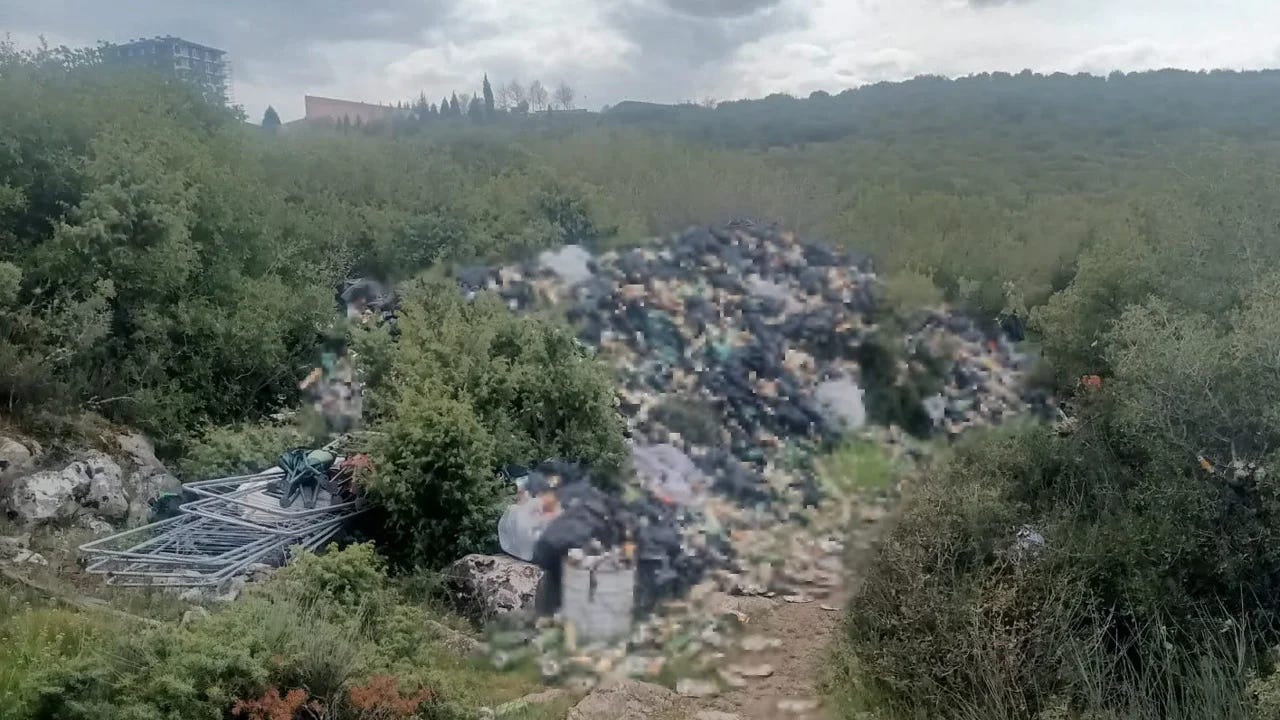
There is a version of the Bilecik (Turkey) story that will be told as a one-off: an illegal site, dead animals discovered, authorities step in, area cleared.
That version is convenient. It is also dangerously incomplete.
Because when eight live dogs are still present, sick enough to require quarantine this is not a static scene. It is not just a dumping ground. It is evidence of a process that was ongoing, unmonitored, and allowed to continue until it became impossible to ignore.
And that is where this stops being a cruelty story alone, and becomes a public health failure.
This Was Not Sudden
Dead animals do not accumulate in isolation. Sick animals do not remain on site without time passing.
The presence of:
multiple carcasses (dogs and a horse)
large volumes of waste
live, unwell animals
points to duration.
This environment did not emerge overnight. It developed, deteriorated, and persisted. Which raises the first critical question:
How does a site like this exist long enough to reach this point without detection?
Animal Suffering and Public Health
There is a persistent tendency to separate animal welfare from public health.
In reality, they are tightly linked and this case demonstrates exactly why.
A site containing:
decomposing animal bodies
unmanaged waste
untreated, sick animals
is not just inhumane. It is a disease environment. Such conditions can facilitate:
the spread of infectious disease between animals
parasite proliferation
contamination of surrounding land and water
increased risk of transmission at the human–animal interface
This is not theoretical. It is the predictable outcome of neglect at scale.
The Traceability Problem
The most important question remains unanswered:
Where did these dogs come from?
Because without origin, there is no accountability.
Were they abandoned?
Were they collected and not recorded?
Were they being kept and allowed to deteriorate?
Each scenario points to a different failure. All of them point to the same underlying issue:
A complete absence of traceability.
No intake records. No oversight of movement. No intervention before crisis point.
When animals can appear, suffer, and die without any system tracking them, the risk does not stop with them.
This Is What Happens When No One Is Watching
The official response will read well:
site cleared
animals removed
investigation opened
But intervention at this stage is reactive. By the time a site reaches this condition:
animals have already died
others are already sick
environmental contamination has already occurred
Public health is not protected at the point of clean-up. It is protected at the point of early detection and control.
The Wider Implication
This is not about one illegal site in one province.
It is about what happens when:
land use is not effectively monitored
animal populations are not tracked
responsibility is diffused across systems that do not communicate
In that gap, conditions like this form.
And when they do, they do not remain contained.
The Line That Should Not Be Crossed
Eight dogs were still alive when this site was found.
That means this was not a past event.
It was ongoing.
Which leads to a simple, unavoidable conclusion:
This was not just a place animals were left.
It was a place they were ending up — repeatedly — without interruption.
Until that pathway is identified and closed, this is not resolved. It is paused.
Final Point
If animal welfare is treated as optional, public health becomes reactive.
If traceability is absent, accountability disappears. And when both fail at the same time, sites like this are not anomalies.
They are outcomes.
Editors Note
Veterinarians removed the dogs still alive & have taken them for medical help.