
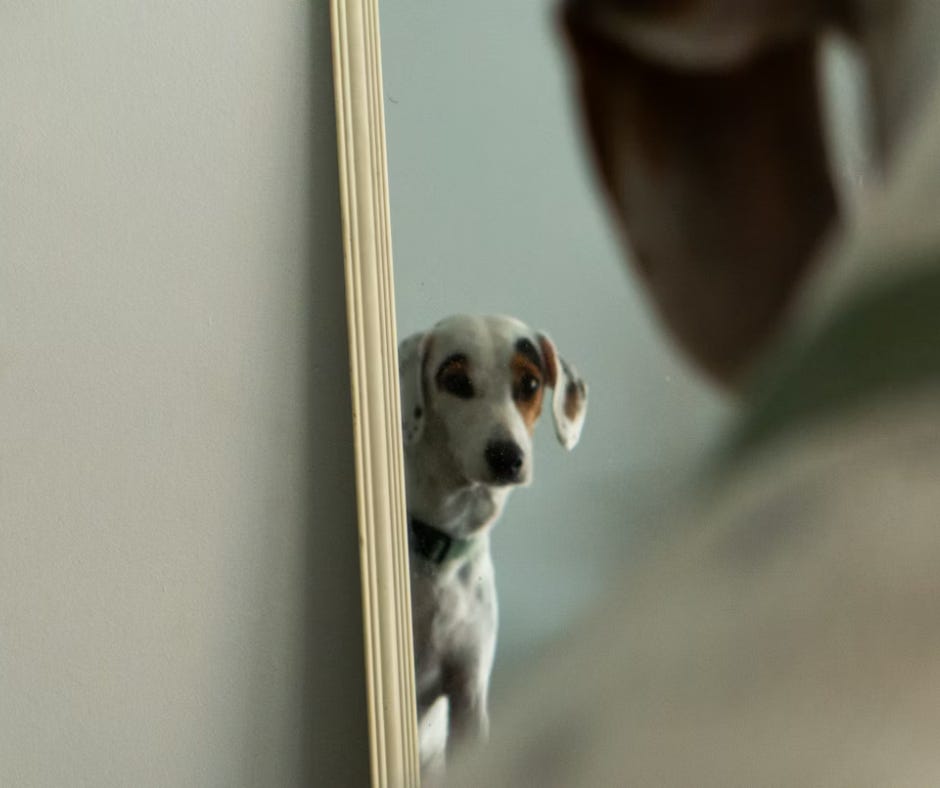
Can Dogs Recognise Themselves in a Mirror?
If you’ve ever held your dog up to a mirror, you’ve probably seen one of three reactions:
Excited barking
Head tilting confusion
Complete indifference
So what’s actually happening?
Do dogs know they’re looking at themselves?
The short answer: probably not in the way humans do.
But that doesn’t mean they lack self-awareness
The Mirror Test
Scientists often use something called the mirror self-recognition test to assess self-awareness. It was first developed by psychologist Gordon Gallup Jr. in the 1970s.
Here’s how it works:
An animal is marked with a spot of dye somewhere they can’t see without a mirror.
If they use the mirror to investigate or touch the mark on their own body, they pass.
Species that have passed include:
Great apes
Dolphins
Elephants
Magpies
Dogs, generally, do not pass this test.
But that may say more about the test than the dog.
Dogs Experience the World Through Smell
Humans are visual creatures.
Dogs are olfactory creatures.
A mirror provides visual information but no scent.
To a dog, a reflection may simply be:
A silent dog
A dog with no smell
A dog that won’t respond socially
Over time, most dogs lose interest. They learn the reflection doesn’t behave or communicate like a real dog would.
Does That Mean Dogs Lack Self-Awareness?
Not at all.
Some researchers have explored whether dogs demonstrate self-recognition through scent instead of sight. In scent-based experiments, dogs show more interest in altered versions of their own odour compared to their normal scent suggesting some form of self-referential awareness.
Self-awareness isn’t a single switch that’s either on or off. It exists on a spectrum.
Dogs may not recognise their reflection visually but they:
Understand their bodies in space
Respond differently to their own scent
Show social awareness
Experience emotions
Demonstrate memory and anticipation
That’s a form of selfhood.
Why This Matters
We sometimes measure animals against human standards.
But intelligence and awareness evolve according to survival needs. Dogs didn’t need mirrors to thrive alongside humans for thousands of years.
What they developed instead was something extraordinary:
The ability to read human facial expressions
Sensitivity to tone and gesture
Deep social bonding capacity
In many ways, dogs understand us better than we understand them.
So next time your dog ignores their reflection, don’t assume they’re confused.
They may simply be thinking:
If it doesn’t smell like me it’s not me.
And that might be wisdom of a different kind


