

Visit the Çerkezköy Municipality website and you will find photographs of official visits, schoolchildren meeting dogs, veterinary facilities and descriptions of the care being provided to animals.
It is a reassuring picture of a municipality investing in animal welfare, developing its facilities and presenting its work to the public.
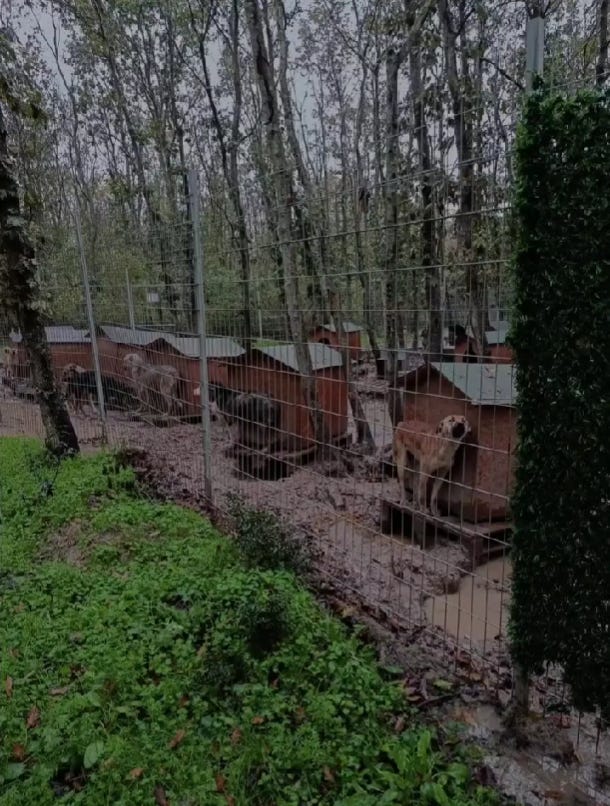
Then look at the footage circulating from an enclosure attributed to its municipal animal shelter.
Dogs standing in thick mud. Water collecting around wooden kennels. An enclosure where the ground is so saturated that little dry space is visible.
It is a very different picture and one that deserves attention.
Beyond the official photographs
Çerkezköy, in Türkiye’s Tekirdağ province, has invested in its municipal animal care facilities. In December 2025, the relocation of its former shelter to a new centre in Ambardere was reported, with examination rooms, an operating theatre, quarantine accommodation and outdoor living areas.
During 2026, the municipality continued to publicise its work. In June, the provincial governor and mayor visited the centre. In October, approximately 400 schoolchildren were welcomed to learn about the animals and the care they receive.
There is nothing wrong with sharing these activities. Investment in veterinary care, education and suitable accommodation should be recognised. But there is a difference between showing the public what a facility contains and showing them how the animals actually live.
A treatment room tells us that veterinary facilities are available. An organised visit shows us an activity taking place. Neither tells us what conditions are like across the outdoor enclosures when the visitors have gone home.
The footage now circulating offers another perspective.
Dogs are visible inside a fenced enclosure where the ground is heavily churned and substantial areas are covered by standing water. Wooden kennels are positioned around the enclosure, some apparently raised above the surrounding ground.
These animals are dependent on the accommodation provided for them. They cannot choose to leave the enclosure or find somewhere else to rest.
Their welfare depends on what happens within those fences.
When the rain comes
Heavy rainfall affected Çerkezköy earlier this week, with flooding reported across parts of the district.
That provides context for the waterlogged conditions shown in the footage, but rainfall alone does not establish whether the dogs had suitable protection or how the situation was managed.
An enclosure affected by extensive standing water raises legitimate concerns about drainage, dry resting areas and the arrangements made for animals during adverse weather.
We cannot determine from the footage how long the conditions persisted or whether dry accommodation was available inside the kennels.
What is visible, however, is an outdoor area in a condition that warrants examination.
The precise location of the enclosure within the municipality’s animal care facilities has not yet been independently established. The footage has nevertheless been publicly attributed to Çerkezköy’s municipal shelter.
The responsibility for animals in municipal care extends to their accommodation and daily living conditions, whatever the weather.
When the visitors have gone home
This is where the municipality’s official presentation becomes particularly relevant.
The photographs and reports on its website document facilities, services and organised activities. They provide useful information about the work being undertaken, but they are only part of the picture.
Animal welfare continues beyond official visits.
It is present in the ordinary routines of feeding, cleaning, veterinary monitoring and maintaining accommodation. It is reflected in whether animals have somewhere comfortable to rest, whether their surroundings are properly maintained and whether problems are identified and addressed.
These are not necessarily the moments that appear in public photographs, but they are central to the lives of animals in shelters.
There is no evidence that the municipality deliberately concealed the conditions shown in the footage. The concern is that its published presentation does not, on its own, provide a complete account of the living conditions experienced by the animals.
The municipality’s investment and veterinary provision are relevant. So are the conditions recorded in the enclosure. Both belong in any meaningful assessment of its animal care service.
The dogs now
The most pressing issue is the welfare of the dogs shown in the footage.
As of 6 November, we have not located publicly verifiable information confirming their present circumstances or documenting any measures taken in response to the conditions shown.
A clear account of the enclosure’s location, the accommodation available to the animals and any subsequent inspection or remedial work would help establish what happened.
That information is particularly important in Türkiye, where municipalities have significant responsibilities for dogs collected from public spaces and placed in public care.
The public is regularly told about collection operations, shelter developments and investments in facilities. There is far less opportunity to see the daily conditions experienced by the animals once they have entered those facilities.
The footage from Çerkezköy brings that distinction into focus.
It shows dogs in a heavily waterlogged enclosure. It does not establish the duration of those conditions or the animals’ subsequent treatment, but it provides a clear reason for seeking further information about their welfare.
The part that counts
An animal shelter is more than its buildings, equipment and official activities.
It is a place where living animals depend entirely on people for their safety, health and wellbeing.
Veterinary facilities are important. Investment is important. Public engagement and education are important. But none of these can replace the everyday responsibility to provide suitable accommodation and care.
Çerkezköy Municipality has shared its account of the facilities and services it provides. The recent footage adds another element that deserves to be examined alongside those official records.
The dogs shown in that enclosure are not an abstract part of a municipal programme. They are individual animals whose living conditions deserve the same attention as the buildings and services intended to support them.
Because the measure of an animal shelter is not how it looks when officials visit or photographs are taken. It is how the animals live when nobody is watching.
And that is the part we need to see.
Sources and further reading
Çerkezköy Municipality — Schoolchildren visit the animal care centre, October 2026
Çerkezköy Haber — Relocation of the municipal animal care centre, December 2025
Çerkezköy Ekspres — Governor visits the animal care centre, June 2026
Marmara Haber — Shelter conditions reported, 6 November 2026
Dog Desk Animal Action CIC | Independent animal welfare reporting and advocacy