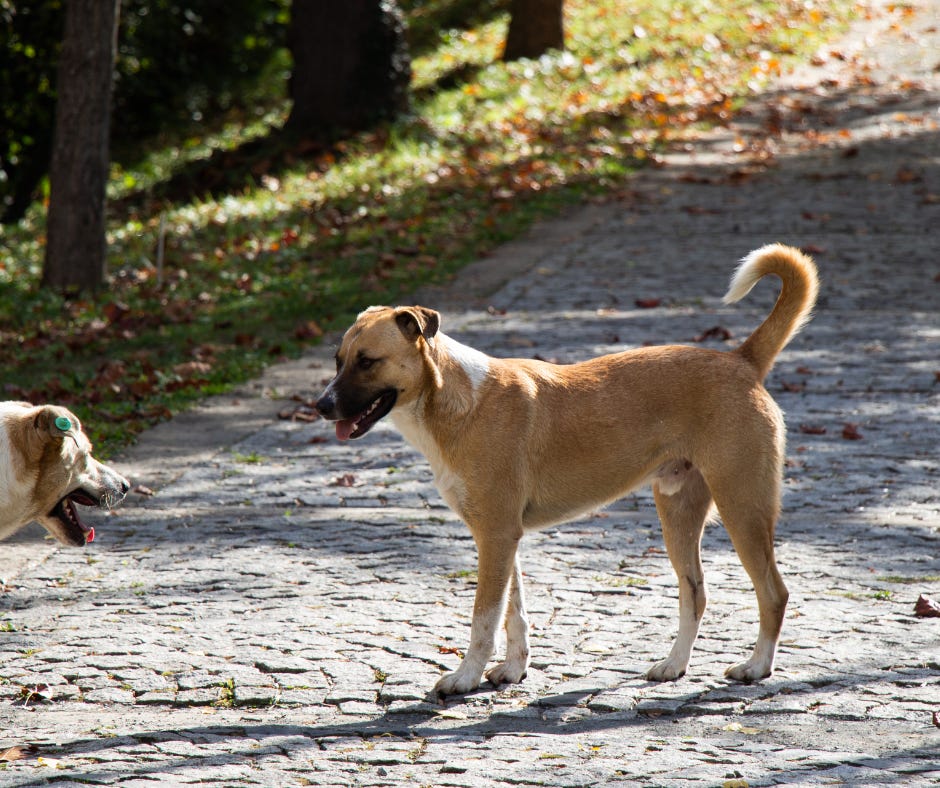
Community Dogs: Coexistence or Conflict?
When shared spaces meet shared responsibility

Across much of the world, not every dog belongs to one household.
Some belong to a street, a market, a campus, a neighbourhood. They sleep near the same shops, follow the same routes, recognise the same people. Residents know their faces, their habits, even their preferred resting spots.
These are often called community dogs, animals who live among humans without being privately owned.
Their presence sparks strong opinions. For some people they represent compassion in action. For others they represent risk and disorder.
The reality is more complex than either view.
What a Community Dog Actually Is
A community dog is not simply an abandoned pet wandering randomly.
Most occupy stable territories and develop predictable routines. They are fed by multiple people, avoid certain areas, and coexist with daily human activity.
Behaviourally, they resemble village dogs, a type of dog that has lived alongside humans for thousands of years without full domestication into households.
They are neither wildlife nor pets. They are a human-adapted species living independently within human environments
Why They Exist in the First Place
Community dogs are not created by kindness. They are created by ecology.
Where food sources exist, markets, bins, outdoor eating areas, dogs will establish populations. Removal alone rarely solves this because the environment continues to support animals. New dogs move in, reproduction resumes, and the cycle repeats.
This is known as the vacuum effect:
empty territory does not stay empty.
In contrast, stable neutered groups tend to regulate themselves. Territorial animals prevent newcomers settling, population growth slows, and behaviour stabilises.
In other words, unmanaged removal increases turnover.
Management creates predictability.
Where Conflict Comes From
Most conflict is not about the mere presence of dogs, but unpredictability.
People feel unsafe when animals behave erratically, chasing, guarding resources, reacting fearfully. These behaviours are usually tied to pressure:
sudden displacement
hunger competition
breeding season
harassment by people
unfamiliar dogs entering territory
A constantly changing population produces constant behavioural tension.
Communities experience this as aggression, even when the underlying cause is instability rather than inherent danger.
The Role of Neutering and Familiarity
Long-term observation in many regions shows a pattern:
neutered, known dogs behave differently from transient populations.
They sleep more. They patrol less. They react less intensely to passers-by.
Humans also adjust behaviour when dogs are familiar. Recognition reduces fear on both sides. The relationship becomes spatial negotiation rather than confrontation, each avoids surprising the other.
Coexistence depends less on affection and more on predictability.
Why Removal Alone Rarely Works
When dogs are removed without environmental change, three things happen:
New animals enter the vacant area
Social structure resets
Conflict temporarily increases
Residents often interpret the return as failure of enforcement, but biologically it is expected. The habitat still exists, so another population forms.
Lasting change requires altering reproduction rates and resource competition, not just the visible individuals.
The Ethical Question
The debate is often framed as compassion versus safety.
In practice, welfare and safety usually align when management is consistent.
Healthy, stable dogs:
avoid unnecessary movement
defend territory less intensely
interact predictably with people
Constant displacement creates nervous animals, the exact behaviour communities fear.
The question is not simply whether dogs should exist in shared spaces.
It is how their existence is structured.
What Coexistence Actually Means
Coexistence does not require everyone to love dogs. It requires a system where neither species must constantly react to the other.
For humans, that means clear pathways, education, and predictable populations.
For dogs, it means food sources that don’t trigger competition and reproduction that does not expand.
When both conditions are met, dogs fade into the background of daily life present but uneventful.
Conflict Is Usually a Sign of Instability
Areas with the most complaints are rarely those with the most dogs.
They are the ones with the most change.
Stable groups become part of the landscape. Unstable populations become a daily issue.
The difference is management, not numbers alone.
A Shared Environment
Community dogs exist because humans create environments that support them. Once present, the choice becomes reaction or regulation.
One produces cycles of removal and return. The other produces familiarity and calm.
Coexistence is not sentimental. It is practical, a recognition that shared spaces require predictable relationships.
Whether people welcome them or merely tolerate them, the outcome depends less on the dogs themselves and more on how consistently humans decide to manage the space they already share.