
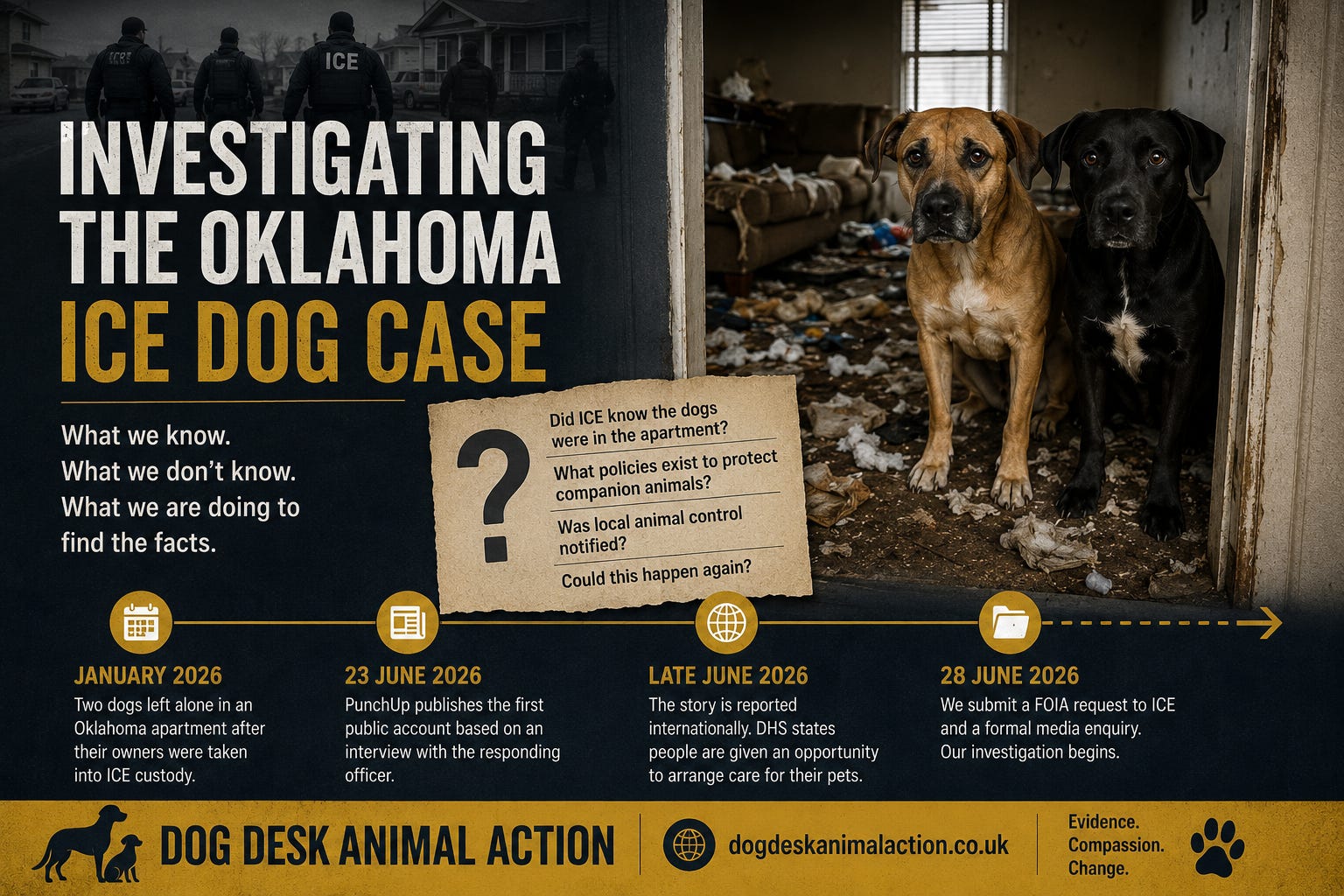
In January 2026, two dogs were left alone inside an apartment in Oklahoma after their owners were taken into custody during an immigration enforcement operation carried out by U.S. Immigration and Customs Enforcement (ICE).
According to reports published several months later, the dogs remained inside the property for approximately one week before neighbours became concerned and local animal welfare officers entered the apartment. The dogs were found alive and taken into shelter care.
Those are the central facts currently in the public domain. Beyond that, however, significant questions remain unanswered.
The incident itself did not become widely known until 23 June 2026, when PunchUp published an interview with the responding animal welfare officer. The story was subsequently reported by The Daily Beast and The Independent, bringing international attention to the welfare of the two dogs and prompting questions about what procedures exist to protect companion animals when their owners are unexpectedly removed from their homes.
For Dog Desk Animal Action, those questions extend far beyond this single case.
Our objective is not simply to understand what happened in Oklahoma. It is to establish whether the systems intended to protect companion animals in these situations are robust enough to prevent it happening again.
Immigration enforcement officers are not animal welfare professionals, but they may enter homes where dogs, cats or other companion animals are present. If an owner is detained and is unable to make arrangements for their animals, the welfare of those animals may depend entirely upon the procedures followed by the attending officers.
A clear policy can help ensure companion animals are identified, appropriate enquiries are made before officers leave a property, and local animal welfare agencies are notified where necessary. Without clear procedures, there is a greater risk that animals may remain undiscovered until neighbours, landlords or members of the public realise something is wrong.
Following publication of the Oklahoma case, the U.S. Department of Homeland Security stated that individuals taken into ICE custody are given an opportunity to arrange care for their pets by contacting relatives, neighbours or friends. The department also stated that ICE does not take custody of personal property, including companion animals.
However, during our research, Dog Desk Animal Action has been unable to identify any publicly available ICE operational policy, directive or guidance specifically addressing companion animals left inside private homes during enforcement operations. We have also been unable to identify any publicly available policy requiring officers to establish whether companion animals remain inside a property or requiring notification of local animal welfare authorities where animals may be left unattended.
That does not necessarily mean such policies do not exist. It simply means we have been unable to locate them within the material currently available to the public. Establishing whether such policies exist, and understanding how they operate in practice, has therefore become a central part of our investigation.
As an organisation committed to evidence based reporting, we believe it is important to establish the facts rather than rely on speculation.
For that reason, Dog Desk Animal Action has submitted a request under the United States Freedom of Information Act seeking copies of any ICE policies, operational guidance and training materials relating to companion animals during enforcement operations. We have also requested information about any policy reviews or procedural changes that may have followed the Oklahoma incident.
At the same time, we have submitted a formal media enquiry to ICE’s Office of Public Affairs asking the agency to clarify several key questions. These include whether officers are required to ask if companion animals remain inside a property, whether local animal control agencies must be notified when animals may be left unattended, whether a written policy exists governing these situations and, if so, whether it can be made publicly available.
As part of our investigation, we have also attempted to identify the local animal welfare agency that rescued the dogs. At the time of writing, that information has not been made public. The responding officer chose not to identify himself or his agency publicly, and none of the published reports identifies the city or local authority involved. As a result, we are currently unable to obtain the incident report directly from the responding agency. We will continue our efforts to establish those facts.
Timeline
January 2026
Two dogs are reportedly left inside an Oklahoma apartment after their owners are detained during an ICE enforcement operation. According to published reports, the dogs remain alone for approximately one week before neighbours raise concerns and local animal welfare officers rescue them.
23 June 2026
PunchUp publishes the first public account of the incident based on an interview with the responding animal welfare officer.
Late June 2026
The Daily Beast and The Independent report the story. The Department of Homeland Security states that individuals taken into custody are given an opportunity to arrange care for their pets but does not identify a publicly available written policy governing these situations.
28 June 2026
Dog Desk Animal Action submits a Freedom of Information Act request to ICE seeking policy documents and records relating to companion animals during enforcement operations. A formal media enquiry is also submitted requesting clarification of ICE procedures. Research also begins to identify the responding animal welfare agency and obtain the relevant incident records.
This investigation is not an examination of immigration policy. It is an examination of animal welfare policy.
The circumstances that lead to someone being unexpectedly removed from their home can vary enormously. It may be an immigration enforcement operation, a police arrest, a medical emergency or another unforeseen event. Whatever the reason, companion animals remain entirely dependent on people recognising that they are there and ensuring they are not forgotten.
The Oklahoma case has highlighted an important question that extends well beyond a single apartment or a single pair of dogs. Our aim is to establish what systems are in place to protect companion animals in these situations, whether those systems are working as intended and, where appropriate, whether improvements should be considered.
As further information becomes available, including any response from ICE or records released under the Freedom of Information Act, we will update our reporting accordingly.


