

Content warning: This article discusses animal deaths and contains descriptions of distressing footage.
There are puppies among the remains of dead dogs in an open pit in Kaynarca, Sakarya. Inside a municipal animal holding facility, the bodies of dogs lie across the ground while surviving animals remain in the same enclosure. These are the images now emerging from Türkiye, and they are utterly appalling.
These dogs were taken into municipal custody under a system that was supposed to provide for their welfare. Once removed from the streets, they became entirely dependent upon the institution holding them for their food, water, veterinary treatment, safety and survival. They had no means of escaping their circumstances and no ability to seek help. At least twenty of them are now dead, and there are deeply disturbing allegations that the true number could be considerably higher.
Video credit: Doğa Hayvan Koruma Kolektifi Instagram
The emerging scale of the deaths
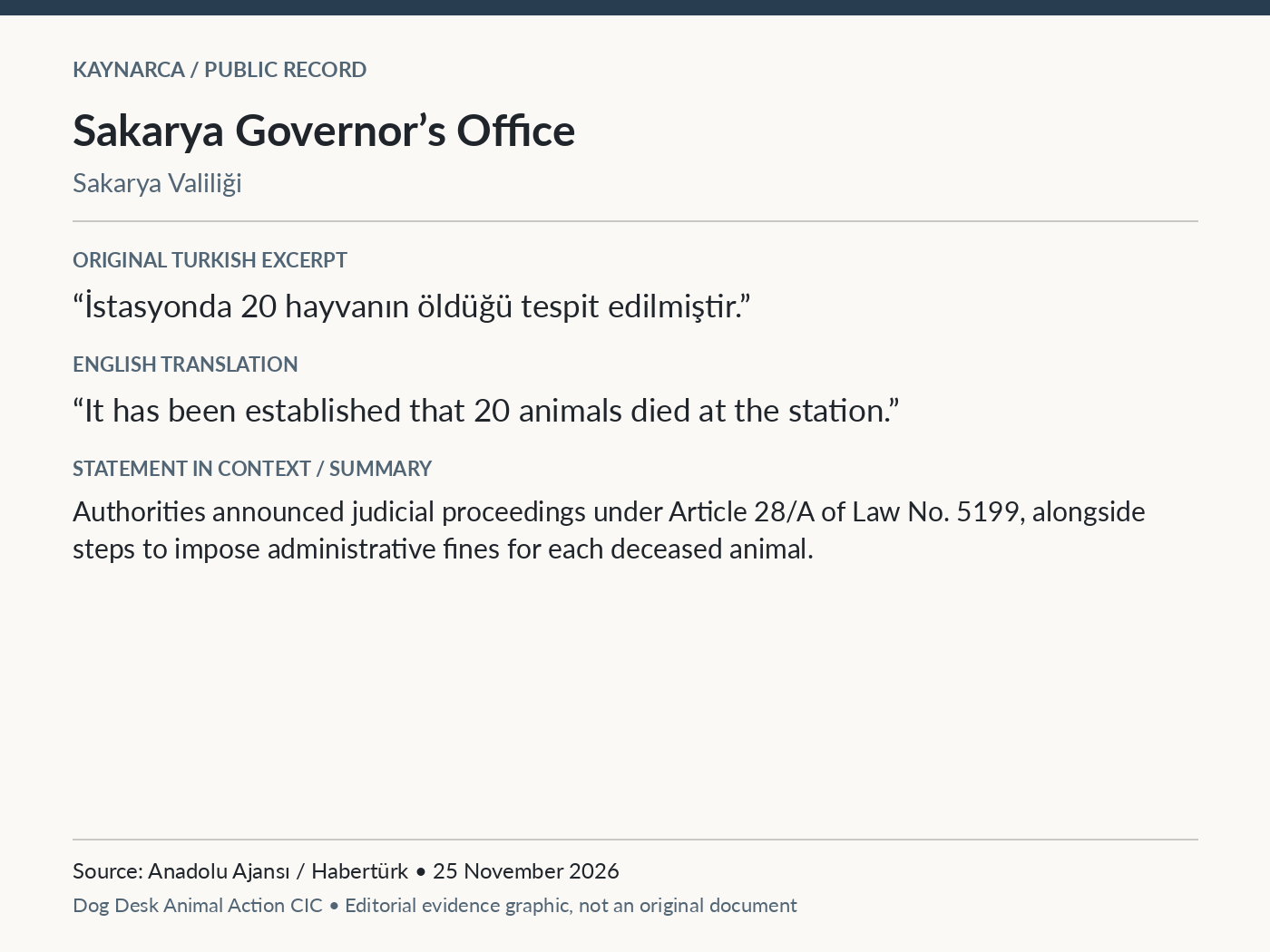
On 26 November 2026, the Sakarya Governor’s Office officially confirmed the deaths of 20 animals at the Kaynarca municipal temporary animal holding facility. Judicial and administrative proceedings have been initiated, including proceedings under Article 28/A of Animal Protection Law No. 5199, and administrative penalties against the municipality are being pursued in relation to the confirmed deaths. The veterinary surgeon responsible for the facility and two shelter employees have reportedly been detained.
However, discrepancies are already emerging in the published figures. Local reporting has placed the number of dead dogs at 23, while animal protection advocates have alleged that approximately 60 animals were killed. Further allegations circulating on social media suggest that the bodies of 30 dogs were intercepted before they could be buried.
The higher figures have not been independently established, and it is unclear whether they refer to overlapping groups of animals. Nevertheless, the footage emerging from Kaynarca, together with allegations of multiple burial sites and previous deaths at the facility, raises the horrifying possibility that the officially acknowledged death toll represents only part of a much larger tragedy.
Twenty dead dogs in municipal custody is already an appalling failure of animal protection. We should not need to discover dozens more bodies before the gravity of what has happened is recognised.
Puppies among the dead
Dog Desk Animal Action has examined footage attributed to Doğa Hayvan Koruma Kolektifi, the Nature and Animal Protection Collective, which identifies the location as Kaynarca Municipality. The recording shows numerous apparently dead dogs lying inside an enclosure, areas of disturbed earth near the perimeter of the facility and an open excavation containing apparent animal remains, including puppies, alongside discarded rubbish.
Among the most distressing scenes are those showing living dogs in close proximity to the bodies of other animals. The person filming describes the excavation as one of the death pits and alleges that this is not the first such incident involving the municipality.
Although the footage alone cannot establish the total number of animals buried, the cause of their deaths or how long the alleged burial sites have been used, what is visible is profoundly disturbing. These were living, sentient animals, not disposable products of a municipal population management programme. The puppies seen among the apparent remains had barely begun their lives.
There is something particularly abhorrent about animals being removed from their communities, placed behind municipal fences and subsequently discovered in circumstances such as these. Whatever protection they might once have received from the people who fed them, cared for them and knew them individually was lost when they entered municipal custody. The institution that assumed responsibility for their lives had an obligation to protect them.
Allegations that dogs were killed by injection
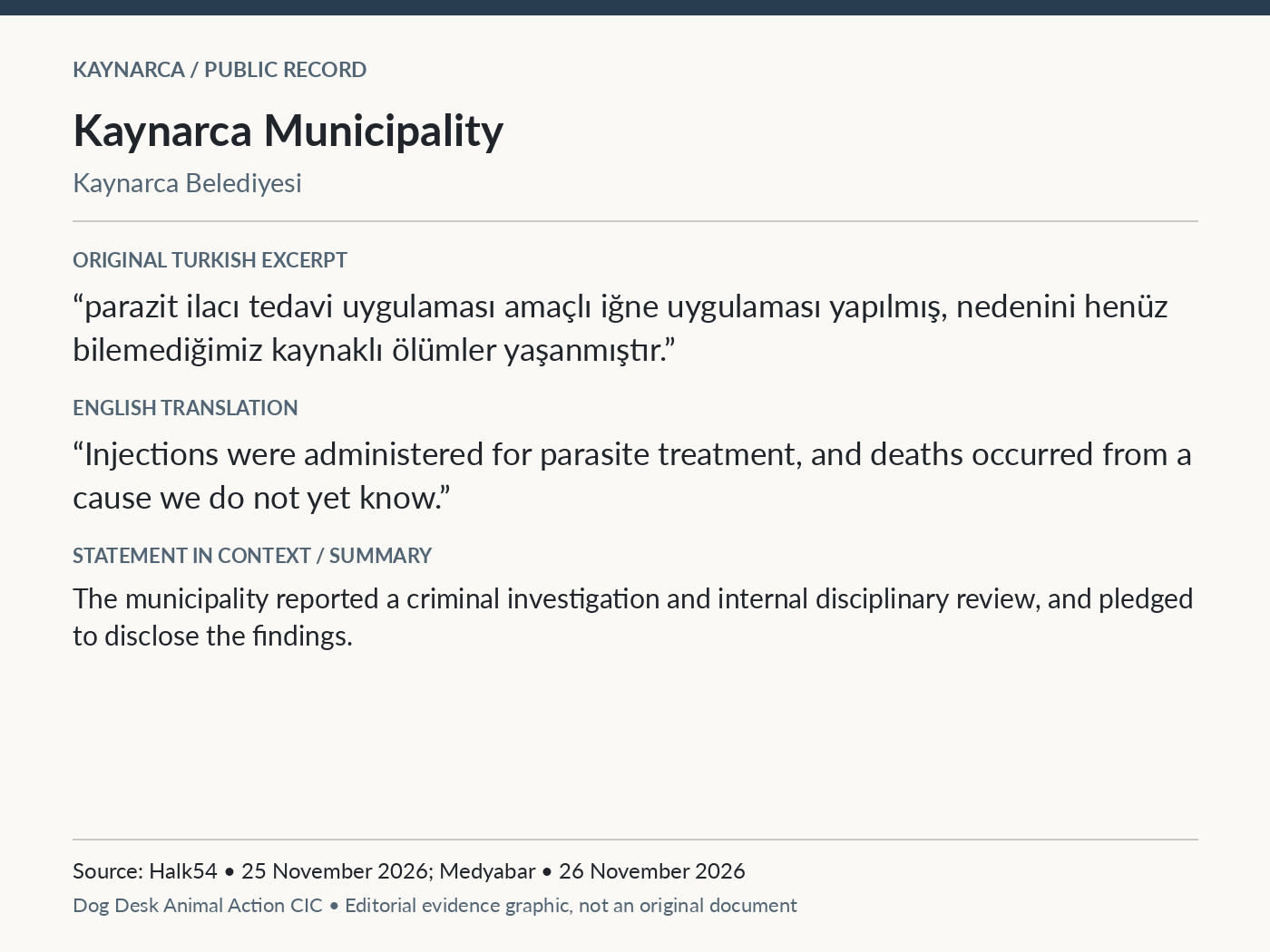
Animal rights lawyer Kübra Oktay has publicly alleged that dogs at the Kaynarca facility were killed through the administration of anaesthetic substances. Kaynarca Municipality has offered a different account, acknowledging that injections were administered but maintaining that they were intended as parasite treatment. The municipality has stated that the cause of the subsequent deaths was unknown.
The possibility of a veterinary drug error has also been raised, and samples have reportedly been sent to Ankara for examination. At the time of publication, Dog Desk Animal Action has not located forensic findings establishing which substances were administered or whether the deaths resulted from deliberate killing, a medication error or another cause.
The circumstances surrounding the administration of these substances are central to establishing what happened and where responsibility lies. What is already established, however, is that at least 20 animals died while under municipal protection, and the allegations emerging from the facility extend considerably beyond those deaths.
The conflicting explanations must not overshadow the animals themselves or the wider concerns surrounding their treatment, the conditions in which they were held and the handling of their remains.
What lies beneath the ground at Kaynarca?
Animal protection advocates have described multiple areas of excavated ground around the facility, and footage circulating publicly appears to show animal remains within an open pit. There are also allegations that vehicles were removing dead animals as volunteers entered the premises.
Reports indicate that dogs whose deaths were identified during the current incident have subsequently been buried. The available public record does not establish whether every body was individually identified, whether independent post-mortem examinations were conducted before burial or whether sufficient biological samples were retained for forensic examination.
Of particular concern is the possibility that the alleged burial sites contain animals that died before the events of this week. If the accounts of previous deaths are substantiated, the ground surrounding this facility could hold evidence of a much longer history of animal suffering.
Without establishing the number of animals buried, the dates and circumstances of their deaths and their identities, it is impossible to determine the true scale of what has happened at Kaynarca. The existence of an officially acknowledged death toll does not establish that every deceased animal has been accounted for.
How many dogs lie beneath the ground, and how long have animals been dying at this facility?
Allegations of previous deaths and ignored warnings
Perhaps one of the most disturbing aspects of this case is the allegation that concerns about deaths at the Kaynarca facility had been raised before.
Yasin Yılmaz, president of the street animal protection organisation SOHAYKO, has alleged that animal protection advocates previously documented deaths at the facility, brought evidence into the public domain and raised concerns that were not adequately addressed. He has also alleged that earlier incidents were concealed. Animal rights lawyer Kübra Oktay has similarly referred to previous complaints concerning deaths at the establishment.
Dog Desk Animal Action has not yet located the original historical complaints or inspection records necessary to independently substantiate these allegations. However, the possibility that serious concerns were raised before the deaths now being investigated cannot be overlooked.
If animals continued to be admitted to the facility after earlier welfare concerns had been identified, it would raise profound questions about the effectiveness of the inspection and regulatory mechanisms intended to protect them. It would also raise questions about how many dogs were subsequently exposed to potentially dangerous conditions and whether opportunities to prevent further suffering were missed.
Municipalities cannot reasonably be entrusted with the lives of thousands of animals without effective mechanisms for identifying and responding to welfare failures. The consequences of inadequate oversight are borne not by the institutions responsible for administering these programmes, but by the animals trapped within them.
Hundreds of surviving dogs are being moved
The Kaynarca facility is now being evacuated, with surviving dogs being transferred to the Sakarya Metropolitan Municipality Natural Life Campus in Karakamış, Adapazarı. Discrepancies have emerged in the reported number of animals involved, with some accounts referring to 334 dogs for transfer and others identifying 334 animals in total, including 23 deceased dogs, leaving 311 survivors.
There have also been reports of fencing being removed during the evacuation, resulting in dogs leaving the facility. Although animals have reportedly begun arriving at the receiving establishment, Dog Desk Animal Action has not located a complete individual transfer register or a final reconciliation establishing the whereabouts of every surviving dog.
The evacuation of Kaynarca must not be mistaken for the resolution of what has happened there. Moving hundreds of dogs from one municipal institution to another does not establish their safety, nor does it provide an account of the animals previously admitted to the facility.
Every dog entering municipal custody should have an individual record documenting their admission, veterinary treatment, movements and eventual outcome. Without that information, it becomes extraordinarily difficult to establish whether animals have been transferred, adopted, released, lost or killed.
This is precisely why traceability is such a fundamental component of animal protection. Animals should never be allowed to disappear within a publicly administered system.
Would these deaths have become public without the intervention of volunteers?
The published chronology indicates that judicial and administrative intervention followed the circulation of images showing dead dogs at the Kaynarca facility. It is not clear from the available public record whether the deaths had already been identified and reported through an established system of municipal oversight.
It is deeply concerning that animal protection advocates continue to be the people discovering and documenting the suffering of animals held within municipal establishments. Volunteers should not have to find bodies, film apparent burial pits or expose appalling conditions before the welfare of animals in public custody receives attention.
A properly functioning animal welfare system would have mechanisms capable of identifying unexplained mortality, investigating unusual patterns of deaths and intervening before further animals were placed at risk. It would not depend upon distressing footage reaching social media before serious concerns became publicly known.
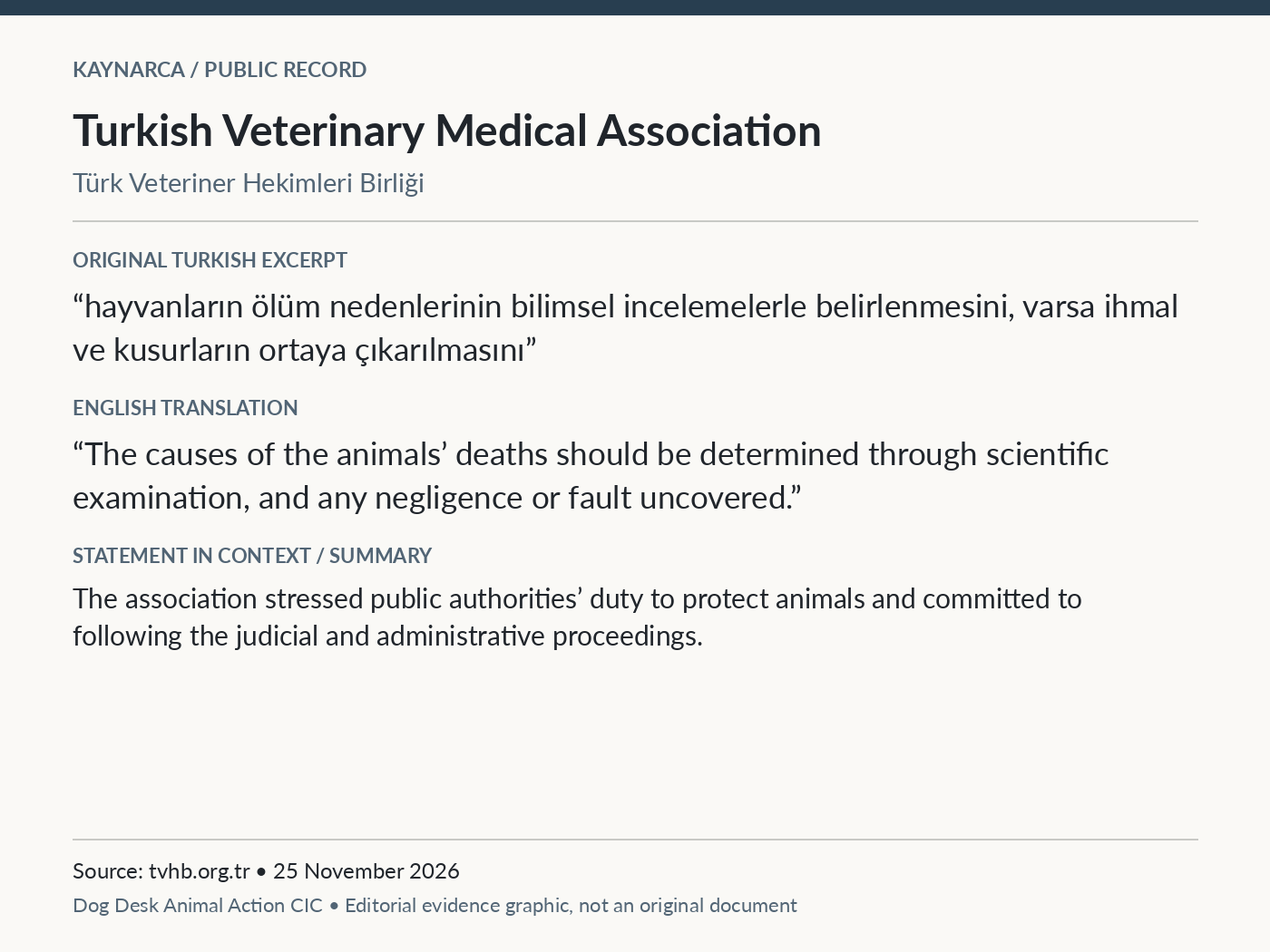
On 25 November, the Turkish Veterinary Medical Association issued a statement emphasising the responsibility of public institutions and local authorities to protect the lives, health and welfare of animals in their custody. The association called for the causes of death to be scientifically established, potential negligence or wrongdoing identified and appropriate legal proceedings undertaken. It also indicated that it would follow the investigations.
The intervention of the veterinary profession is significant, particularly given the conflicting accounts concerning the administration of veterinary substances. Scientific evidence will be essential in establishing what happened to these animals, but the wider failures of animal protection and institutional oversight also deserve considerable scrutiny.
Removing dogs from the streets is not protecting them
Since the introduction of Law No. 7527 in 2024, Türkiye’s municipalities have been required to remove street dogs under a legislative framework that has fundamentally changed the country’s approach to free-roaming animals.
Dog Desk Animal Action has repeatedly highlighted the dangers of removing large numbers of dogs from their communities without sufficient welfare infrastructure, veterinary capacity, independent oversight and transparent systems of individual animal traceability. The events emerging from Kaynarca demonstrate precisely why the disappearance of dogs from public spaces must never be presented as evidence of successful animal population management.
A street from which dogs have been removed tells us nothing about whether those animals are still alive. Collection figures tell us nothing about the conditions in which dogs are subsequently held, the veterinary treatment they receive or the number that die after entering municipal custody. Without meaningful reporting of individual outcomes, collection statistics provide an extraordinarily incomplete picture of what is happening to Türkiye’s dogs.
When governments and municipalities measure success primarily through the number of animals removed from the streets, the welfare of those animals risks becoming secondary to the achievement of numerical targets. The dogs themselves become increasingly invisible, and establishing what has happened to them becomes progressively more difficult.
The animals of Kaynarca were entitled to protection regardless of whether they had owners, lived on the streets or had been collected under government legislation. Their lives were no less valuable because they were street dogs, and their suffering cannot be justified as an inevitable consequence of population management.
Türkiye remains in crisis
Türkiye remains classified as CRISIS on Dog Desk Animal Action’s Global Stray Dog Crisis Map, which monitors legislative developments, municipal population management practices, documented welfare incidents and the treatment of free-roaming dogs around the world.
Only yesterday, we published a separate investigation into allegations emerging from Hatay, where dogs removed from the streets were allegedly killed because the financial cost of keeping them alive was considered too great. Those allegations concern a different municipality and must be considered separately from the deaths at Kaynarca. However, both cases raise serious concerns about the fate of dogs after they are taken into municipal custody.
The international community must look beyond the collection of street dogs and consider what happens to those animals afterwards. The removal of animals from public spaces does not end a municipality’s responsibility towards them. It increases it.
Explore Dog Desk Animal Action’s Global Stray Dog Crisis Map and ongoing reporting
Read our investigation into the allegations emerging from Hatay
We must never become accustomed to this
There is a very real danger that the frequency with which disturbing images emerge from Türkiye will gradually desensitise the international community to the suffering of its street dogs. Another shelter, another collection operation, another group of dead animals, another investigation and another set of allegations that eventually disappear from public attention.
We must never allow this to become normal.
The dogs whose bodies have been discovered at Kaynarca were individuals with their own personalities, relationships and experiences. Many will have known the kindness of people within the communities from which they were removed. Some will have spent their lives alongside other dogs with whom they had formed close social bonds. The puppies had scarcely begun to experience the world before their lives ended.
Their deaths are not simply figures in an administrative investigation. They represent the loss of individual lives that a public institution had assumed responsibility for protecting.
Dog Desk Animal Action unequivocally rejects the suffering and destruction of street dogs as a means of managing their populations. Humane, evidence-based alternatives exist, including sustained sterilisation and vaccination programmes, responsible ownership, abandonment prevention and properly regulated animal welfare services.
There is no acceptable justification for treating sentient animals as disposable, and there can be no meaningful claim of successful population management when the fate of the animals removed remains unknown.
Stand with Türkiye’s dogs
More than 12,000 people have already signed Dog Desk Animal Action’s petition calling for humane reform of Türkiye’s approach to street dog population management. We continue to oppose legislation and practices that expose street dogs to suffering and destruction, and to advocate for humane, sustainable alternatives that protect both animals and communities.
The events emerging from Kaynarca are yet another devastating reminder of why this campaign remains so important. If you have already signed our petition, please share it again. If you have not yet signed, please add your voice and help us ensure that the international community does not turn away from the suffering of Türkiye’s dogs.
SIGN AND SHARE — Protect Stray Dogs in Turkey Through Humane Reform
Please share this investigation and help bring international attention to what is emerging from Kaynarca. These dogs were removed from public view, but their lives and the circumstances surrounding their deaths must not be forgotten.
At least twenty dogs are officially confirmed dead. There are allegations of dozens more killed, footage of apparent burial pits containing animal remains and accounts of previous deaths at the same facility.
How many dogs lie buried in Kaynarca, and how many more across Türkiye have suffered a similar fate without anyone ever knowing?
Sources and supporting evidence
Governor’s Office announcement and judicial proceedings — 26 November 2026
Kaynarca Municipality’s statement concerning the deaths — 25 November 2026
Turkish Veterinary Medical Association statement — 25 November 2026
Reporting concerning allegations of 60 deaths and previous incidents
Social media documentation and allegations of additional deaths
Dog Desk Animal Action CIC continues to monitor developments through publicly available evidence, official announcements and independent reporting.