

Do Kennel Free Dogs Fight? What Honest Rescue Looks Like When Dogs Live Together

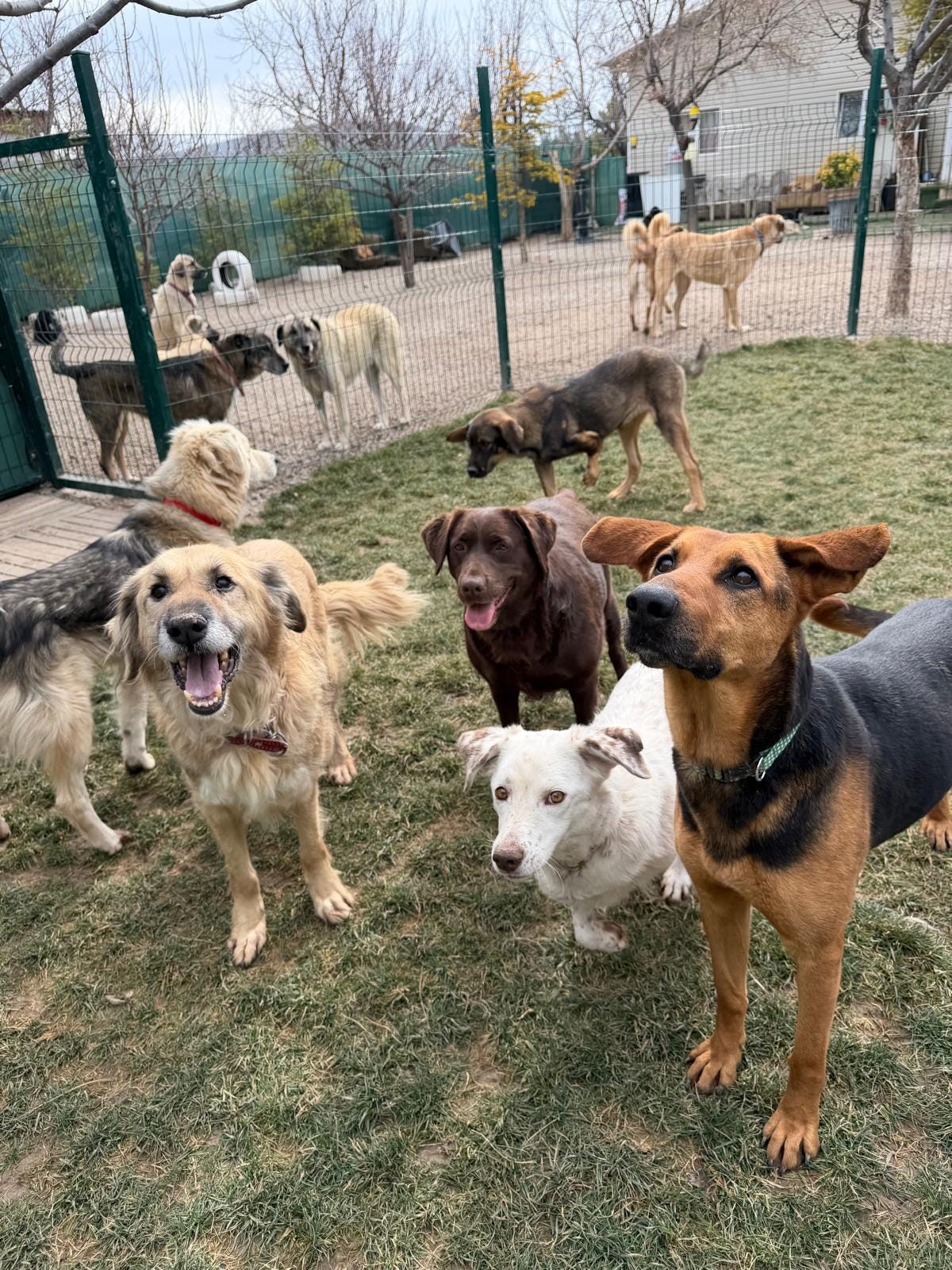
It is a question we are sometimes asked usually with concern, sometimes with scepticism:
If the dogs are not confined to kennels, if they move freely, if they live as a group
Do they ever fight?
The honest answer is simple. Yes. Sometimes they do.
And that is precisely why pack management matters.
The Reality of Dogs Living as a Group
When dogs are allowed to live in a shared environment, they are not stepping into a controlled, artificial system. They are entering a social structure.
Dogs communicate. Dogs establish boundaries. Dogs form preferences, alliances, and distances.
And occasionally, dogs disagree. This is not failure. It is behaviour.
The idea that dogs can be placed together with no risk of conflict is not grounded in reality. Equally, the idea that the only solution is permanent confinement is a failure of imagination and of understanding.
Why Conflict Happens
Conflict between dogs does not appear without reason. It is usually linked to:
Uncertainty in a new environment
Competition over space, food, or attention
Differences in temperament or past experience
Stress during transition periods
Misreading of signals between unfamiliar dogs
Many of the dogs arriving into sanctuary have lived through instability, street life, abandonment, or time in high-stress shelters. They do not arrive as a balanced, ready-made group.
They arrive as individuals.
What Responsible Sanctuary Management Looks Like
Allowing dogs to live freely does not mean allowing chaos. In a well-managed sanctuary, freedom is structured, not reckless.
At Dog Desk Animal Action, this means:
Controlled Introductions
New dogs are never immediately placed into the main group.
They are first housed in a private kennel space, where they can:
Decompress from transport and change
Be observed for behaviour and health
Gradually become familiar with the environment
Introductions are then done slowly and intentionally, often beginning with one or two compatible dogs.
Careful Observation
Dogs are not left to work it out. Their interactions are monitored closely:
Body language is assessed
Early signs of tension are recognised
Intervention happens before escalation
This is skilled, continuous work not passive oversight.
Group Management
Not every dog suits every group.
Some dogs:
Prefer smaller social circles
Need distance from certain personalities
Require longer integration periods
Management may include separating individuals, adjusting groupings, or creating quieter spaces.
Understanding the Individual Dog
Every decision is made with the individual dog in mind. There is no one-size-fits-all approach. A confident, social street dog may integrate quickly.
A dog coming from confinement or trauma may need time, space, and a far more gradual process.
Why No Fighting Ever Is the Wrong Benchmark
A system that claims dogs never disagree is not necessarily a better system.
In many cases, it simply means:
Dogs are isolated
Movement is restricted
Social interaction is minimised
This may reduce visible conflict, but it also removes:
Choice
Social learning
Natural behaviour
The goal is not to eliminate all possibility of conflict.
The goal is to manage it responsibly while allowing dogs to live meaningful lives.
Risk, Responsibility, and Reality
There is always risk when living beings share space. What matters is how that risk is understood and managed.
At Dog Desk Animal Action, we do not present sanctuary life as perfect or without challenge.
We present it as:
Structured
Observed
Responsive
Grounded in real canine behaviour
Because honesty is part of responsibility.
The Bigger Question
Perhaps the question is not:
Do they ever fight?
But instead:
What kind of life are we offering dogs if they never get to be dogs at all?
A life behind concrete barriers may reduce conflict. But it also removes freedom, choice, and social connection.
Sanctuary work exists in that space between safety and life itself. And getting that balance right is where the real work happens.