


India
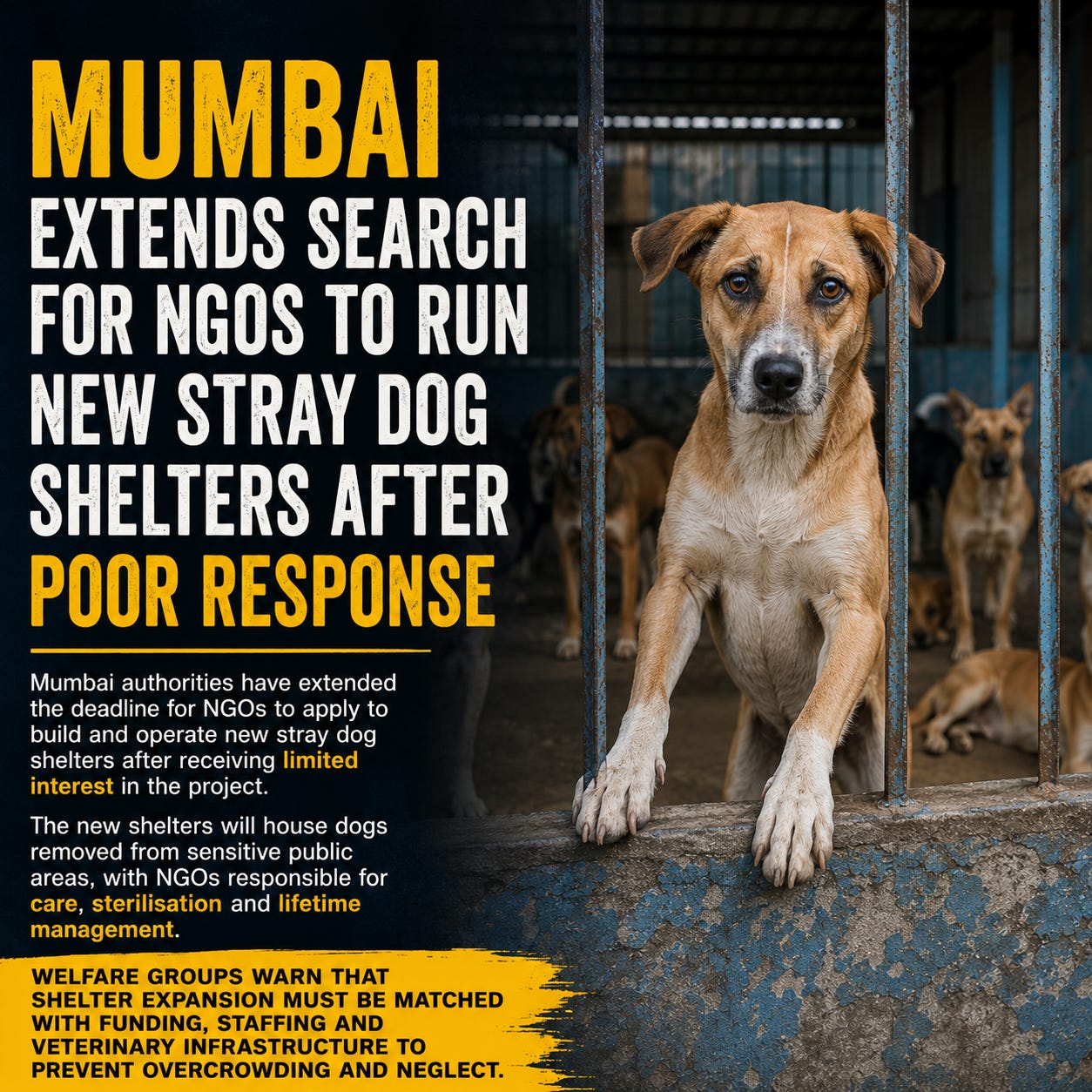
Mumbai Extends Search For NGOs To Run New Stray Dog Shelters After Poor Response
Mumbai authorities have extended the deadline for NGOs to apply to build and operate new stray dog shelters after receiving limited interest in the project. The Brihanmumbai Municipal Corporation plans to create multiple long-term dog facilities under a Design-Build-Operate-Transfer model following increasing pressure linked to India’s escalating stray dog debate.
The proposed shelters would house dogs removed from areas around hospitals, schools and transport hubs following recent Supreme Court directives prioritising public safety. NGOs selected for the scheme would be responsible for food, veterinary treatment, sterilisation and lifetime care for dogs unable to be returned to the streets.
The weak response from organisations has already triggered questions about whether cities can realistically scale up long-term shelter systems at the pace now being demanded. Animal welfare groups continue warning that shelter expansion without sufficient funding, staffing and veterinary infrastructure risks creating overcrowding and welfare deterioration behind closed doors.
Turkey
Interior Minister Says All Remaining Street Dogs Will Be Removed By October
Turkey’s Interior Minister Mustafa Çiftçi stated this month that all remaining street dogs across the country are expected to be removed from public areas by October 2026. Speaking about the implementation of the new stray dog law, Çiftçi claimed that around 80% of the country’s free-roaming dogs have already been collected.
Animal welfare groups continue questioning how municipalities will safely house, monitor and provide veterinary care for such large numbers of dogs, particularly in provinces where shelter infrastructure remains severely limited.
Turkey
Istanbul Governor Says 46% Of Dogs Already Collected
Istanbul Governor Davut Gül announced that 46% of the city’s street animals have now been collected under the nationwide implementation of Turkey’s new dog law. He also stated that authorities aim to ensure “not a single stray dog remains on the streets.”
The statement has intensified fears among welfare advocates who warn that rapid removals without transparent oversight risk worsening conditions behind shelter walls while making independent monitoring increasingly difficult.
Turkey
Animal Welfare Protesters Warn Turkey’s Dog Policy Is Creating Social Division
Demonstrators protesting Turkey’s stray dog law this month warned that escalating hostility toward free-roaming animals risks deepening social tensions throughout the country. Activists argued that violence against animals should not become normalised under the pressure of political rhetoric and public fear.
The protests reflect growing concern among campaigners that the debate surrounding street dogs is increasingly moving beyond animal welfare alone and becoming part of a wider discussion about ethics, governance and social psychology.
Pakistan
Lahore Dog Killings Spark Renewed Anger In Pakistan
Animal welfare activists in Lahore have again criticised dog culling operations after reports emerged alleging the use of poisoning and inhumane killing methods despite existing court opposition to indiscriminate culling.
Campaigners continue calling for Punjab authorities to fully implement sterilisation and vaccination programmes already outlined in provincial policy frameworks instead of relying on reactive killing campaigns.
Morocco
Continuing International Criticism Ahead Of 2030 World Cup
International animal welfare organisations continue criticising Morocco over allegations of large-scale street dog killings linked to preparations for the 2030 FIFA World Cup. Campaigners argue that image management and tourism concerns are increasingly shaping dog population policies.
Moroccan authorities continue publicly promoting vaccination and sterilisation initiatives, while welfare groups insist that humane long-term population management requires transparent TNVR infrastructure rather than mass removals.
Global
Rabies Debate Continues As Welfare Groups Push Back Against Culling
International debate surrounding rabies control strategies continues to intensify as welfare organisations increasingly challenge dog culling as a public health solution. Campaigners continue arguing that sustained vaccination coverage, public education and sterilisation programmes remain the most evidence-supported long-term approaches to reducing rabies transmission.
The discussion is becoming increasingly global as governments face growing pressure to balance public health concerns, tourism, politics and animal welfare within rapidly changing urban environments.
End of Bulletin