
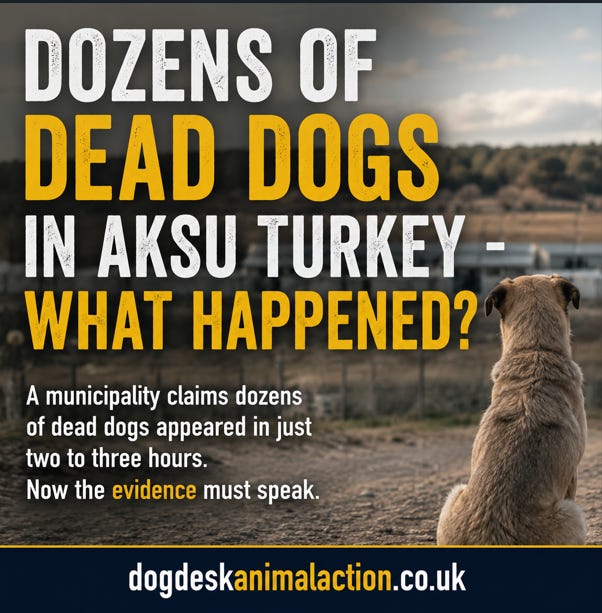
A few days ago horrifying images emerged from Aksu in Antalya, where dozens of dead dogs were discovered in pits close to the municipal animal shelter. Understandably there was outrage, there were accusations and there were immediate demands for answers about who these dogs were, how they had died and why so many of them had ended up buried in this place.
We now have something of an explanation, although importantly it has not come in the form of a formal public statement from Aksu Municipality that we have been able to find. Instead, Akdeniz Gerçek has spoken to an unnamed Aksu Municipality official and what that official told the newspaper is extraordinary.
According to the account given to Akdeniz Gerçek, only eight dogs had died at the shelter during the previous week. Four had reportedly been injured in road traffic accidents and four had died from illness. The official says there are records for all of them and that animals buried by the municipality are documented, with paperwork signed by a veterinarian and municipal police.
But the official says the far greater number of dogs subsequently discovered did not come from the municipality at all.
The claim being made is that municipal workers were at the burial area at around 9am and that when the area was seen again just two or three hours later there were suddenly somewhere between 40 and 50 dead dogs in the pit. The suggestion is that somebody else had brought those dogs there and that the municipality was being deliberately targeted.
That is an incredibly serious allegation, but it is also one that should be possible to investigate because if somebody really did move 40 or 50 dead dogs onto municipal land within the space of just two or three hours, they had to come from somewhere.
Somebody would have needed access to an extraordinary number of dead animals. Those dogs would have had to be collected, loaded into a vehicle, transported to the burial area, unloaded and placed into the pit. This is not something that could easily be done without leaving some sort of trail, particularly when we are being given such a narrow period in which it supposedly happened.
The official told Akdeniz Gerçek that police are examining CCTV and that could be enormously important. If a vehicle arrived carrying dozens of dead dogs during that period, can it be seen? Which roads lead to the burial area? Are there cameras on those roads? Can a registration number be identified? Were there witnesses? Were there tyre tracks or other evidence at the scene? If the municipality really has been the victim of an attempt to manufacture evidence against it, then finding out who brought those dogs there should be every bit as important as establishing how the dogs died.
There is also an important distinction in the account given to the newspaper about exactly where the dogs were found. We are told that the location where the footage was recorded is outside the physical boundary of the shelter, but according to the same account this is municipal land being used for the burial of animals, with the location apparently agreed with the relevant authorities. That means we need to be careful about how this is described. The dogs may have been found outside the shelter boundary, but they were not simply found on some unrelated piece of land miles away. They were found at an area being used for animal burial.
That makes the records the official says exist particularly important. If the municipality can document the eight dogs it says died during the previous week, those records should help establish which animals were legitimately taken to the burial site and when. Those dogs should have histories. There should be information about when they entered municipal care, what happened to them, why they died and when their bodies were taken for burial.
Then we need to know who all the other dogs were.
Earlier reporting from Antalya Kent Haber on 10 August described more than one pit in the area. Animal advocates said one pit was already closed while another remained open, and they claimed that some animals appeared to have been placed there recently while others had been there considerably longer and were decomposing in the heat. The same report included claims that some of the dogs did not have microchips.
None of that proves that Aksu Municipality killed these dogs and we should be very clear about that. But it does create questions that need to be reconciled with the account now given by the unnamed municipal official. If 40 or 50 dogs appeared during a period of only two or three hours, what about the dogs reportedly already decomposing? How many pits were actually there? How long had each pit been used? How many dogs were recovered from each one and which of those dogs correspond with the municipality’s own burial records?
These are not unreasonable questions and asking them is not the same as deciding who is guilty.
The dogs themselves may also provide some of the answers. The municipal official says samples were taken by Agriculture Directorate personnel and reportedly argues that the condition of the bodies suggested the dogs had died recently because they were not swollen or decomposed. That is something for appropriate veterinary or forensic examination to determine rather than something that should be decided from photographs or appearances alone.
Every one of those dogs should also be scanned for a microchip. Where chips are present, their records may help establish where the dogs came from, where they had previously been registered and whether they had passed through a municipal system before their deaths. If some of the dogs were not chipped, that needs to be recorded too. The important thing is that these animals are not allowed to disappear into the description of “40 or 50 dogs” when each individual body may hold information capable of helping investigators establish what happened.
The unnamed official speaking to Akdeniz Gerçek reportedly believes that the municipality has been deliberately targeted and that the incident was intended to damage its reputation and obstruct its shelter project. If that is true, it is an extremely serious matter in its own right. Somebody acquiring dozens of dead dogs and transporting them to an official animal burial area in order to create the appearance of wrongdoing would require a serious investigation.
But we cannot replace one assumption with another.
When images such as these appear online it is very easy for people to decide immediately what they are looking at and who must be responsible. It is equally easy for an institutional explanation to be repeated as though that explanation settles the matter. Neither approach gets us any closer to knowing what actually happened to these dogs.
What we have now is something much more useful. We have claims that can be tested against evidence.
If municipal workers really were at the burial area at around 9am and dozens of dead dogs arrived within the following two or three hours, investigators have a remarkably narrow window to examine. If the municipality has records for every animal it buried there, those records can be compared with the dogs found. If CCTV exists, it can be examined. If the bodies have been preserved and properly investigated, they can be scanned for microchips and examined for evidence about when and how they died. If vehicles entered the area, there may be a way of identifying them.
We do not need to guess.
If somebody brought dozens of dead dogs to that burial area in an attempt to frame Aksu Municipality, the evidence should be followed until those responsible are identified. If that explanation does not stand up to scrutiny, then that matters just as much and the investigation needs to establish where these dogs actually came from and what happened to them.
At the moment we have horrific images, allegations from animal advocates and a detailed account attributed to an unnamed municipal official. What we have not found is a formal public statement from Aksu Municipality setting out its position and presenting the evidence supporting it.
There are dozens of dead dogs at the centre of all of this and somewhere there is an explanation for how they came to be there.
Those dogs cannot tell us what happened, that is why the evidence has to.


People who do this to dogs, the very animals that give their trust and loyalty to humans, really need to be apprehended. If it were up to me, those who killed them would be joining them in the burial pits.someone has to be the poor dogs voices.