
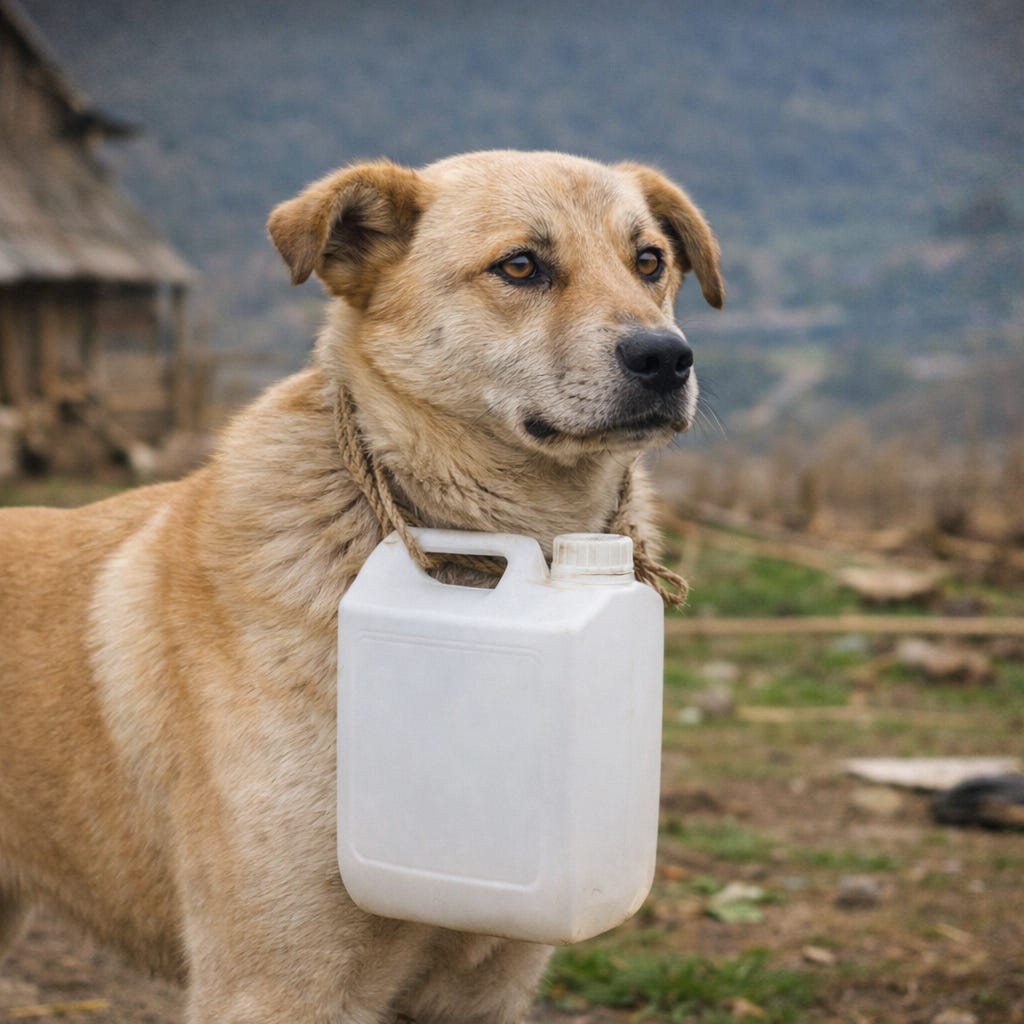
There are images that circulate online from time to time that stop people in their tracks. A dog standing in a field with a crude plastic bottle tied around its neck.
For many of us in the UK, it feels shocking. Unthinkable, even. But before we react, we need to understand.
What You’re Seeing and Why It Happens
In documented cases across parts of the world, bottles (or other objects) have been tied around a dog’s neck as a form of restraint. Not in the way we might expect, not as punishment in the conventional sense but as a physical limitation.
The intention is usually simple, to stop the dog from:
jumping fences
squeezing through gaps
chasing livestock
roaming too far
The bottle acts as a crude barrier. It catches on openings. It makes movement awkward. It slows the dog down. It is not humane. But it is not always done with cruelty as the primary motive.
And that distinction matters if we actually want to change it.
A Familiar Concept Just in a Different Form
To understand this properly, we have to acknowledge something uncomfortable, this idea is not entirely foreign.
Across many rural communities globally, variations of this method have existed for decades. You will see:
Wooden crosspieces attached to livestock guardian dogs
Makeshift anti-escape devices
Physical deterrents used where fencing is weak or non-existent
These are not modern, welfare-led solutions. They are improvised responses to real-world constraints.
The Reality Behind It
In many of these environments, the people involved are not working with the choices we assume they have. They may not have:
secure fencing
access to veterinary guidance
education in dog behaviour
financial means to implement better containment
And in some cases, they are trying in their own way to prevent outcomes that are worse:
a dog being killed for worrying livestock
a dog being hit on the road
a dog disappearing entirely
That does not make the method right. But it explains why it exists.
Where Welfare Is Compromised
Even when the intent is not overtly cruel, the impact on the dog can be significant:
Restricted natural movement
Increased stress and frustration
Risk of entanglement or injury
Long-term physical and behavioural effects
A dog is not simply a problem to contain. And this is where the line must be drawn clearly.
The Easy Reaction and the Wrong One
It is easy to share these images with outrage. To label entire countries or communities as backward or abusive. But that approach does nothing to help the dog in front of us. In fact, it often makes change harder.
Because people who feel judged or attacked are far less likely to engage, listen, or adapt. I am often heard saying
Nobody will listen to you if they think you are their enemy
What Actually Changes Things
Real change comes from:
Access to practical alternatives
Education that respects context
Support, not condemnation
Infrastructure, fencing, sterilisation, veterinary care
Long-term engagement, not viral outrage
You cannot shame someone into resources they do not have. And you cannot educate effectively if your starting point is blame.
A More Honest Conversation
There is a balance that needs to be held here, we should be able to say clearly, this is not acceptable welfare. While also recognising that not everyone has been given the tools to do better.
Those two truths are not in conflict. They are the starting point for meaningful progress.
Closing Note
If an image like this makes you uncomfortable, that instinct is not wrong. But what we do next matters.
Because if the goal is to improve the lives of dogs globally, then the conversation has to move beyond reaction and towards understanding.
Not to excuse. But to change.
We have not observed this practice in Turkey. However, we have been informed that similar methods have been reported in parts of Asia, though documentation remains limited. I have used AI to create an image of what people have seen but not documented


