

The Istanbul Bar Association’s Animal Rights Centre has called for scrutiny of the operation that removed dogs from Ege University’s campus, raising questions about administrative authority, animal welfare, transparency and police conduct.
The removal of dogs from Ege University in İzmir during the night of 16–17 October 2026 has prompted a formal intervention from the Istanbul Bar Association’s Animal Rights Centre. In a three-page public statement, the Centre questions not only the circumstances in which the dogs were collected but also the legal authority under which the operation was conducted.
The intervention introduces an important dimension to a dispute that has already attracted considerable attention. The university Rectorate has defended the operation on grounds of human safety and animal welfare, while students who previously cared for the dogs have appealed for their return and sought permanent homes for animals transferred to municipal accommodation.
The Bar Association argues that the legality of the operation must be assessed through more than its stated objectives.
Questions About the Authority to Remove the Dogs
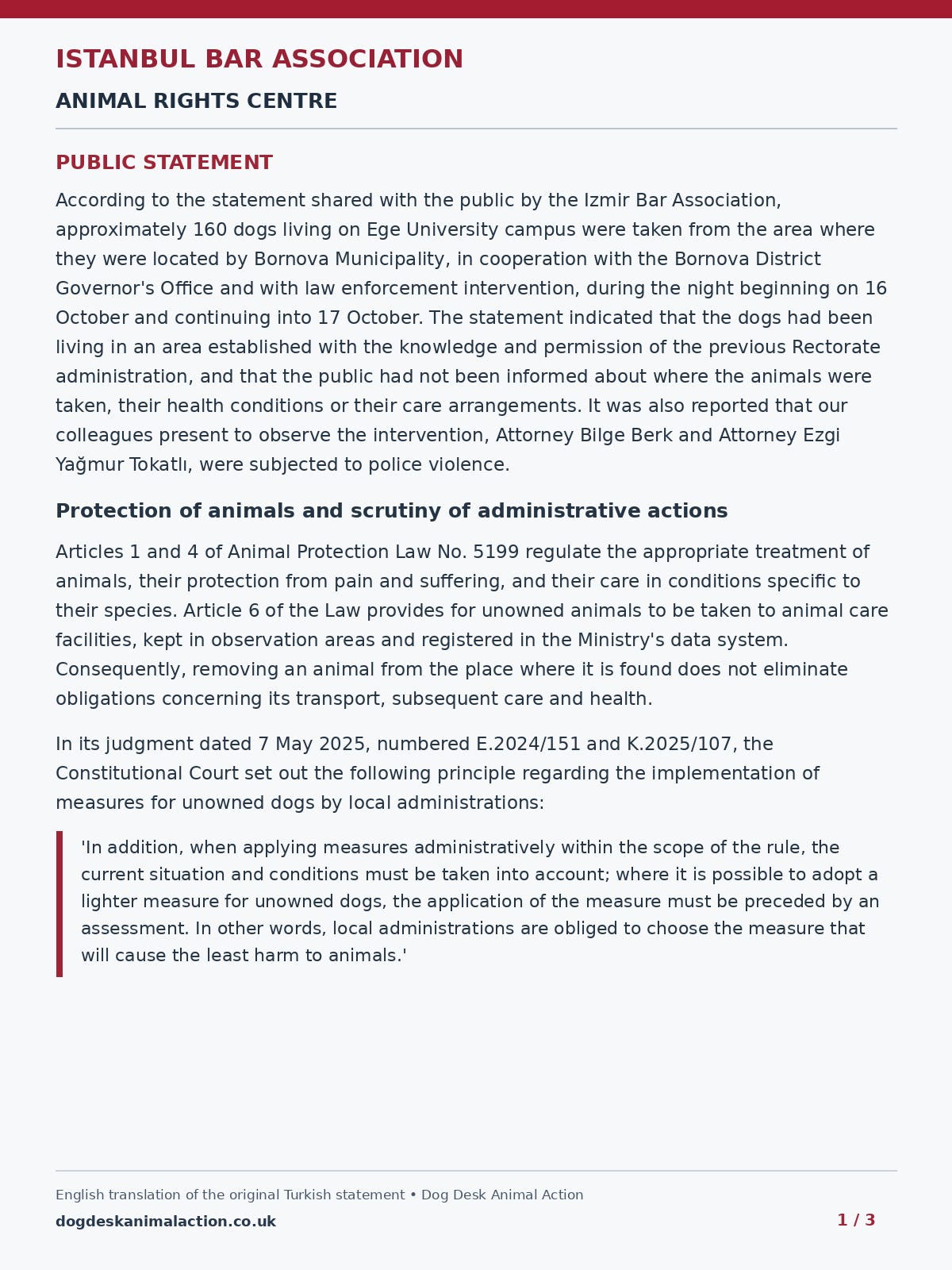
According to the Bar Association, approximately 160 dogs were removed from an area on the university campus during an overnight operation involving Bornova Municipality and law enforcement personnel. The Rectorate’s official statement gives a figure of 83 dogs collected, including 31 identified as owned.
The difference between these figures remains unresolved. They should not be treated as proof that animals are missing without first establishing how each figure was calculated and which animals were included.
The Bar Association also states that the dogs had been living in an area established with the knowledge and permission of the previous university administration.
That assertion is particularly relevant because Ege University’s own historical publications document institutional support for organised animal care on campus, including the official opening of a dog training area in October 2022.
The current Rectorate has described the facility as unauthorised, unlicensed and operating without appropriate veterinary supervision. The earlier institutional involvement does not establish whether the facility complied with every legal requirement in October 2026. It does, however, make the history of its authorisation and management an important subject for examination.
What the Courts Have Said About Administrative Powers
The Istanbul Bar Association cites provisions of Türkiye’s Animal Protection Law No. 5199, alongside decisions of the Constitutional Court and Council of State.
Its statement refers to a Constitutional Court judgment dated 7 May 2025, arguing that administrative measures affecting animals must take account of existing circumstances, available resources and the particular conditions in which animals are living.
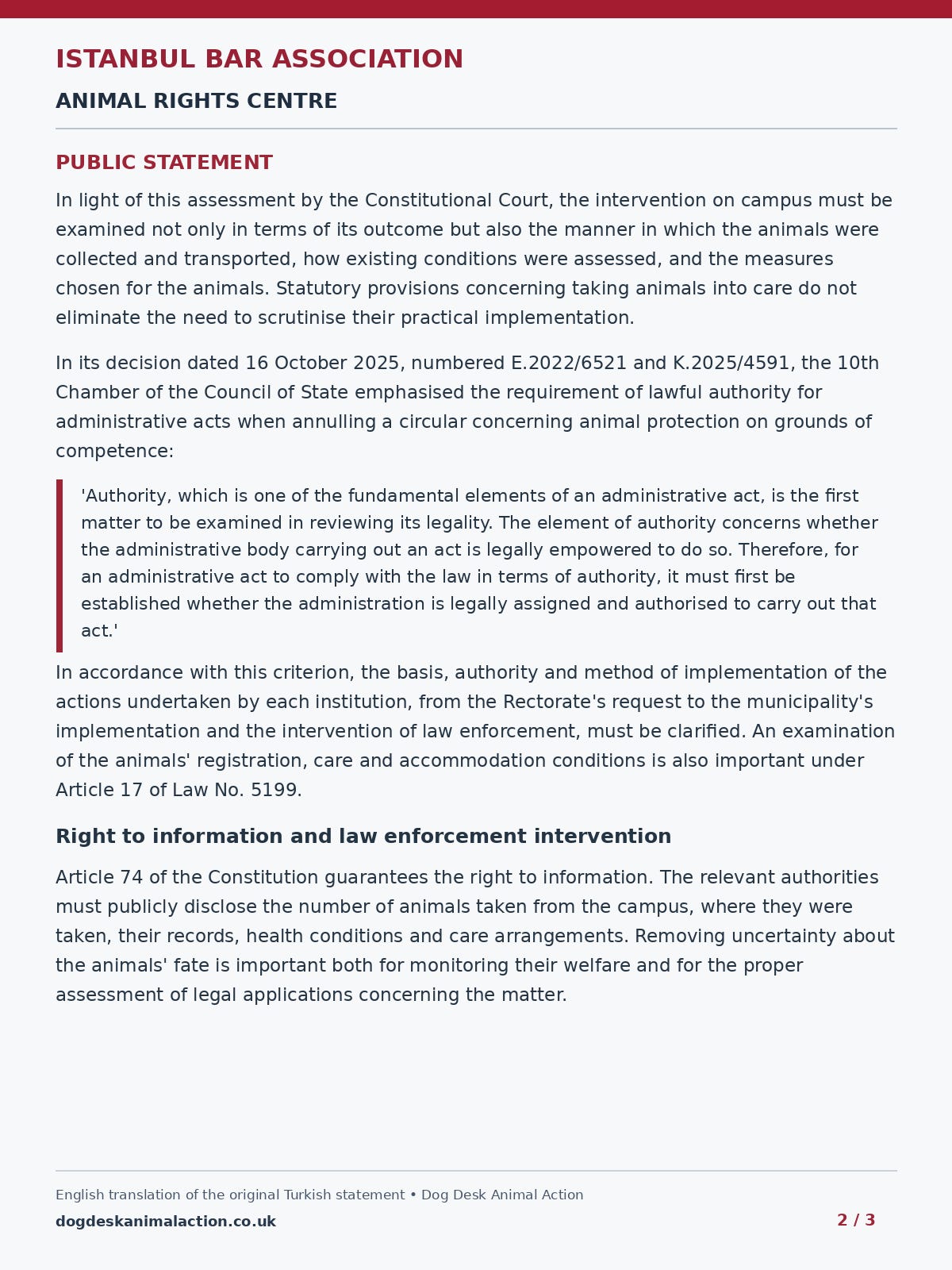
It also cites a Council of State ruling dated 16 October 2025 concerning the legal authority required for administrative action.
The principle highlighted by the Bar Association is that a public authority must have the legal competence to take a particular decision. The fact that an institution considers an intervention necessary does not, by itself, resolve whether the correct authority made the decision or whether the prescribed procedures were followed.
Applied to Ege University, the Centre calls for clarification of the respective roles of the Rectorate, Bornova Municipality and the police.
Who formally authorised the operation? What assessments supported the decision? Under which powers did each institution act, and how were the arrangements for removing and receiving the dogs determined?
These are questions raised by the Bar Association, not findings that the operation was unlawful. Establishing the answers would require examination of the relevant administrative records and decisions.
Where Are the Dogs Now?
The Bar Association also challenges the lack of publicly available information concerning the animals’ individual circumstances.
It calls for disclosure of the number of dogs removed, their destinations, registration records, health conditions and arrangements for their continuing care.
The Rectorate has stated that dogs remaining in municipal custody will receive treatment and rehabilitation under specialist supervision, while arrangements will be made for the return of owned animals.
Those assurances are relevant, but they do not provide a complete account of the animals’ individual outcomes.
For dogs accustomed to a particular environment and established carers, relocation may involve substantial changes in their daily lives. Their health, behaviour, treatment requirements and ability to adapt are all relevant to assessing their welfare.
Transparency about where each dog has been taken and what care is being provided would allow the public to assess what has happened beyond the initial collection operation.
Allegations Concerning Police Conduct
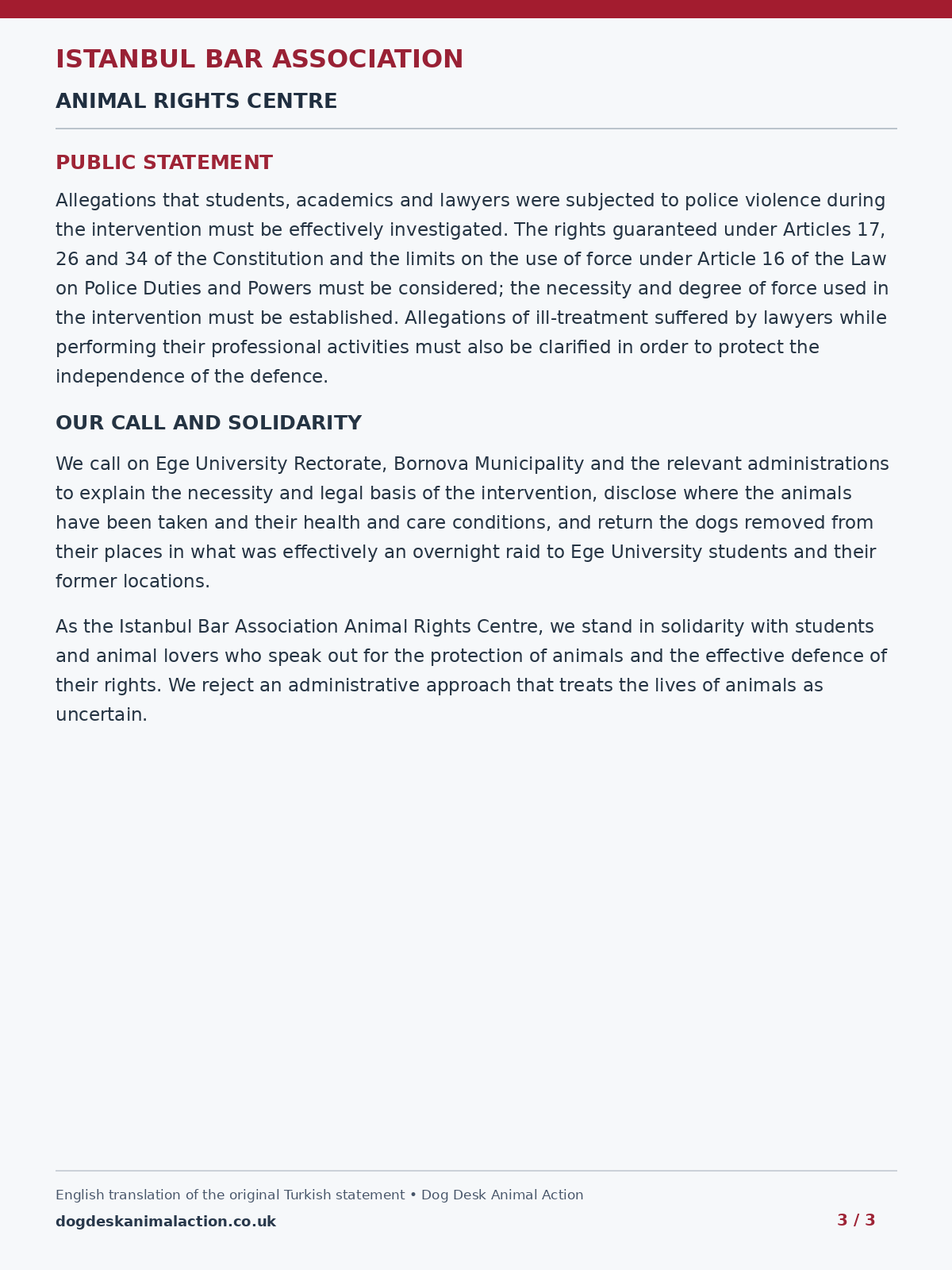
The statement also addresses reports that students, academics and lawyers were subjected to police violence during the operation.
The Bar Association identifies lawyers Bilge Berk and Ezgi Yağmur Tokatlı among those reportedly affected and calls for an effective investigation.
It refers to constitutional protections and legal safeguards concerning the use of force, the treatment of individuals and the professional activities of lawyers.
These allegations have not been established through the material examined for this article. Nevertheless, the Bar Association’s request for an investigation forms a distinct part of its public statement and should not be overlooked in an assessment of the operation.
A Call for the Dogs to Be Returned
In its concluding appeal, the Istanbul Bar Association’s Animal Rights Centre calls on Ege University Rectorate, Bornova Municipality and the relevant authorities to explain the necessity and legal basis of the intervention, disclose the dogs’ circumstances and return them to the university students and the places from which they were removed.
The Centre expresses solidarity with those seeking to protect the animals and rejects an administrative approach that, in its view, creates uncertainty about their lives.
This position goes further than requesting improved conditions in municipal facilities. It challenges the decision to remove the animals and seeks restoration of their previous care arrangements.
Whether such a return is legally or practically possible remains to be established.
Accountability Beyond the Collection Operation
The Ege University case now presents several questions that deserve separate consideration.
The Rectorate has explained its concerns about safety and the conditions of the student-managed facility. Historical university records document earlier institutional involvement in animal care arrangements. The Istanbul Bar Association has questioned the legal basis and implementation of the operation and called for disclosure of the animals’ circumstances.
What is needed is a clear account of the decisions taken, the legal authority relied upon, the evidence supporting the intervention and the arrangements made for every animal affected.
Removing dogs from a university campus is an administrative action. Establishing that the action was lawful, necessary and consistent with the animals’ welfare requires evidence that extends well beyond the moment of their removal.
Sources and further reading
Istanbul Bar Association Animal Rights Centre, Public Statement Concerning the Intervention Against Animals on Ege University Campus, three-page Turkish-language statement, October 2026.
Ege University Rectorate, official two-page public announcement concerning the collection of 83 dogs, October 2026.
Dog Desk Animal Action: Ege University’s Dogs: What Changed?
The Bar Association’s legal arguments are reported as its stated position. The court decisions cited in its statement have not been independently analysed against the full administrative record of this operation.