Ege University publicly supported facilities for dogs cared for by its student animal welfare society. Today, the Rectorate describes the facility as unauthorised and unsuitable. The university’s own records reveal a history that deserves closer examination.
In October 2022, Ege University publicly celebrated the development of facilities for dogs cared for by its student animal welfare society. The university’s own publications describe allocated space, veterinary treatment arrangements and institutional support for the students’ work.
Four years later, following the overnight removal of 83 dogs from the campus on 16–17 October 2026, the Rectorate has described the facility as unauthorised, inadequately supervised and unsuitable for animal welfare.
Both accounts come from the same university.
There may be explanations for the differences. Regulatory requirements, management arrangements and conditions can change over time. But the university’s earlier involvement is an important part of the history, and one that deserves to be understood alongside its latest statement.
What the Rectorate Says
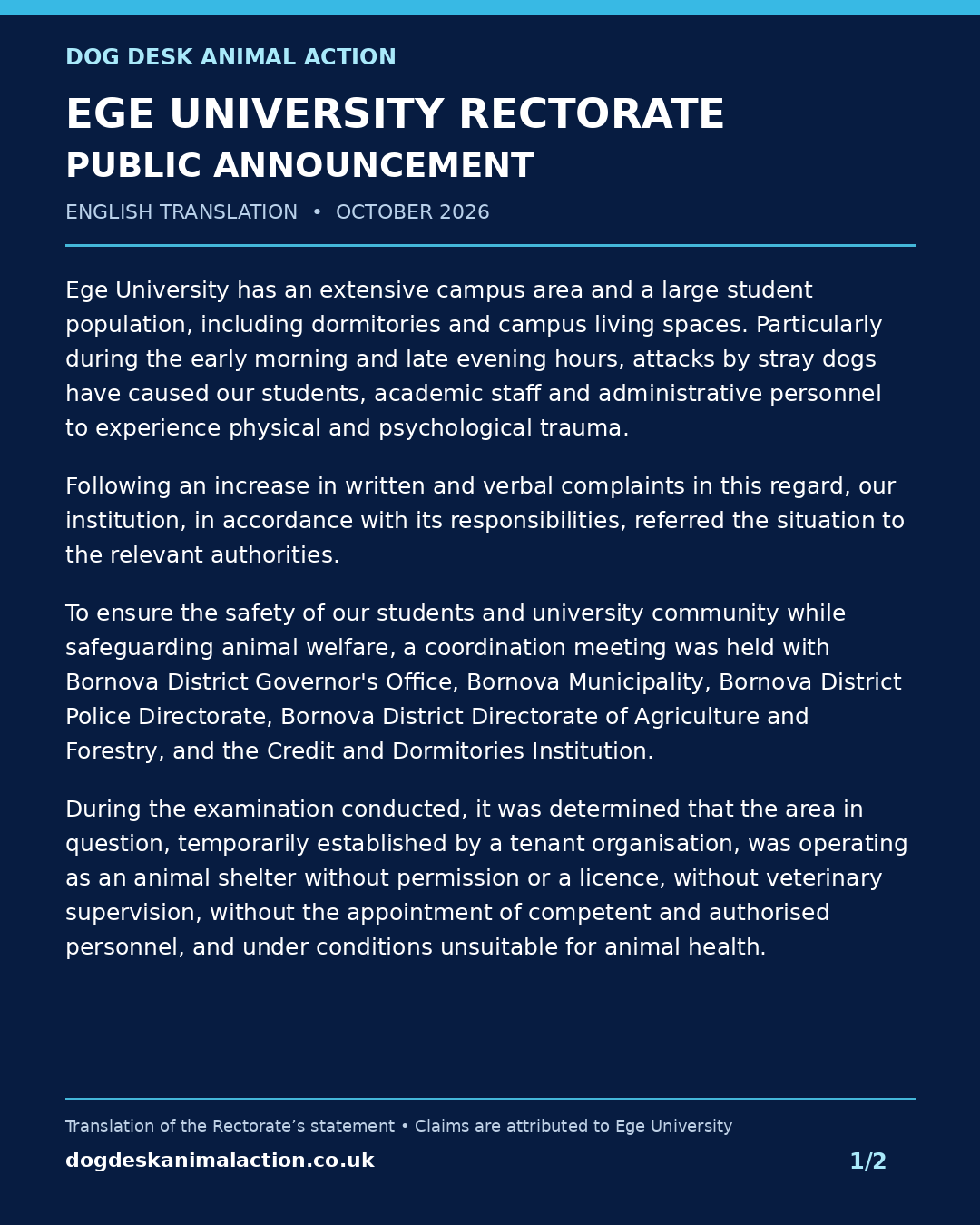
In its statement of 18 October, Ege University Rectorate referred to complaints concerning dogs on campus, including reported attacks on students and staff. It also raised concerns about the student-managed facility, describing it as:
“izinsiz, ruhsatsız, veteriner kontrolü olmaksızın”
“Without permission, unlicensed and without veterinary supervision.”
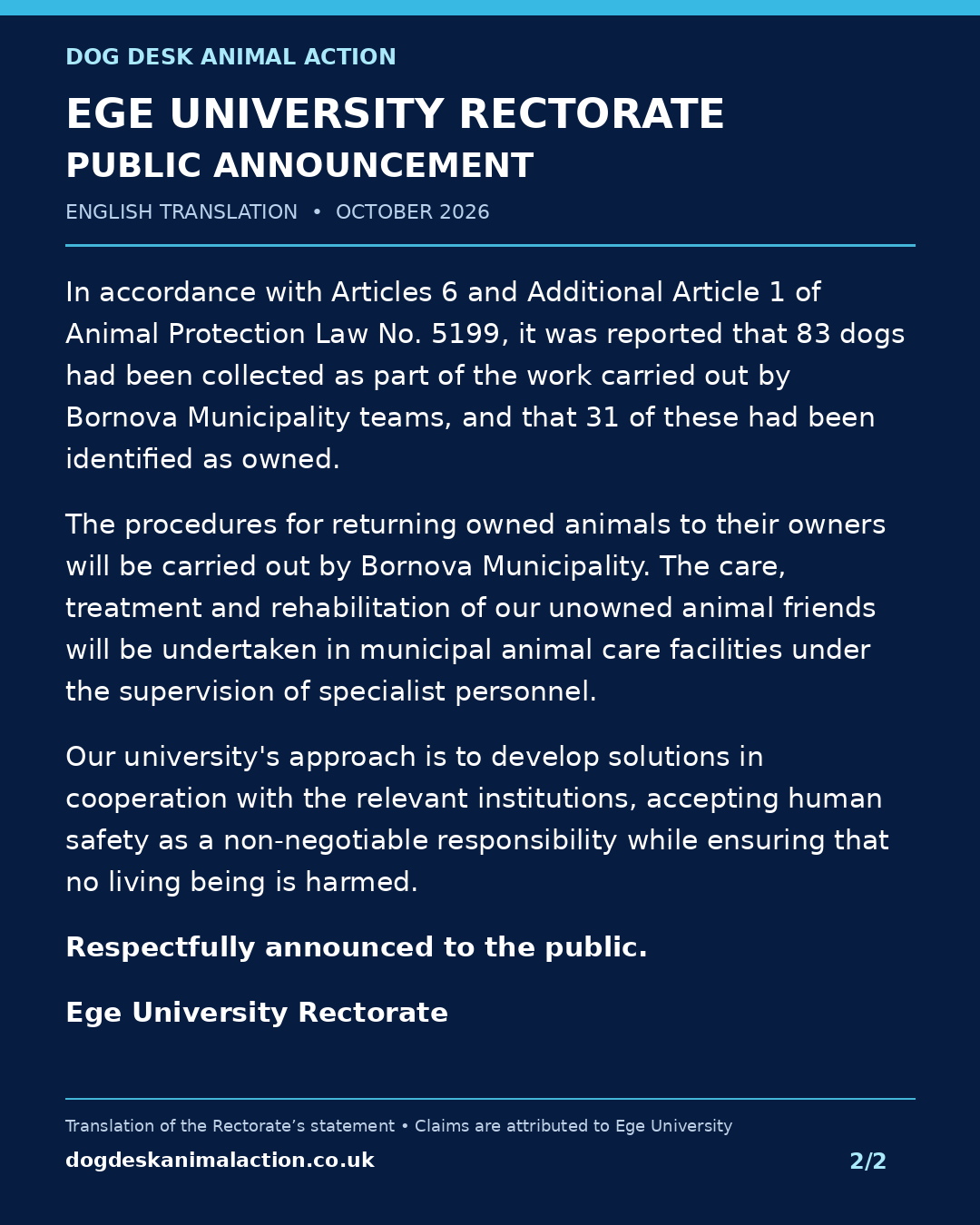
The Rectorate stated that the dogs would receive care, treatment and rehabilitation in municipal facilities under qualified supervision.
The published statement does not include the underlying inspection reports, veterinary assessments or incident records. That does not mean these records do not exist, but it leaves important questions about the circumstances leading to the operation unanswered.
What the University’s Earlier Records Show
Ege University’s Department of Health, Culture and Sports has an official webpage describing the activities of its Animal Rights Society. It records that the Rectorate allocated an area for dogs and acknowledges the society’s involvement in treatment, rehabilitation, feeding and sterilisation, including cooperation with municipal services.
In October 2022, then Rector Professor Necdet Budak attended the opening of a facility associated with the students’ animal welfare activities. Contemporary reporting described arrangements for shelter, feeding and veterinary services.
Other university publications refer to veterinary treatment arrangements and postoperative care. These are not claims made by campaigners following the recent operation. They form part of the university’s own published history.
That history does not establish whether the facility possessed every licence required in October 2026, or whether its conditions had subsequently changed. University permission to use land is not necessarily equivalent to statutory authorisation to operate an animal care facility.
Nevertheless, the earlier records demonstrate that the university knew about and supported organised animal care activities on campus.
The question is what changed between that period of institutional support and the concerns expressed in October 2026.
From University Care to Municipal Responsibility
Bornova Municipality has confirmed receiving 83 dogs following the operation, including 31 identified as owned. Arrangements have been announced for the return of owned animals, while the remaining dogs are expected to stay in municipal care.
The transfer represents a substantial change for animals who had become accustomed to their surroundings and the people caring for them.
The Rectorate has indicated that the dogs will receive appropriate care and rehabilitation. Those assurances are important, but the welfare benefits of relocation cannot be established simply by the existence of a municipal facility or the availability of professional services.
For dogs who have spent years in a familiar environment, their individual medical histories, established relationships and ability to adapt to different surroundings are relevant considerations.
What Happens to the Dogs Now?
The official figure of 83 dogs provides a starting point, but their individual outcomes will be far more informative.
The return of owned dogs will be an important development. For those remaining in municipal care, their health, living conditions and long-term arrangements will determine whether their welfare needs are being met.
It is also important to establish whether the dogs’ existing medical histories and other care information have accompanied them, particularly where animals have ongoing treatment requirements.
The university’s historical publications show that organised care, veterinary treatment and student involvement were previously recognised and supported. Its recent statement describes concerns about the facility and explains the decision to move the animals into municipal responsibility.
Both are part of the public record.
What remains to be understood is how the arrangements changed, what the relevant assessments established and how the dogs themselves will fare following their removal.
A change in responsibility is not, by itself, evidence of improved welfare. For the 83 dogs removed from Ege University, the most important evidence will be what happens to each of them next.
Sources
Ege University — Department of Health, Culture and Sports, Animal Rights Society
https://sksdb.ege.edu.tr/tr-5494/hayvanhaklari.html
Eğitim Rotası — October 2022 report on the opening of the facility
https://www.egitimrotasi.com/rektor-prof-dr-budak-vizyoner-uygulamalarina-devam-ediyor/4768/
Ege’de Sonsöz — Ege University Rectorate statement, 18 October 2026
https://www.egedesonsoz.com/universiteden-toplatilan-kopeklere-dair-aciklama
Update — 18 October 2026: Student Society Appeals for Permanent Homes
Ege University’s Animal Rights Society has issued a public appeal seeking permanent homes for dogs removed from its campus care area and taken into municipal shelter accommodation.
In a post published on X, the society wrote:
“We need permanent homes to get our furry friends, who were brought to the shelter from our training area, out of there.”
The appeal ends with the words “RETURN OUR DOGS.”
This is a significant development. While the Rectorate has stated that dogs remaining in municipal care will receive treatment and rehabilitation under specialist supervision, the students who previously cared for these animals are now seeking permanent homes to secure their departure from the shelter.
The appeal does not establish that the dogs are receiving inadequate care. It does, however, underline the importance of establishing what will happen to each animal, whether existing carers can remain involved and what arrangements are being made for their long-term welfare.
Update — 18 October 2026: Ege University Rector Issues Statement