
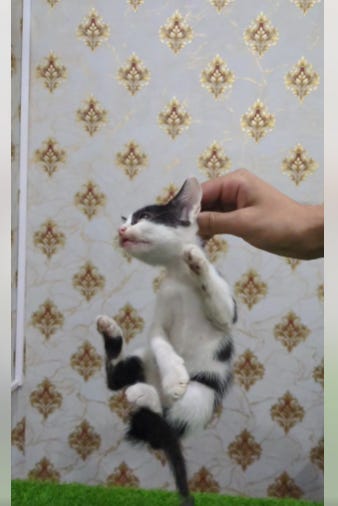
Meta has allowed a Facebook video, which shows a clearly distressed young kitten being hung by the skin around its neck to stay on the internet after it had decided that the video did not violate its Community Standards.
The video was uploaded by a Facebook page named diyarcat; it depicts a black and white kitten being held up without any support under its body. The entire weight of the kitten seems to be hanging from the skin on either side of its neck or upper back as it moves its legs and shows clear signs of distress. It is not a brief scene taken while the animal was being moved to safety or getting the care it needed. The kitten was intentionally put into this position so that the situation could be filmed and circulated as a form of entertainment.
Dog Desk Animal Action filed a report about the video due to the immediate concern for the kitten and because of the greater risk of making this type of handling appear to be harmless or funny. Although Facebook looked into the report it did not remove the post, stating that the content was not in violation of its Community Standards.
The decision is very worrying since it is clear from the footage that the kitten is in a state of distress: its body is not being supported, it is unable to move away from the person who has it, and it has no say in what is happening. The issue goes beyond the possibility that someone might find the video disturbing, it is that a young and vulnerable animal seems to be feeling fear and discomfort while it is being used to produce content.
Other viewers have also picked up on what is going on. The comments under the video ask why anyone would hang a kitten like this and cautions that the way it is being handled is carelessly and dangerously done. Nevertheless, Facebook’s moderation system has decided that the video can stay up.
Kittens are small and physically vulnerable animals and their bodies need to be properly supported if they are to be lifted. If a kitten is held up by only the loose skin this may result in pain, fear or injury. The fact that no wound is visible does not imply that the animal is unharmed. Distress is important. Fear is important. The method by which an animal is handled is important.
The effects go beyond that single video. Content on social media is copied and mimicked, especially since it is given reactions, comments, shares and greater visibility. If a platform allows videos to be shown in which animals are frightened, restrained or handled improperly for the purpose of entertainment, it runs the risk of normalising such behaviour and of encouraging others to carry it out.
It also sets up a deeply unsettling motivation. Posts showing an animal in an unusual or distressed situation may draw in viewers exactly since they are shocked by it; each and every reaction, including acts of anger, can help the post spread further. The animal’s distress thus becomes a means of generating engagement and the account posting the material may gain greater exposure.
Since animals can never agree to be used as props in social media content, the platforms that carry such material have a duty to tell the difference between normal pet videos and those in which the animal’s welfare has been harmed in order to gain attention.
The animal abuse and brutality that Meta has published policies regarding do seem to be accompanied by a serious discrepancy between the policies and the way they are enforced. In this instance, if a kitten is clearly in a state of distress and is hanging without any support and the content is still considered to be in compliance with Facebook’s rules, then how much suffering would have to be visible before action is taken?
Dog Desk Animal Action is requesting that Meta clarify whether a person with adequate knowledge of animal welfare has seen the entire video and was therefore able to identify the kitten’s distress. We also want to know how Meta evaluates unsafe animal handling in cases where there is no blood or obvious wound, whether it takes into account the risk of imitation, and whether accounts can still receive recommendation or monetisation benefits from such content.
We are also requesting that Meta examine the account’s broader pattern of content involving animals, since dealing with each video separately could mask a recurring behaviour and stop the reviewers from spotting the fact that animals are regularly being used in dubious situations in order to gain engagement.
The origin of the footage and the location where it was recorded have not been verified yet. It seems that the page’s biography states that there is a link with Malaysia. However, this fact by itself does not prove where the person who ran the page or the animals seen in the videos are based. Dog Desk Animal Action will not put forward any unsupported assertions regarding the identity of the person who made the video or as to whether a criminal offence has been committed.
All that can be established is the fact that the footage clearly shows the kitten in a state of distress and that Facebook has decided the post does not breach its rules.
This situation shows a more general problem when it comes to accountability. Harmful content involving animals doesn’t always include blood, visible injuries, or severe violence; an animal can be frightened, provoked, held back, handled incorrectly, or put at risk without suffering an injury which an automated system can easily detect.
If the moderation system does not understand the context, the material might be labelled as harmless pet entertainment. The person who made the report is then informed that the content does not violate the rules and could be advised to block the account or to manage what they view. While this may stop the particular viewer from seeing the video again, it achieves nothing to protect the animal or to stop similar content from being created.
Dog Desk Animal Action is requesting a further review and taking this matter to Meta as an organisational animal welfare and platform accountability concern. We have preserved the footage, screenshots, direct link and Facebook’s original decision, and we will continue attempting to establish where the video originated.
Meta will be asked to explain its decision and to verify that the video will be subject to a proper human review. The article will be updated should the company respond or change its decision.
No animal should have to put up with visible suffering in order to convince an algorithm that the platform considers their welfare important.
Yes. Place it at the end of the blog, immediately before any subscription or sharing prompts. It works as evidence that DDAA formally approached Meta and gave the company an opportunity to respond.
Add this introduction above the image:
Our Letter To Meta
Dog Desk Animal Action contacted Meta’s press team on 3 August 2026 and requested a human review of the video, an explanation of the original decision and a substantive response from the appropriate policy team. Our correspondence is reproduced below.
This article will be updated if Meta responds or reconsiders its decision.


