


For weeks we have been asking one very simple question about the dogs who entered Miranda’s Rescue in Humboldt County, California. Who was responsible for making sure those dogs could ultimately be accounted for? We know there were authorities responsible for land use and the permits attached to the property, we know law enforcement can investigate suspected criminal offences and we know charitable organisations have regulatory obligations, but what we have struggled to identify is the authority responsible for routinely overseeing what happened to the dogs themselves once they moved from a shelter or another rescue into the care of an independent rescue.
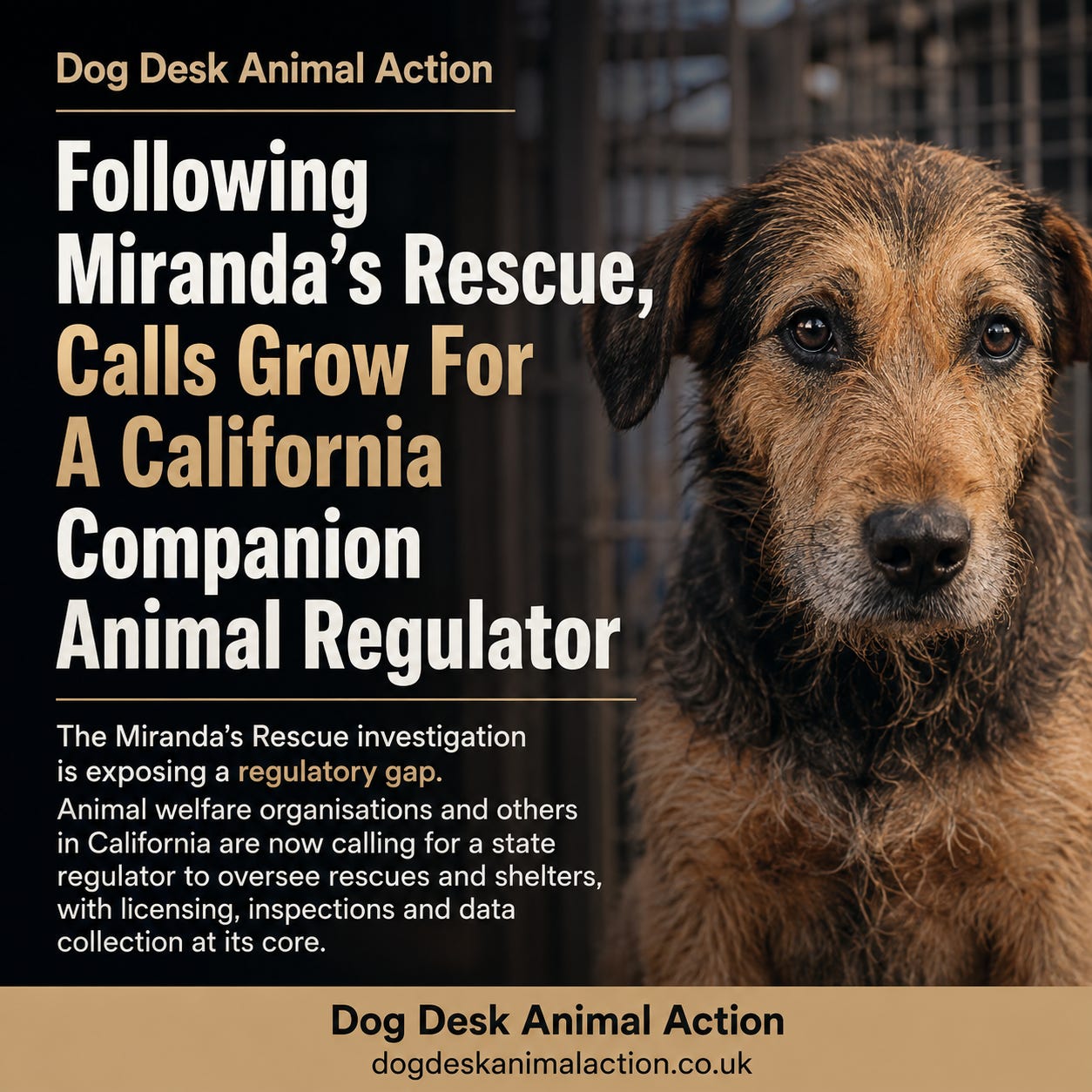
Now, in response to what has emerged from the Miranda’s Rescue investigation, animal welfare organisations and others in California are calling for the creation of a Bureau of Companion Animal Welfare, a dedicated state body that would oversee companion animal shelters, rescues and related organisations. Proposals being discussed include statewide licensing, inspections, mandatory data collection and enforcement, with support reportedly coming from animal welfare organisations as well as the Humboldt County Sheriff’s Office. The proposal is expected to be formally launched at the California State Capitol and, given the questions we have been asking ourselves, we will be following it very closely.
This development is particularly interesting to us because we have already started trying to establish where responsibility currently sits. We contacted the California Department of Food and Agriculture asking what safeguards exist to ensure that dogs transferred from shelters into rescue organisations remain traceable and that their eventual outcomes are recorded. Their response to us was unequivocal: “CDFA does not regulate companion animal species, such as dogs and cats.” That left us with the rather obvious question of who does.
We have subsequently contacted California’s Registry of Charities and Fundraisers to ask whether its supervision of charitable organisations extends to the welfare of animals and the records relating to dogs held by rescue organisations. If it does not, we have asked them to identify which authority does have that responsibility and, importantly, we have also asked them to tell us if no California authority currently has responsibility for routinely monitoring the intake and subsequent outcomes of dogs held by independent rescues.
Meanwhile, information emerging from the Miranda’s Rescue investigation demonstrates exactly why this matters. According to reporting, shelters transferred hundreds of dogs to Miranda’s Rescue over a period of around six years and hundreds of thousands of dollars were reportedly paid in connection with those transfers, while comparatively little information was subsequently received about adoption outcomes. That is an extraordinary situation to contemplate now that investigators are trying to establish what happened to so many of the dogs that entered Miranda’s care.
We need to be careful about what conclusions are drawn from that because this must not become an opportunity to attack the organisations that entrusted their dogs to Miranda’s Rescue. Shelters and rescues work together every day and they have to. Resources are finite, kennels fill, foster spaces become available, specialist organisations can sometimes provide something another rescue cannot and dogs move between organisations because people believe that move gives them a better chance. Those relationships are built through checks, experience, reputation and trust, and organisations that transferred dogs to Miranda’s have described the checks they undertook and the reasons they believed those dogs were being handed into safe care.
For us, the important question is not why somebody trusted another rescue. It is what safeguards existed around that trust once the dog had been handed over. If a dog leaves a shelter and enters a rescue, there should surely be a way of establishing what subsequently happened to that animal, whether they were adopted, remained in care, moved to another organisation, died or were humanely euthanised. Whatever the outcome, the dog should continue to exist somewhere within a record and, if hundreds of dogs enter an organisation without hundreds of corresponding outcomes being capable of verification, there should surely be a point at which the system recognises that something may be wrong.
Investigators are now having to reconstruct those journeys retrospectively. Records are being examined, microchips traced, shelters and rescues contacted and remains identified as authorities attempt to establish the histories of individual dogs. That is painstaking work being undertaken after the event, and it raises the obvious question of whether a better system of traceability could have identified concerns while those dogs were still alive rather than leaving investigators to piece their stories together afterwards.
That is why the proposal for a dedicated companion animal regulator deserves serious consideration, but it does not follow that creating another regulator automatically solves the problem. More regulation does not automatically mean better animal welfare, and when something as disturbing as the Miranda’s Rescue investigation happens there is an understandable temptation to demand more rules immediately. Regulation can establish minimum standards, create accountability, require information to be recorded and give authorities powers to intervene, but poorly designed regulation can also produce consequences nobody intended, particularly for small legitimate rescues and foster based organisations operating with limited resources.
If regulation becomes so burdensome that good rescues reduce the number of dogs they can accept, fosters decide they can no longer participate or smaller organisations close altogether, dogs will feel the consequences of that too. That does not mean regulation should be resisted; it means it needs to be designed around the problem it is actually trying to solve. Before adding requirements, California needs to understand what failed, where responsibility currently sits, where the gaps actually are and which measures would have been capable of identifying the problems now being uncovered at Miranda’s Rescue.
For me, one of the most important things any new system could achieve is actually very simple. Dogs should not be able to disappear when they move between organisations. If a shelter transfers dogs to a rescue, there should eventually be corresponding outcomes for those animals and those records should follow the dogs for as long as necessary. That does not require government interference in every decision a rescue makes, but it does require enough transparency for somebody to recognise when the numbers entering an organisation and the outcomes leaving it no longer make sense.
That kind of accountability would protect the dogs, but it would protect good rescues too. Organisations handing animals into another rescue’s care should not have to discover months or years later that nobody can tell them what happened to those dogs, and responsible rescues should not find themselves treated with suspicion because another organisation has failed catastrophically. Good regulation should make responsible organisations easier to recognise and bad practice harder to conceal, without making legitimate rescue so difficult that animals lose the very people trying to help them.
There are plans to take the proposal for a Bureau of Companion Animal Welfare to the California State Capitol and we want to see the detail before deciding whether it provides the answer California needs. We want to understand how any licensing and inspection system would work, what information organisations would be required to record, whether individual dogs would remain traceable when they move between organisations and how smaller and foster based rescues would be affected. Most importantly, we want to understand how California would determine whether the new system was actually improving animal welfare rather than simply creating more regulatory activity.
The number of licences issued, inspections completed, organisations registered and forms submitted can tell us how busy a regulatory system is, but it cannot by itself tell us whether dogs are safer because of it. The measure of success has to be what happens to the animals the system was created to protect.
The Miranda’s Rescue investigation has left authorities attempting to reconstruct the histories of hundreds of dogs after the event. Some have reportedly now been identified among the dead and the fate of many others has had to be painstakingly traced. Whatever eventually emerges from the criminal investigation and subsequent legal proceedings, California now has an opportunity to look at the system surrounding those dogs and ask whether something could have been done differently.
If that leads to regulatory change, it needs to be the right change. Not regulation introduced simply so somebody can say something was done, and not another layer of administration that looks reassuring on paper while failing to identify what is happening to animals in practice. It needs to protect dogs while allowing good rescues to continue doing the work those dogs desperately need.
Above all, if hundreds of dogs begin disappearing from sight, somebody needs to notice.