

From Wolves to Pets - How Dogs Came to Live With Us

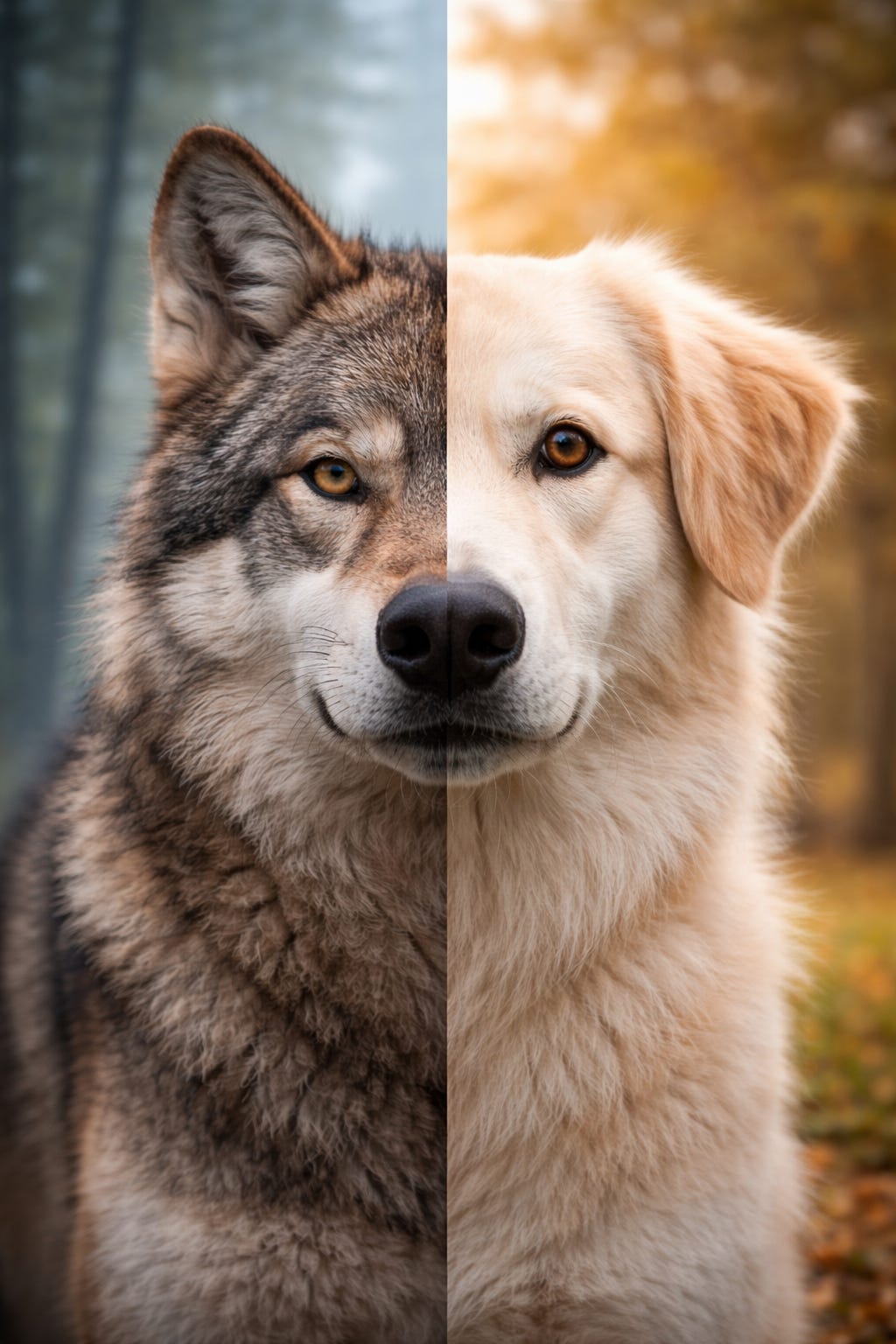
A dog lying quietly at our feet feels like a constant in human life. But it isn’t.
There was a time, for most of our history when dogs did not exist at all. There were only wolves. Independent, self-sufficient, and entirely separate from us.
So how did that change?
It Didn’t Start With Humans Choosing Dogs
The story most people imagine is simple: humans found wolf puppies, raised them, and over time they became dogs.
The reality is more gradual and more interesting. The earliest shift likely came from wolves themselves.
Some wolves began to move closer to human settlements. Not all of them, only the ones who were less fearful, more tolerant, more curious. Human camps created waste: bones, scraps, leftovers. For a wild animal, that was an opportunity.
The wolves who could tolerate human presence gained access to food that required less energy to obtain.
Over generations, those wolves survived more successfully than the ones who stayed away.
This wasn’t domestication in a single moment. It was selection happening slowly, over thousands of years.
The First Dogs Were Not Pets
These early proto-dogs were not companions. They lived alongside humans, but not with them in the way we think of today.
They were:
Opportunistic
Watchful
Adapted to human environments, but not dependent on human affection
In return for food access, they provided something valuable.
They alerted to danger.
They noticed movement.
They acted as an early warning system.
A relationship formed but it was practical, not emotional.
A Shift Towards Partnership
Over time, humans began to recognise the value of these animals. Not just as scavengers, but as collaborators.
Dogs began to take on roles:
Assisting in hunting
Guarding resources
Moving with human groups
At the same time, humans began, consciously or not, selecting for traits:
Reduced aggression
Increased tolerance
Willingness to engage
This is where dogs truly begin to diverge from wolves. Not just physically, but behaviourally.
Living Closer & Changing
As human societies became more settled, dogs moved closer still.
From the outskirts of camps to within them.
This proximity changed everything. Dogs began to:
Form stronger bonds with humans
Rely more on human-provided resources
Adapt to structured environments
Humans, in turn, began shaping dogs more deliberately. Selective breeding accelerated:
Appearance
Behaviour
Function
Some dogs were bred to herd. Some to guard. Some to retrieve. And eventually, some simply to be companions.
The Emergence of the Pet Dog
The idea of a dog as a pet is relatively recent in the timeline. For most of history, dogs had roles. Only as societies became more stable, urban, and structured did dogs begin to exist primarily for companionship.
They moved:
From working partners
To household members
And with that shift came new expectations.
Dogs were now expected to:
Live in confined spaces
Follow human routines
Suppress natural behaviours
Some adapted easily. Others did not.
One Species, Many Outcomes
Today, we see the full spectrum of that history. Some dogs are:
Highly human-focused
Comfortable in homes
Quick to bond and settle
Others remain:
Independent
Environmentally driven
Less reliant on human interaction
Street-born dogs, community dogs, and many shelter dogs often sit somewhere in between. They are not unfinished pets. They are the result of the same long history just shaped by different conditions.
When History Meets Modern Expectations
The difficulty arises when we expect all dogs to fit the same model.
A dog that:
Paces
Avoids close contact
Struggles in confined spaces
is often seen as a problem. But these behaviours can reflect something deeper.
They can reflect a dog whose instincts are still closely tied to:
Movement
Choice
Environmental awareness
When that dog is placed suddenly into a home, the challenge is not always behavioural. It is environmental.
What This Means for Rescue Work
In rescue, this understanding matters. Because not every dog is suited to the same outcome.
Some dogs thrive in homes. Some adapt with time and support. Some do better in sanctuary or community settings.
Recognising this is not lowering standards. It is improving them.
A More Honest Relationship
Dogs came to live with us through a long process of adaptation on both sides.
We shaped them. But they also shaped the relationship. And that relationship is still evolving.
If we understand where dogs came from, we are better placed to understand the dog in front of us not as a fixed idea of what a pet should be, but as an individual shaped by history, environment, and experience.
Closing Thought
Dogs did not begin as pets. They became something else first, neighbours, partners, collaborators. Only later did they become companions. And even now, not every dog fits neatly into that final role.
Understanding that is not a limitation. It is the beginning of doing better by them.