Video: Gori animal shelter, shared by Mariam Tsertsvadze, 15 October 2026
Disturbing footage from a municipal shelter in Gori has exposed serious concerns about the treatment of puppies in government care. But behind the scandal lies a much larger question: can Georgia account for the dogs being removed from its streets under a national population-management programme?
The images from Gori are difficult to forget. Dozens of puppies crowded into a small, dirty enclosure, some appearing thin and wet, with barely enough room to move. The footage, circulated on 15 October 2026, provoked outrage across Georgia and brought animal welfare advocates to the gates of the municipal shelter the following day.
What followed was an extraordinary rescue effort. Volunteers, private rescuers and animal welfare organisations began removing puppies from the facility, while veterinary clinics offered assistance to animals reportedly suffering from serious illness. Estimates suggest between 100 and 300 animals were taken into private care, although the exact number has not been independently established.
Some rescuers alleged that puppies died during transportation and that sick animals had been housed alongside healthy ones. There were also allegations of inadequate food, water, quarantine and veterinary supervision. These claims require independent investigation, particularly where they concern deaths and the possible spread of infectious disease.
The regional agency responsible for the shelter rejected accusations of improper care. It said the puppies had been temporarily gathered in an auxiliary enclosure while staff carried out routine cleaning and disinfection, and argued that the footage had been presented without its proper context.
That explanation does not resolve the central questions. How many puppies were being housed at Gori? How long were they kept together? What veterinary assessments had they received, and how many animals had died before the footage emerged?
The shelter’s records should be capable of answering those questions.
Gori had already attracted controversy earlier in 2026, when footage of smoke rising from its incinerator prompted allegations that animals were being killed and their bodies burned. Some campaigners went further, suggesting that live animals were being incinerated. No convincing evidence establishing that allegation has emerged, and the authorities rejected it.
Nevertheless, the earlier controversy is relevant because it demonstrates how little confidence some animal welfare advocates have in the institutions responsible for animals taken from Georgia’s streets. The October footage has intensified that distrust.
The wider problem extends far beyond one shelter.
In February 2026, Georgia approved a national dog-overpopulation management programme intended to capture approximately 36,116 free-roaming and community-cared-for dogs for veterinary procedures, including sterilisation, vaccination, identification and disease screening.
On paper, the programme represents an approach that could deliver significant welfare and public health benefits. Sterilisation can prevent unwanted litters, vaccination protects animals and communities against rabies, and identification provides a means of tracking individual dogs.
But the success of such a programme depends on what happens after capture.
Georgia’s arrangements generally envisage returning dogs following veterinary treatment, subject to restrictions concerning locations such as schools, kindergartens, medical facilities, markets, food establishments and playgrounds.
Those restrictions create a serious practical difficulty. Many community dogs live precisely in the places where people gather. They are fed outside shops, cared for by market traders or recognised by residents living near schools and residential areas.
If those dogs cannot be returned to their original territories, where are they taken instead? That question has troubled animal welfare advocates for months.
In May, Georgian reporting documented accounts from community carers searching for dogs that had disappeared during government collection operations. Some animals were eventually located, while others reportedly remained missing. Campaigners expressed fears that dogs were being relocated to unfamiliar areas where they might struggle to find food, water or the people who had previously cared for them.
The authorities have denied allegations of systematic killing and maintain that the programme involves veterinary treatment followed by return.
There is evidence that returns do take place. On 2 April, Georgia’s Ministry of Environmental Protection and Agriculture reported that 57 dogs had been collected in Zugdidi, of which 28 had already been returned. The ministry said the remaining animals would follow after the necessary procedures.
That is an important statement, but it does not answer what happens across the programme as a whole.
The government should be able to demonstrate how many dogs were captured, how many received treatment, how many were returned to their original locations and how many were transferred elsewhere. It should also be possible to establish how many died while in care, were euthanised on veterinary grounds or remain in shelters.
Without those records, neither official assurances nor allegations of disappearance can be properly tested.
Transparency International Georgia has independently raised concerns about the programme, particularly the restrictions on returning dogs to certain locations. The organisation has warned that moving animals away from familiar environments could expose them to serious welfare risks.
A sterilised and vaccinated dog returned to a familiar community, where it knows its surroundings and receives regular care, may have a very different future from one released into an unfamiliar location without established access to food, water or shelter.
Relocation is therefore not necessarily a harmless administrative adjustment. Its consequences must be assessed and documented.
Georgia’s experience also raises questions about the effectiveness of earlier population-management efforts. A previous pilot programme envisaged collecting 9,000 stray and community-cared-for animals for veterinary procedures. Government figures published in September 2025 reported 2,113 dogs and cats taken to shelters and vaccinated, 1,835 sterilised or castrated, and 1,863 returned to their environment. Another 250 remained in shelter care at the time of reporting.
Those figures demonstrate that the authorities have undertaken substantial veterinary work. They also show why transparent outcome reporting is possible and should be a routine requirement, not something communities must demand after animals disappear.
Georgia has also introduced legislation addressing pet registration, breeding and abandonment. These measures are essential because the continuing arrival of unwanted puppies cannot be resolved through street collections alone.
Every abandoned litter places additional pressure on shelters, veterinary services and the volunteers who ultimately care for animals that the system cannot accommodate.
The Gori incident illustrates the consequences when that pressure meets inadequate capacity or management. Whatever the explanation for the footage, the sight of so many vulnerable puppies confined together raises legitimate concerns about infection control, accommodation and the ability of staff to provide individual care.
The reported movement of potentially infected puppies into private homes and veterinary clinics also creates a difficult dilemma. Rescuers understandably wanted to remove animals from conditions they considered dangerous, but moving sick puppies without coordinated quarantine arrangements can expose other animals to infection.
That is why independent veterinary oversight is so important. Emergency intervention should protect animals from immediate suffering without creating further preventable risks.
There are now two distinct matters requiring investigation. The first concerns Gori itself: the number of animals admitted, their conditions, the deaths reported by rescuers, the shelter’s capacity and the whereabouts of puppies transferred into private care.
The second concerns the national programme: whether every dog captured can be traced through veterinary treatment to a documented outcome.
These questions should not be confused with an allegation that Georgia is operating a nationwide extermination programme. The available evidence does not establish that. The government’s stated policy includes sterilisation, vaccination and return, and those are measures that deserve recognition when properly implemented.
But a humane policy cannot be judged by its stated intentions alone. It must also be judged by what happens to individual animals.
If a dog is taken from a community, the authorities should be able to identify where it was collected, where it was housed, what treatment it received and where it went afterwards. If an animal died, the circumstances and veterinary records should be available for appropriate scrutiny.
The same standard should apply to puppies entering municipal shelters. Their welfare should not depend upon footage reaching social media or volunteers organising emergency rescues.
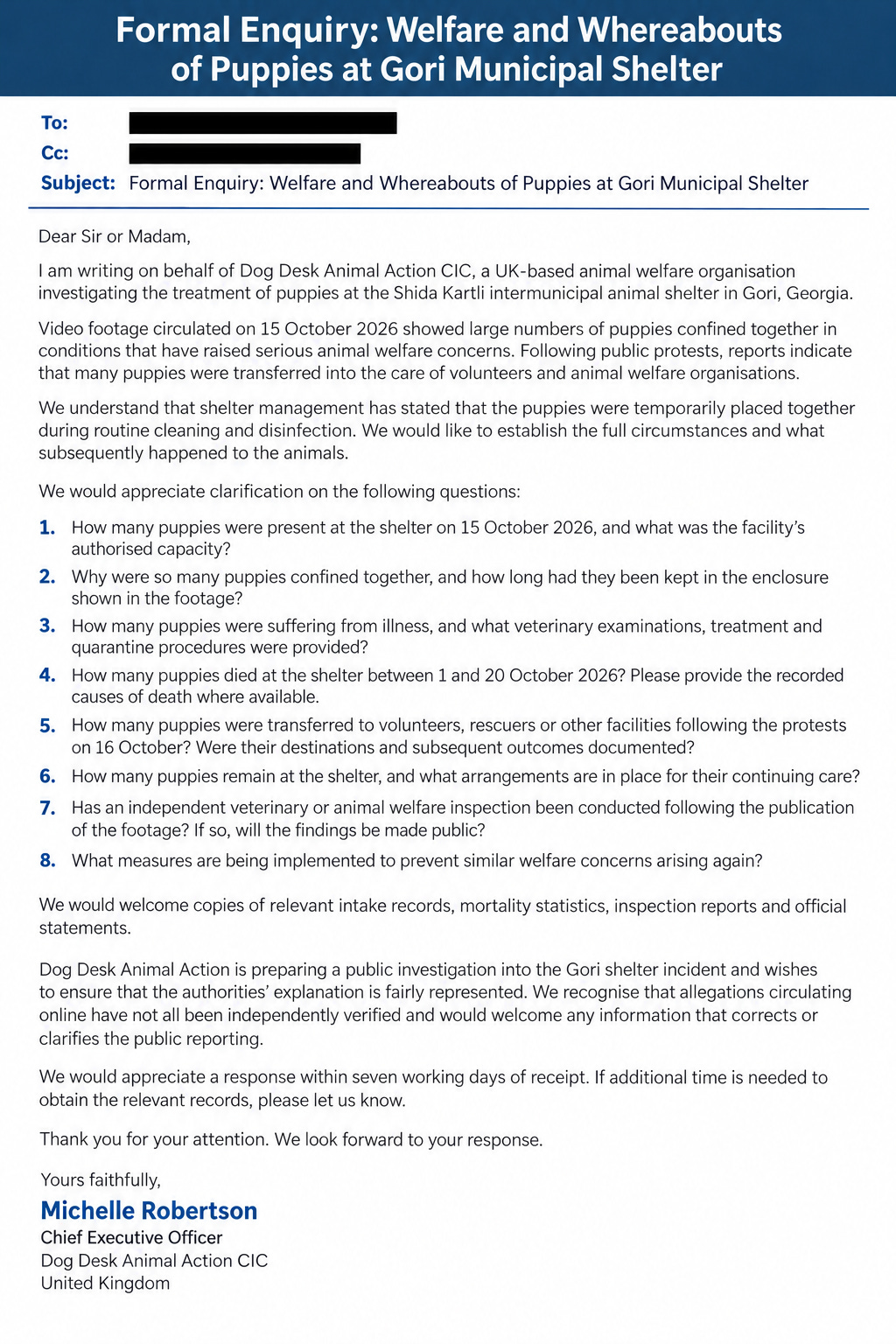
Dog Desk Animal Action is calling for the publication of comprehensive capture, transfer, return and mortality records under Georgia’s national programme, together with an independent examination of the conditions and reported deaths at Gori.
We also believe the authorities should explain how restrictions on returning dogs to particular locations are implemented in practice, and what safeguards prevent animals from being released into unfamiliar environments where their welfare may be compromised.
Georgia’s programme has the potential to deliver meaningful improvements for free-roaming dogs. But that potential will be undermined if communities cannot establish what happens to animals once they are taken away.
The question is not how many dogs Georgia can remove from its streets. It is whether the country can account for every dog it takes into its care.