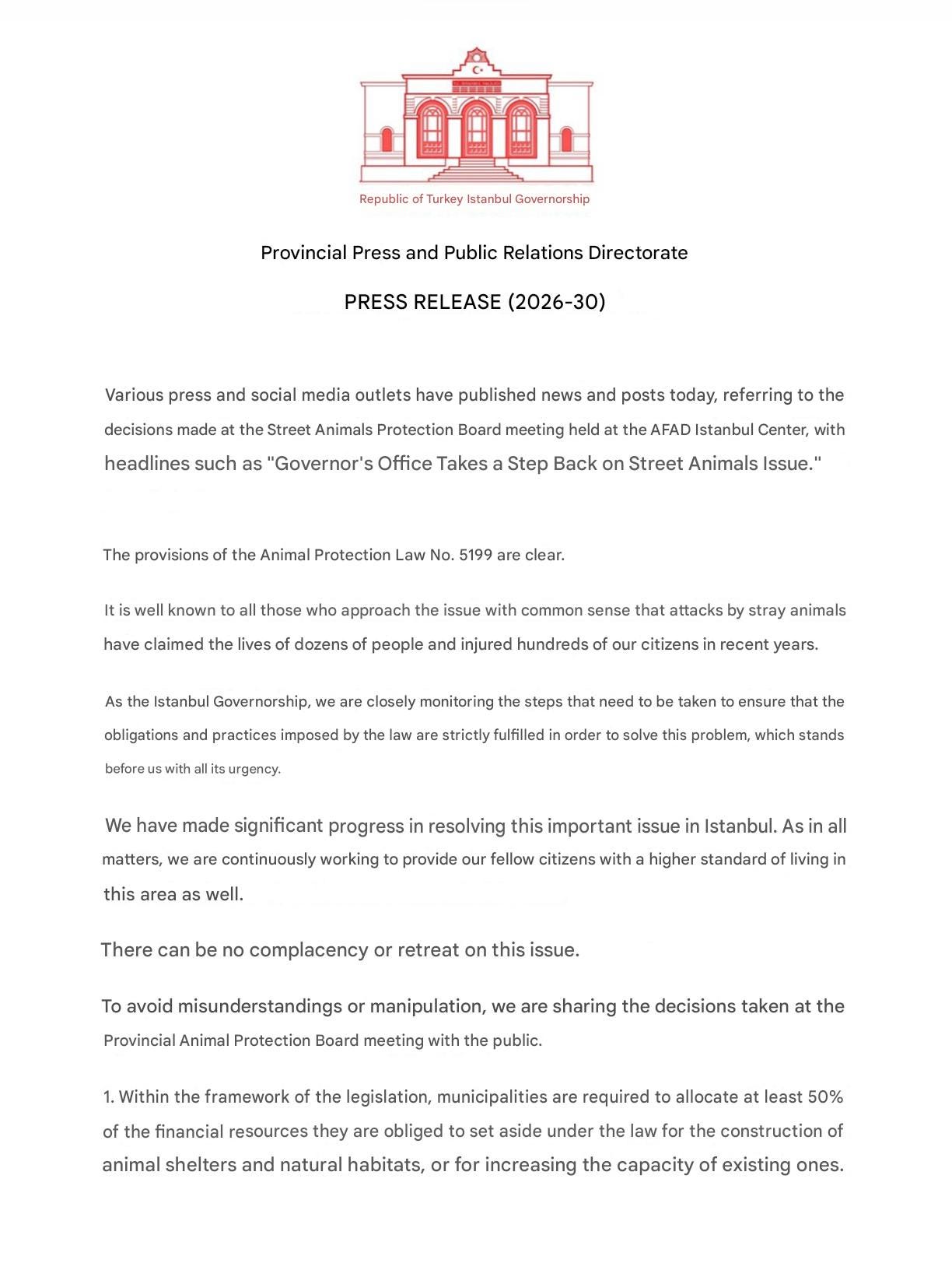
A new statement issued by the Istanbul Governorship following the latest Animal Protection Board meeting has made one thing unmistakably clear: authorities want the public to understand that street dog collection efforts are continuing and that pressure on municipalities is not easing.
The wording of the announcement is striking.
The statement was issued in response to news reports and social media posts claiming the Governor’s Office had taken a step back on the street animal issue.
The response from the Governorship was firm.
It stated there could be no complacency or retreat on the issue and emphasised that municipalities would continue to be closely monitored to ensure obligations under the law are strictly fulfilled.
Taken together, the language strongly suggests officials wanted to make clear that enforcement and collection efforts are not slowing down following the meeting.
And the measures outlined in the statement reinforce that impression.
Municipalities are being instructed to:
accelerate shelter and natural habitat projects,
conduct monthly stray dog inventories,
submit data centrally through HAYBİS,
increase capacity,
and continue gathering dogs into designated facilities.
Pendik and Tuzla are specifically referenced as districts where collection infrastructure is being completed so dogs can be gathered there.
Municipalities that fail to allocate required funding are also warned about possible legal sanctions.
But beneath the enforcement language sits a question that remains unanswered publicly:
Where will all the dogs actually go?
This is why many welfare concerns are now focusing less on the language of collection itself and more on the practical reality of what happens after dogs disappear from public view.
The statement also includes measures aimed at preventing illegal abandonment of dogs, including involvement from security and gendarmerie units.
Preventing abandonment matters. Deliberately dumping dogs into different districts has long contributed to instability and suffering.
But another omission from the statement is equally striking:
There is virtually no meaningful discussion of sterilisation
No large-scale sterilisation framework is outlined.
No expansion of neutering capacity is announced.
No long-term breeding prevention strategy is explained.
Instead, the overwhelming focus is on:
collection,
monitoring,
construction,
enforcement,
and transfer into facilities.
That creates a fundamental contradiction.
Because a city cannot permanently reduce a street dog population through collection alone while new litters continue entering the system.
If breeding continues, intake pressure continues.
The pipeline keeps refilling.
This is the issue at the centre of growing concern among many animal welfare observers and advocates.
The latest statement confirms acceleration.
It confirms monitoring.
It confirms pressure on municipalities.
But it leaves the most important long-term questions unresolved.
Where will the dogs go?
How will humane conditions be maintained at this scale?
And if sterilisation is not central to the strategy, how does the cycle ever actually end?