

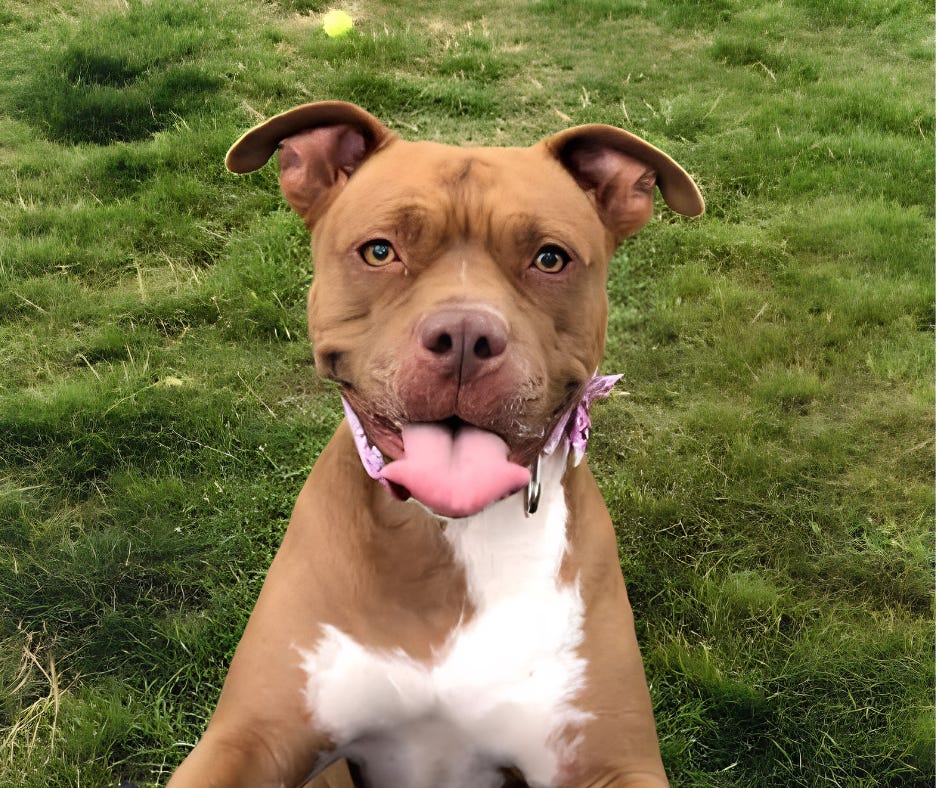
In August 2019, a much loved family dog called Lola was taken from her home by police. She had not attacked anyone, she had not bitten anyone and she had never given her family reason to believe she was dangerous. But someone had reported her as a vicious Pit Bull and that was enough to set in motion a chain of events that would change her life forever.
Lola was taken away in a police van. Her owner, Anita, was not told where she was going or whether she would ever see her again. She was not even allowed to send a familiar blanket, a favourite toy or something carrying the scent of home. One moment Lola was a cherished member of her family, the next she was alone in an unfamiliar kennel, separated from everything and everyone she knew.
And all because of the way she looked.
When we first shared Lola’s story in 2024, we wanted people to understand what breed specific legislation actually means for the dogs and families caught up in it. Behind the legal terminology, the measurements and the court proceedings are living, feeling animals whose lives can be turned upside down despite having done absolutely nothing wrong.
The Dangerous Dogs Act was introduced in 1991 following a series of serious dog attacks that attracted intense media attention and public concern. The government needed to respond, and protecting people from dangerous dogs was a perfectly legitimate objective. Nobody should have to live in fear of being attacked by a dog, and nobody working in animal welfare should pretend otherwise. But the response was legislation that allowed certain dogs to be prohibited not because of anything they had done, but because of their physical appearance.
Thirty five years later, we are still living with the consequences.
Under the legislation, a dog does not need to be a pedigree Pit Bull Terrier to be classified as a prohibited type. It does not need to have Pit Bull ancestry established through genetic testing. What counts is whether its physical characteristics are considered to fit the recognised type. A dog can be a crossbreed, can have lived peacefully with its family for years, can be gentle with everyone it meets and still find itself facing seizure and possible destruction because somebody decides it looks like a Pit Bull.
That is what happened to Lola.
Anita described her as a sweet-natured, sensitive and gentle girl. Lola was an American Bulldog and Staffordshire Bull Terrier cross, but the assessment of her physical characteristics resulted in her being classified as Pit Bull type. According to Anita, the officer who assessed Lola recognised that she was obedient, well balanced and showed no aggression. Even the kennel staff reportedly commented on what a lovely dog she was.
None of that changed her classification.
Anita had to go to court to bring Lola home. The court accepted that she did not pose a danger to the public, but her return came with lifelong restrictions. Lola would have to be muzzled and kept on a lead whenever she was in public. The freedom to run along a beach, explore the woods or chase her ball was gone, not because she had behaved dangerously, but because her body fitted a particular set of measurements.
The separation had already taken its toll. When Lola finally returned home, Anita described a dog who cried, struggled with anxiety and began experiencing problems she had never had before. She was so distressed by the muzzle that even a year later she continued trying to rub it from her face. Medication was prescribed to help with her stress.
Lola was home, but the life she had known had changed forever.
And Lola was one of the lucky ones.
Other dogs have been seized, detained and destroyed despite having no history of aggression. Families have faced the emotional and financial burden of legal proceedings while their dogs remain in kennels, sometimes for prolonged periods. The legislation does allow courts to consider whether a prohibited dog can be safely exempted, but that does not remove the distress of seizure or the possibility that an animal who has never harmed anyone may lose its life.
We have to ask ourselves what this achieves.
Breed-specific legislation was introduced to protect the public, yet serious dog attacks have continued. The prohibited list has expanded, most recently with the addition of XL Bully types in England and Wales in 2024, but the fundamental approach remains the same. We identify dogs according to physical characteristics and impose restrictions on them in the belief that this will make communities safer.
The difficulty is that the evidence needed to demonstrate how effectively this approach prevents attacks remains inadequate. In 2025, the government’s Animal Sentience Committee examined the Dangerous Dogs Act in relation to XL Bullies and raised important concerns about the information available to assess the legislation and its animal welfare consequences. Dog bite data is fragmented, the circumstances surrounding incidents are not consistently recorded, and identifying the contribution of breed-specific restrictions to public safety is far from straightforward.
This should concern us all. If we are going to give the state the power to seize and potentially destroy an animal because of its appearance, surely we have a responsibility to demonstrate that doing so is an effective and proportionate way of protecting people.
A dog’s size and strength can influence the severity of an injury. That is a reasonable consideration when assessing risk. But the physical ability to cause harm is not the same thing as a demonstrated likelihood of behaving dangerously. A muscular dog with a broad head is not automatically aggressive, any more than a smaller dog is automatically safe. Behaviour is influenced by a range of factors, including breeding, early experiences, socialisation, training, health, environment and the way an animal is managed.
Yet our legislation places extraordinary weight on what a dog looks like.
It is also worth considering what happens to the dogs themselves. We talk about seizure, detention and exemption as though these are simply administrative processes, but dogs do not understand legislation. They do not understand why strangers have entered their home or why they have suddenly been separated from their family. They cannot understand why the person they trust most in the world has disappeared or why their familiar routines have been replaced by confinement and uncertainty.
For some dogs, the psychological consequences of that experience may be considerable. Lola’s distress was plain to see, and her experience should remind us that animal welfare does not begin and end with whether a dog is eventually returned alive.
There is another question that deserves far more attention. What could we achieve if the resources devoted to identifying, seizing, kennelling and prosecuting prohibited dogs were also directed towards preventing dangerous behaviour before anyone is hurt?
We need responsible breeding, education, appropriate socialisation, early intervention and effective enforcement when owners fail to manage their dogs safely. We need to understand the circumstances in which attacks occur and act on that information. We need legislation that takes dangerous behaviour seriously, regardless of the breed or appearance of the dog involved.
And we need accountability from people.
Dogs do not choose the circumstances into which they are born. They do not choose who breeds them, how they are raised, whether they are socialised or whether their owners take their responsibilities seriously. Yet it is so often the dog who pays the ultimate price when those responsibilities are neglected.
None of this means ignoring the suffering of people who have been attacked. Their experiences deserve compassion, and preventing further tragedies must remain a priority. But protecting people and protecting dogs are not competing ambitions. We should be capable of doing both, and we should be prepared to challenge legislation when its effectiveness is uncertain or its consequences are unjust.
The debate has become so polarised that questioning breed-specific legislation is sometimes treated as though it means dismissing public safety. It does not. It means asking whether we have chosen the right tools to achieve it.
We should be able to recognise the devastating consequences of a serious dog attack while also recognising the injustice of condemning an individual animal who has never displayed dangerous behaviour. Those two positions are not contradictory.
When I think about Lola, I think about a dog who was loved, who had a home and a family, and whose gentle nature was recognised by the very people assessing her. I think about Anita waiting to find out whether she would ever see her again. I think about the distress Lola experienced and the restrictions she would live with for the rest of her life.
And I think about the dogs whose families never got to bring them home.
Thirty five years is a long time to continue with legislation that raises such serious questions about evidence, fairness and animal welfare. We should not accept its consequences simply because it has become familiar, and we should not mistake the existence of a law for proof that it is achieving what it was intended to do.
The Dangerous Dogs Act was supposed to protect people. That remains a responsibility we cannot abandon. But surely, after all these years, we owe it to people and dogs alike to examine whether there is a better way.
Lola was not dangerous. Her family knew it, the people who assessed her recognised her gentle nature, and the court accepted that she posed no danger to the public.
Yet she was still punished for the way she looked.
A dog’s appearance is not evidence of guilt, and being born with the wrong measurements should never be a death sentence.
Lola’s story was first shared with Dog Desk Animal Action by her owner, Anita, and published in October 2022. The account reflects her experiences at that time.