


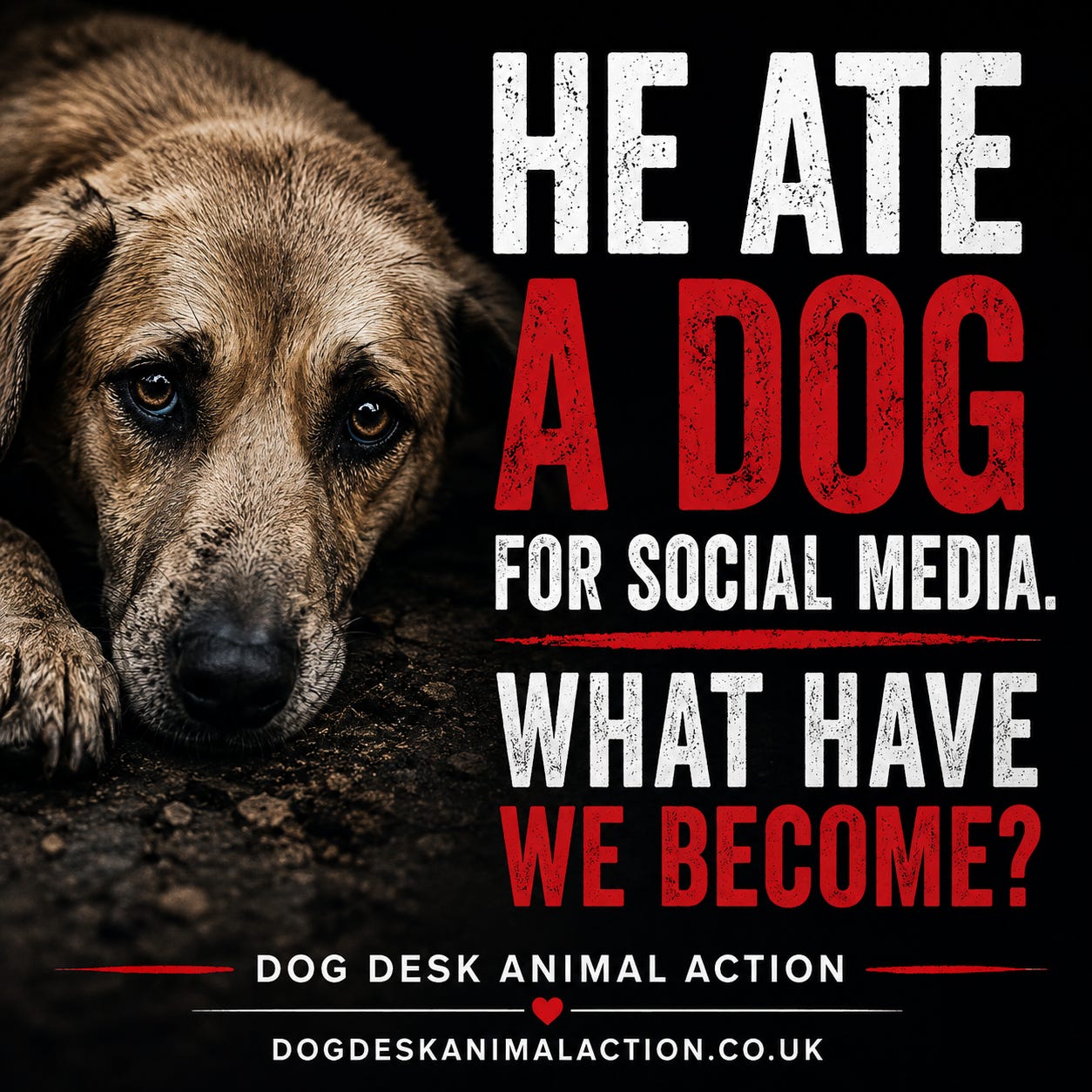
He filmed himself skinning, cooking and eating a dog. He didn’t hide it. He didn’t keep it private. He uploaded the video to social media, where it quickly spread across the internet, attracting hundreds of thousands of views before being removed. Days later he was arrested. He has now been sentenced to eight months in prison.
The case has shocked people around the world, but for Dog Desk Animal Action the most important question isn’t simply what happened to one dog. It is how we reached a point where somebody believed this was content worth creating.
The influencer, Ayoub Ben Nesnes, already had a substantial online following. His videos had long relied on provoking reactions, pushing boundaries and attracting attention. This time, the subject was a dog.
He has denied killing the animal, claiming he found it already dead after it had been struck by a vehicle. Public reports do not establish that the court found he killed the dog himself. What is beyond dispute is that he chose to film himself skinning it, cooking it and eating it before uploading the footage for the world to see.
Some people will focus on the prison sentence. Others will debate whether it should have been longer or shorter. Those discussions are important, but they risk overlooking something much bigger.
Why are animals increasingly becoming props for online content?
Every day social media rewards the extraordinary. The more shocking the video, the more likely people are to stop scrolling. They react, they comment, they share it with friends in disbelief. Before long the content has travelled across countries and languages, reaching millions of people who may never even have heard of the person who uploaded it.
That attention has value.
Large audiences create opportunities. More followers lead to greater influence. Greater influence can open the door to advertising, sponsorships and other commercial opportunities. We cannot know what was in this influencer’s mind when he made the video, but we do know that social media platforms consistently reward material that provokes the strongest emotional reactions.
That should concern anyone who cares about animals.
Whether an animal is alive or dead, there is something profoundly unsettling about reducing it to a spectacle. The dog ceases to be an individual deserving of dignity and becomes nothing more than a means of capturing attention.
This is not just a Moroccan story. It is part of a much wider question about what social media is becoming and what it is encouraging. Every time an animal is frightened, provoked, injured or used simply because somebody believes it will generate engagement, we move a little further away from compassion and a little closer to treating living beings as disposable entertainment.
Technology did not create cruelty, but it has transformed the speed at which cruelty, outrage and controversy can be consumed. The algorithm does not distinguish between kindness and shock. It simply measures engagement.
Animals deserve better than to become content. They deserve better than to become challenges, stunts or viral moments designed to capture attention for a few fleeting days before the internet moves on to the next sensation.
Somewhere between filming it, editing it and pressing publish, a dog stopped being a living being and became content. That should horrify every one of us.