
It is difficult to imagine a greater betrayal of the purpose of veterinary medicine. A dog enters a veterinary clinic because it is sick or injured and needs help. It places that animal in the hands of people whose profession exists to relieve suffering. Yet animal welfare activists in Bengaluru say healthy street dogs were taken into a private veterinary facility, their limbs deliberately broken and orthopaedic surgery then practised on them. Some dogs are reported to have died. Police are now investigating those claims.
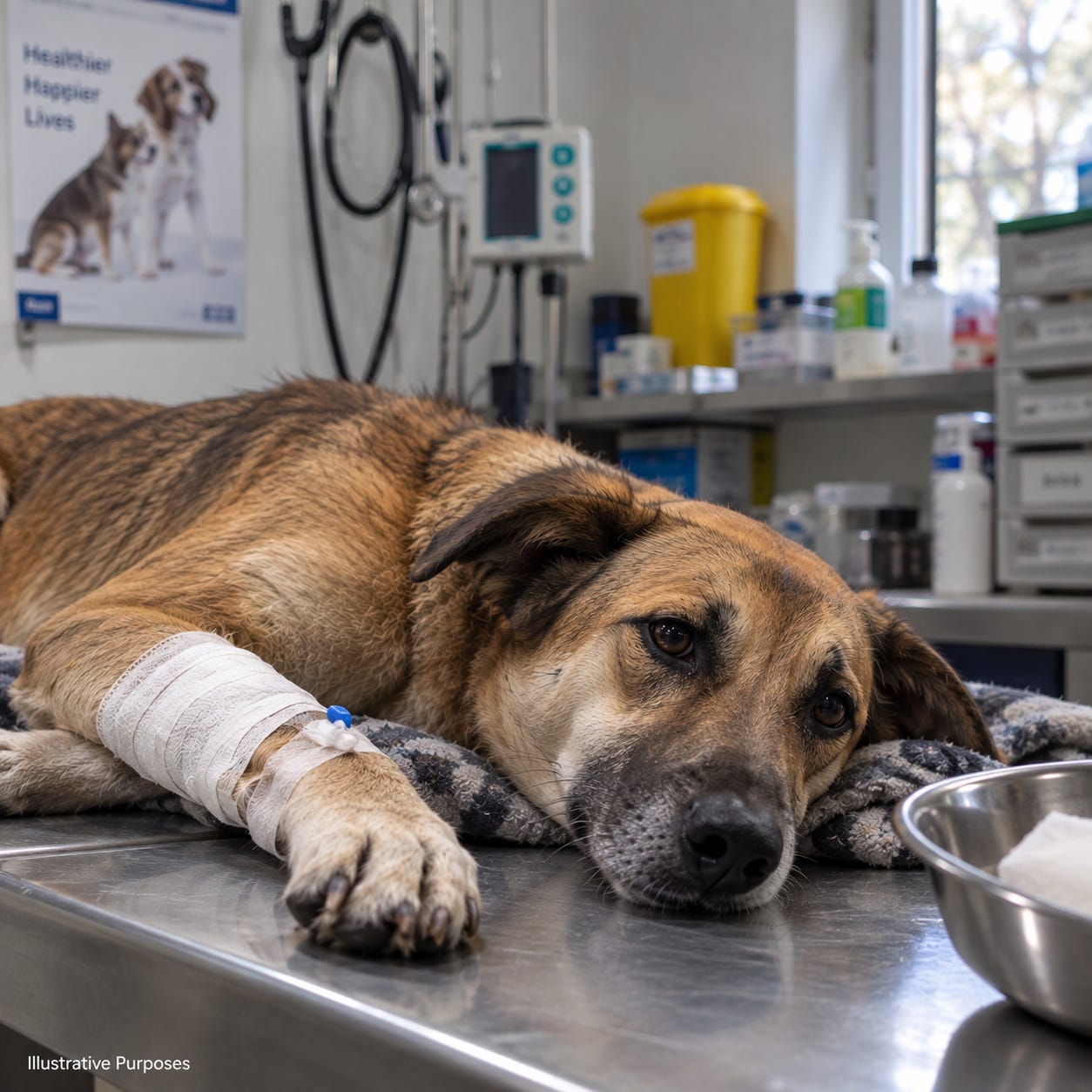
On 9 September, police and officials from the Greater Bengaluru Authority raided a veterinary facility in Doddakannelli, near Bellandur, following complaints and video evidence supplied by animal welfare activists. Indian media have identified the premises as Primecare Vet Hospital, formerly Anicure. Twelve dogs and one cat were found alive inside. A dog was also found dead. Several of the surviving animals required veterinary care and were removed from the premises.
A veterinarian and a postgraduate veterinary student have been booked as the investigation gets underway. The authorities will ultimately have to determine individual responsibility and exactly what took place inside the facility, but the immediate concern is the animals. We need to know how many dogs went through those doors and what happened to them.
One of the most disturbing claims is that people catching street dogs were being paid approximately ₹500 / £3.87 / 5.23 for each animal supplied. Investigators now need to establish whether such payments were made and, if they were, how extensive that supply was. A system in which somebody could obtain another living dog from the street for a few hundred rupees would go some way towards explaining how this could continue. It would also raise the possibility that the dogs were selected precisely because they were free roaming animals and therefore perceived as easier to take.
That perception fundamentally misunderstands what a community dog is. Street dogs do not simply wander through cities unnoticed and unknown. They live alongside people. The same shopkeeper sees them every morning. Residents feed them. Volunteers arrange sterilisation and vaccination. People give them names, recognise their behaviour and know where they sleep. They may not have one conventional owner, but many are very much part of the communities in which they live.
That appears particularly relevant in Bengaluru because reporting indicates that concern about the facility escalated after an animal welfare activist traced a missing dog there.
Imagine, then, the possibility that there were others. A familiar dog disappears from outside a shop or a residential street. The person who feeds them assumes they have moved to another area, been collected for sterilisation, been adopted or perhaps been injured. Meanwhile that animal may have entered a veterinary facility and never returned. This is why determining the origin of every dog that passed through these premises matters so much.
The dogs who were found alive also need to be treated as individuals, not simply recorded as 12 dogs recovered. Each deserves an independent veterinary examination. Their bodies may tell investigators things that records cannot. Radiographs can reveal fractures, previous orthopaedic surgery, implants and healing injuries. Scars and wounds can provide further evidence. Those findings can then be compared with clinical histories, radiographs, surgical notes and records of anaesthesia and pain relief held by the facility. Where surgery was medically necessary, there should be a clinical reason for it. Where there isn’t one, investigators need to establish why that procedure took place.
The dead dog found during the raid deserves the same attention. A post-mortem examination could help establish why that animal died and whether its death was connected to any procedure performed at the facility. But we also need to know whether there were other deaths before authorities arrived. Activists have raised concerns about dogs dying after procedures and about the disposal of bodies. Investigators need to trace mortality and disposal records and reconcile them with the number of animals brought onto the premises.
India already has safeguards intended to prevent animals being used invisibly in research, teaching and training. The Committee for Control and Supervision of Experiments on Animals regulates the use of animals in these areas, including dogs, and the system requires appropriate registration, ethical oversight and records. Large-animal protocols are subject to approval requirements. If what happened in Bengaluru was being presented as surgical training, there should therefore be a clear answer as to what was authorised, by whom, under which protocol and using which animals.
The involvement of a postgraduate veterinary student also means authorities need to establish whether any connection existed with formal veterinary education. Indian reporting identifies the student as being associated with Veterinary College, Hebbal, and activists have made further claims concerning activity at the college. We have not seen evidence establishing that the college authorised or knew about what was taking place at the private facility, and that question now needs to be put directly to it. If this was being done in the name of education, the institution responsible for that education should be able to establish whether it formed any part of an approved programme.
There is also the question of how community dogs could have been removed from the streets in the first place. India’s Animal Birth Control system provides for the controlled capture of street dogs for sterilisation and vaccination, with animals recorded and generally returned to the area from which they were collected after recovery. It is not a mechanism for providing healthy dogs for private surgical practice. If people were collecting dogs for this facility, authorities need to establish who they were, where they operated and how many animals they supplied.
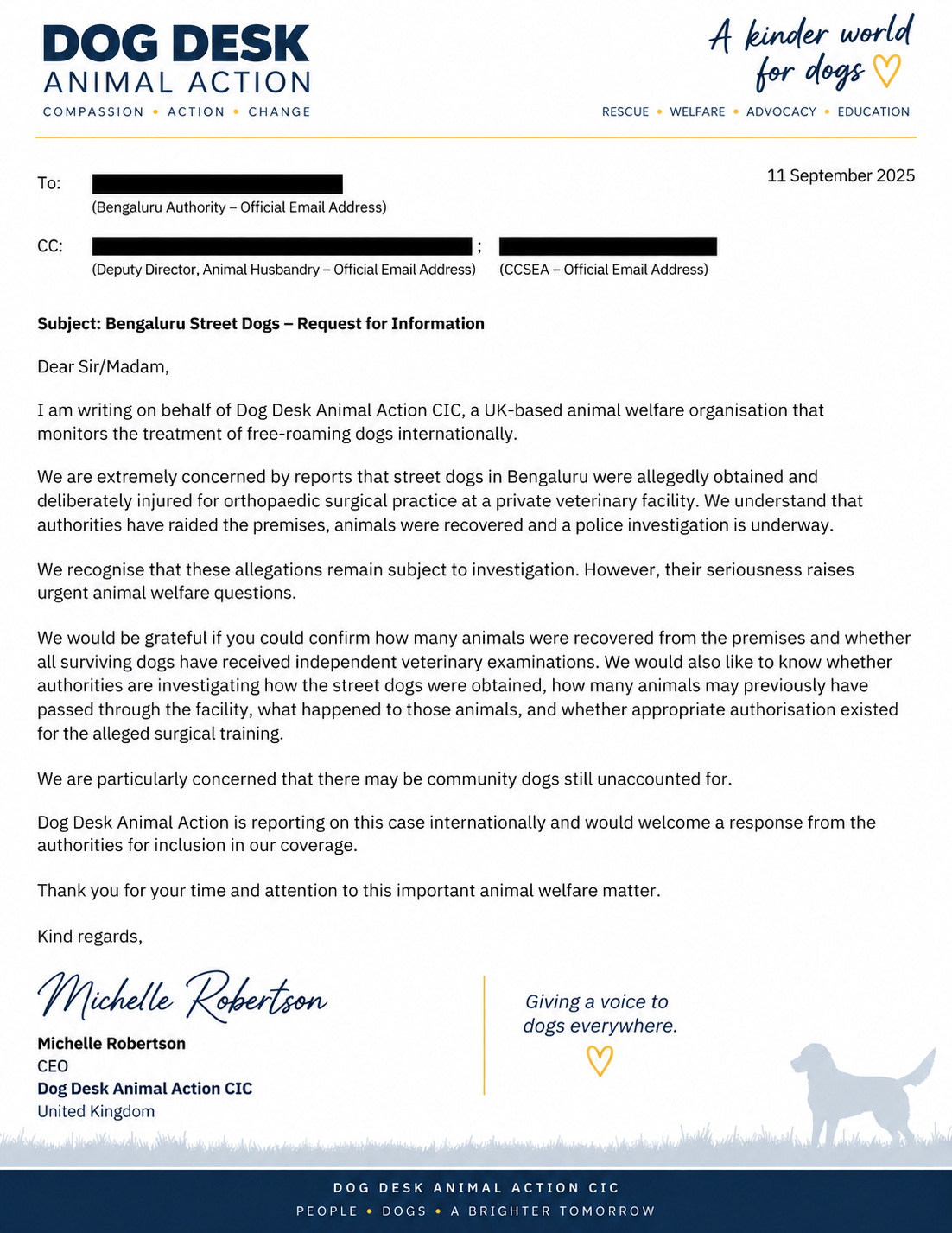
Dog Desk Animal Action has now written to the Bengaluru authorities because we want those questions answered. We have asked how many animals were recovered, whether the surviving dogs have received independent veterinary examinations, whether investigators are tracing the origin of the dogs and whether they are looking backwards to establish how many other animals passed through the facility. We have also asked what authorisation existed for the surgical activity under investigation.
But none of those questions should allow the paperwork to become more important than the animals.
Twelve living dogs were found. One dog was dead. Somewhere there may be records of others who were there before them. There may also be people in Bengaluru who remember a dog disappearing from their street and still do not know where that animal went.
Veterinary medicine should be the place where a dog with a broken leg is taken to have it repaired. The idea that a healthy dog could instead be taken from the street, have a leg deliberately broken and then be operated upon so that somebody could practise repairing it is abhorrent.
These dogs were not teaching aids. They were not a cheap supply of biological material. Their status as street dogs did not make their pain less important or their lives less valuable.
Now that the doors of this facility have been opened, the investigation cannot stop with the animals who happened to be there on the day of the raid. Authorities need to go back through the records and account for every dog that entered.
For the dogs who survived, for the dog who was found dead, and for those who may no longer be there, we need to know what happened to them.
Dog Desk Animal Action has written to the Bengaluru authorities regarding this case. We have asked for information about the animals recovered from the facility, the welfare and veterinary examination of the surviving dogs, how the street dogs came to be there, whether other animals had previously passed through the facility and what happened to them. We have also asked what authorisation, if any, existed for the surgical activity under investigation.