

On 30 August 2026, a one-year-old miniature donkey named HeeHaw was shot and killed by a police officer in Georgia, United States. He was standing in a pasture belonging to Elsberry Riding and Farm when officers entered the property during a search for a missing 12-year-old girl.
HeeHaw was not a wild animal. He was a domesticated donkey who had been bottle-raised, was accustomed to people and was regarded as a member of the family. His owner, Hannah Israel, has described a sociable young animal who participated in petting-zoo activities. By the end of that night, he was dead.
The officer who shot HeeHaw, Trenton Garner of Cedartown Police Department, stated in his incident report that the donkey charged towards officers and a K-9 handler. According to his account, an attempt to deter the donkey using a TASER was unsuccessful, and he discharged his firearm.
HeeHaw’s owner disputes the suggestion that her donkey posed a threat. She has filed a federal civil-rights lawsuit against the officer, alleging that police entered her enclosed pasture without consent or a warrant and unlawfully killed her animal. Those allegations remain contested.

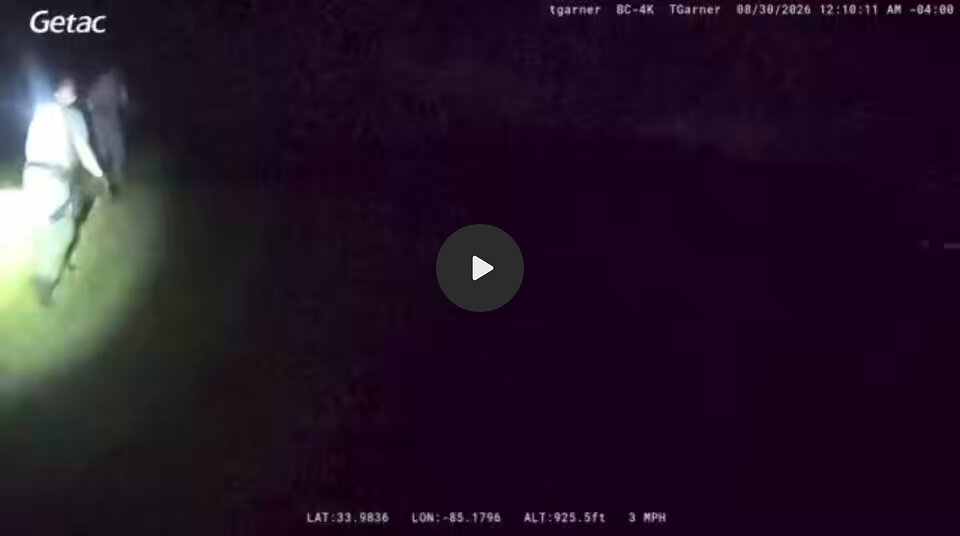
On 9 October, local broadcaster WSB-TV published body-camera footage of the encounter. The footage brings renewed attention to the circumstances of HeeHaw’s death, but it also raises a question that goes beyond the actions of one officer.
How much do police officers actually know about the animals they encounter while carrying out their duties?
A search for a missing child is a serious and urgent police operation. Nobody disputes the importance of locating a vulnerable child as quickly as possible. But urgency does not eliminate the need to understand the environment into which officers are entering, particularly when that environment contains animals.
A pasture is not an empty field. It is an occupied space in which animals may react to unfamiliar people, unfamiliar dogs, sudden movement, noise and perceived threats. A donkey approaching an intruder may be curious, defensive, alarmed or displaying several responses at once. Movement towards a person does not, by itself, establish an intention to attack.
At Dog Desk Animal Action, we have direct experience of donkeys living alongside dogs. The donkeys are accustomed to canine companions, familiarity is important. An animal’s acceptance of dogs it knows does not necessarily tell us how it will respond to unfamiliar dogs arriving in its enclosure during the night.
There is a question about responsibility. When officers enter a space occupied by animals, particularly with police dogs, they are introducing unfamiliar elements into an established environment. If an animal responds defensively, that response cannot automatically be assessed as though the animal had independently created the confrontation.
Police officers are trained to assess threats, make rapid decisions and protect themselves and others. But human threat assessment and animal behaviour assessment are not interchangeable skills.
An officer may be highly competent in conventional policing yet have little understanding of equine behaviour. A K-9 handler may be experienced in managing a working dog without having received meaningful instruction in how livestock respond to dogs. Those are training questions, not assumptions about the competence of the particular officers involved in HeeHaw’s death.
We want to establish what training was actually provided, what procedures existed and whether those procedures were followed.
Dog Desk Animal Action Has Opened Formal Enquiries
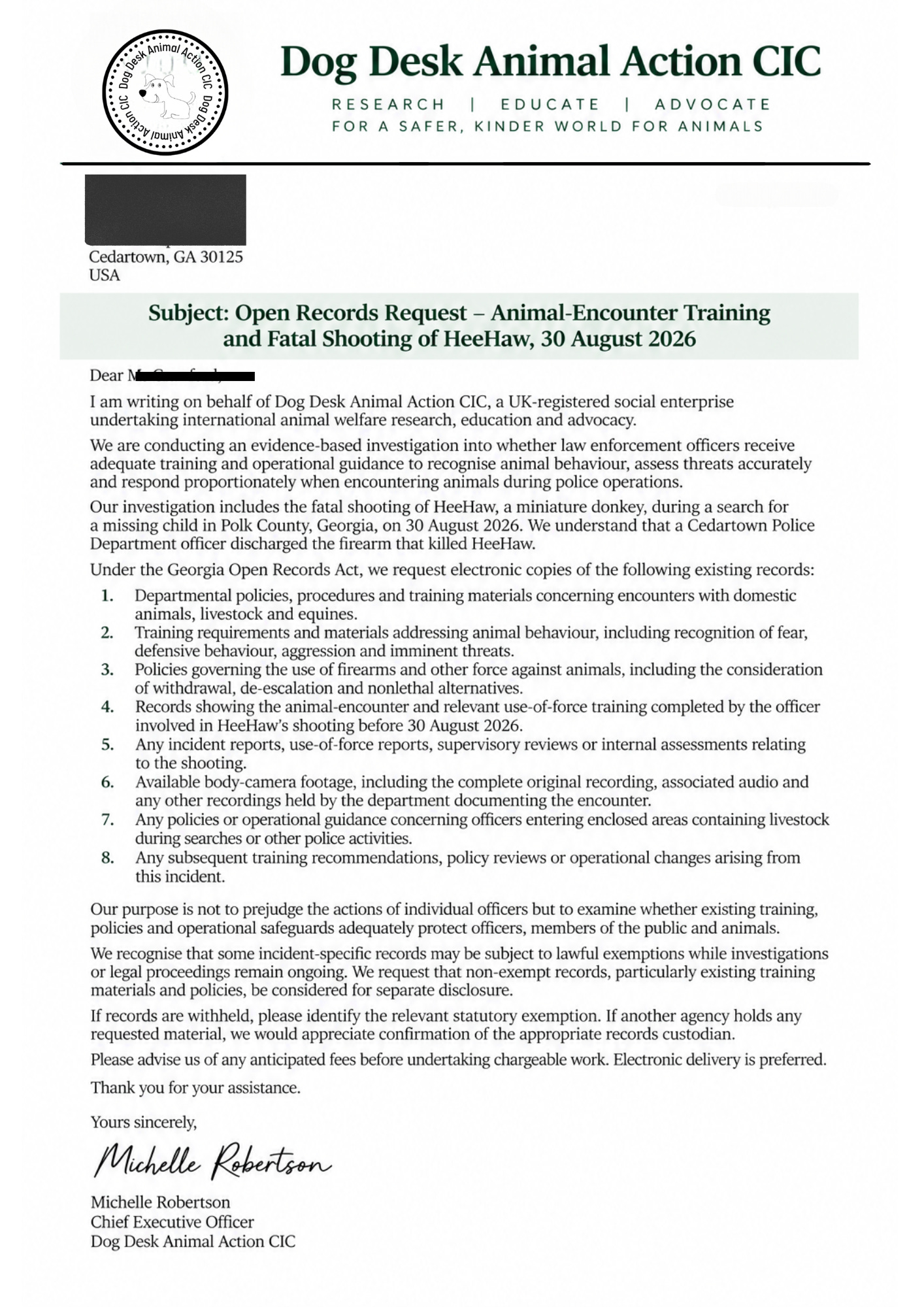
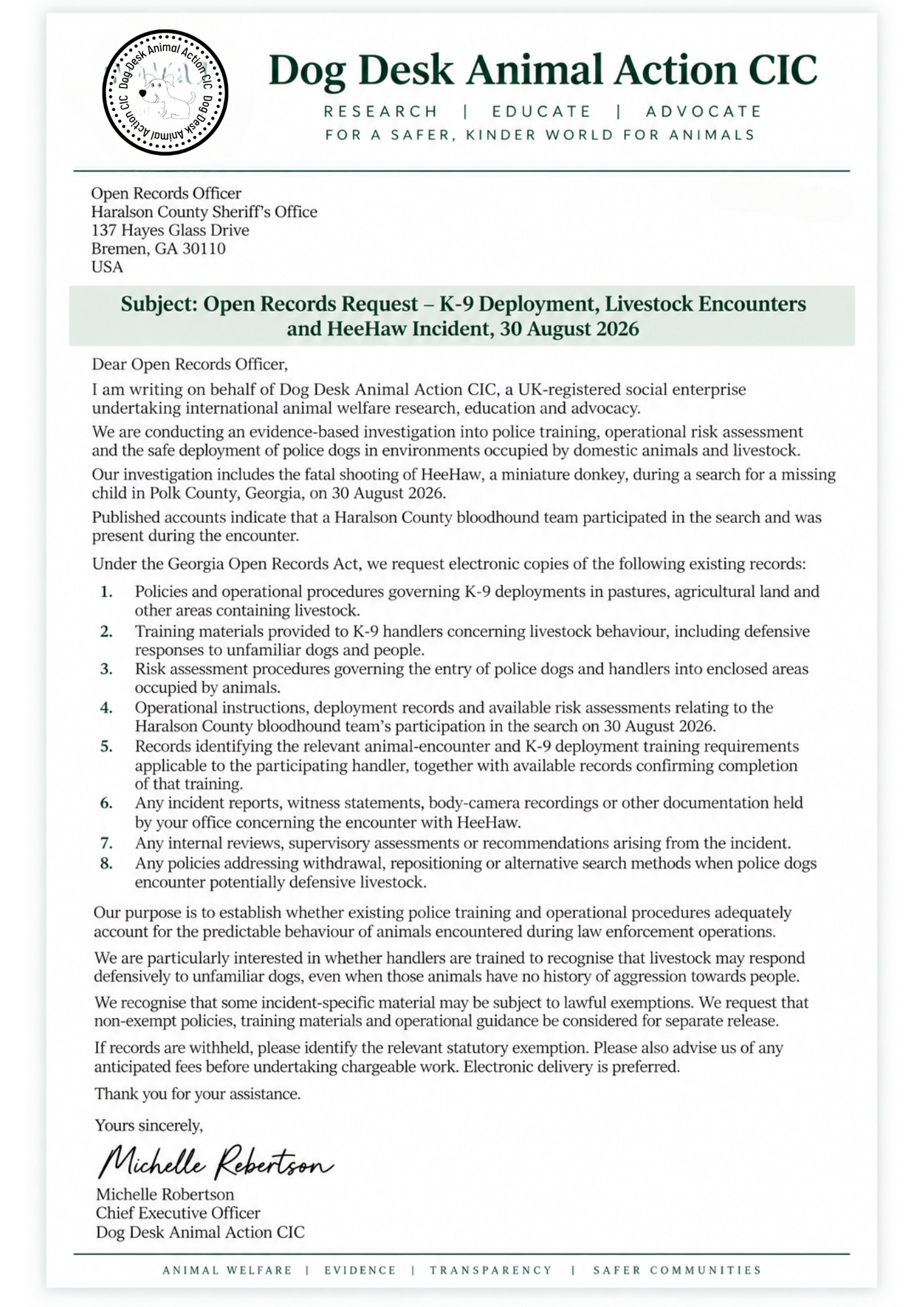
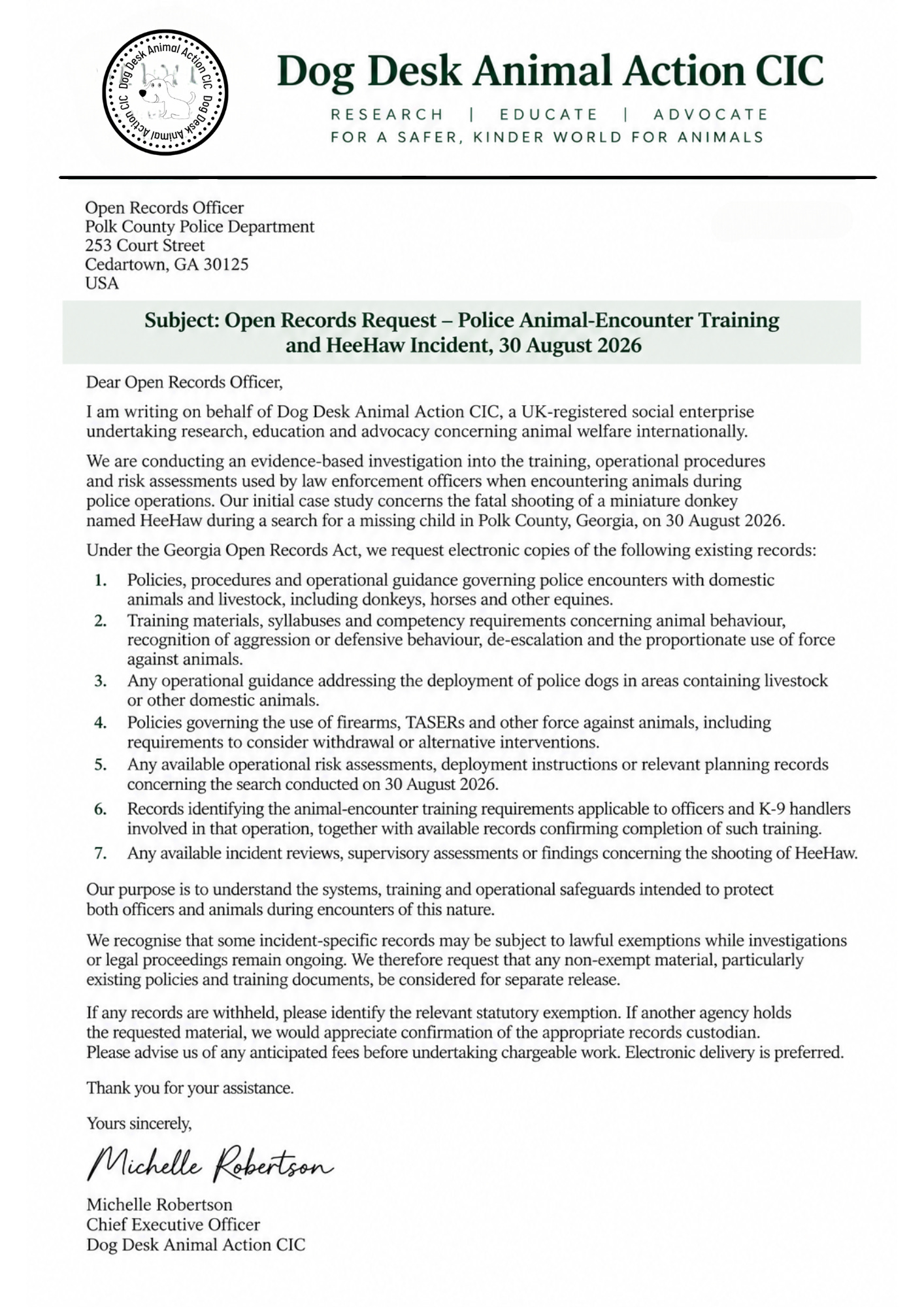
We have prepared formal requests under the Georgia Open Records Act directed to Polk County Police Department, Cedartown Police Department and the Haralson County Sheriff’s Office.
The requests seek existing policies, training materials, operational guidance, risk assessments, K-9 deployment procedures and records relating to the shooting of HeeHaw.
We are asking whether officers receive specific instruction on recognising fear, curiosity, defensive behaviour and aggression in domestic animals and livestock. We want to know what guidance exists for entering enclosed pastures, particularly when police dogs are involved, and whether officers are required to consider withdrawal, repositioning or alternative approaches before using force against an animal.
The Georgia Department of Agriculture’s Law Enforcement Division has also been investigating the incident, while HeeHaw’s owner is pursuing legal action. Our work is separate from those proceedings.
This Investigation Is Bigger Than One Donkey
HeeHaw’s death has brought an important issue into focus, but the question applies to many different animals and many different policing situations.
Police officers encounter dogs in homes, gardens, streets and public spaces. They encounter horses and livestock during rural searches, traffic incidents and emergencies. They may be called to situations involving injured, frightened, confined or distressed animals.
In each case, the animal’s behaviour can be affected by its surroundings and by the actions of the people approaching it.
The ability to recognise those influences should not be treated as optional knowledge when officers are authorised to use force that can end an animal’s life.
We are not suggesting that every encounter is safe or that officers should be expected to expose themselves to serious injury. Genuine threats exist, and there will be circumstances in which immediate protective action is necessary.
But a proportionate response requires more than identifying a possible danger. It requires understanding the nature of that danger, how it arose and whether it can be reduced without killing the animal. And we are not sure that officers are fully equipped with the knowledge they need to carry out operations to the best of their ability when animals enter their spaces of operation.
Better training cannot guarantee that every encounter will end safely. It can, however, give officers more information on which to base decisions, improve operational planning and reduce the risk of avoidable confrontations.
That is what we intend to examine.
HeeHaw Cannot Be Brought Back
For HeeHaw’s family, this is not an abstract discussion about policing procedures. A young animal they raised and loved was killed in his own pasture. That is a tragic & deeply upsetting incident for them & for the public.
The legal process will address the allegations made in the federal lawsuit. Investigators will examine the circumstances of the shooting. Our concern is with the wider question of whether the systems surrounding such encounters are sufficiently informed by animal behaviour and welfare.
If officers are entering environments containing animals without adequate species-specific knowledge, that is a problem which deserves attention well beyond Georgia.
If effective training and safeguards already exist, we want to see them. If there are gaps, we want to identify them and consider what improvements could prevent another animal from dying unnecessarily.
An animal should not have to die before anyone asks whether the people approaching it understood its behaviour.
Dog Desk Animal Action will publish the responses to our enquiries, subject to appropriate redaction, and report on what the evidence establishes.
HeeHaw’s death deserves a thorough examination. So does the wider question it has raised.
This investigation is ongoing. Requests for records do not imply findings of wrongdoing. The allegations in the civil proceedings remain subject to determination.