


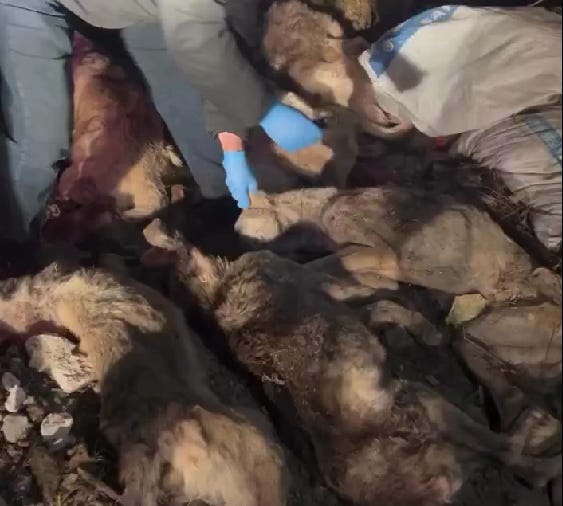
On 17 March 2026, around forty dogs were found dead in a dump site in the Eminkuyu area of Edremit, Balıkesir Turkey
They were not discovered one by one. They were found together. In the same place.
At the same time. Many of them had municipal ear tags. None of them had been buried.
That is what we know.
What Happened
The discovery followed a report, bringing police, municipal teams, and authorities to the scene.
The dogs were located in what has been described as an old rubbish or dump site.
Not a roadside. Not across multiple locations. Not over time. All at once
A single site.
This detail matters, because it immediately tells us something, these were not unrelated, natural deaths occurring independently.
They were part of the same event. At the time of writing, there is:
no confirmed cause of death
no confirmed timeline
no identified individual responsible
An investigation is ongoing.
The Detail That Cannot Be Ignored
Multiple reports confirm that many of the dogs had municipal ear tags. These are dogs that have already passed through the system.
They have been:
collected
processed
registered
under municipal responsibility
They are not unknown animals. They are accounted for. Which leads to a simple and unavoidable question:
How do dozens of registered dogs end up dead together in a dump site?
What Normally Happens When Dogs Die
It is important to be clear and fair.
Dogs do die in shelters and under municipal care. This is true everywhere in the world
Some die of old age
Some from injuries that cannot be treated
Some arrive with advanced or complex disease and do not survive despite intervention
Municipalities also have responsibilities to:
collect road traffic casualties
And there are designated municipal burial sites for this purpose.
This is normal. This is expected. But these dogs were not buried in a designated site they were left in a garbage dump with zero dignity
What Our Experience Tells Us
In our own work, we do see loss. Some dogs arrive in extremely poor condition.
Some cannot be saved. But the number is tiny.
Over years of working in Turkey, across large numbers of dogs, the overwhelming majority:
survive
stabilise
and go on to live
What we do not see is ever is large numbers of dogs dying at once.
Why This Case Is Different
Even taking everything above into account:
natural deaths
road traffic casualties
We would not expect to find thirty or forty dogs together in a single location at the same time.
That is not consistent with:
normal mortality
routine municipal operations
or the realities of shelter work
The scale alone changes the nature of the question. This is not about whether dogs sometimes die.
It is about how this number of dogs came to be in one place, at one time.
What the Pattern Suggests
It is important to stay within what is known. There is no confirmed cause of death.
But there are observable facts:
A high number of dogs
A single location
Simultaneous discovery
Presence of municipal ear tags
Taken together, this is not a pattern consistent with:
isolated incidents
natural death over time
It points to a single event affecting multiple animals.
That does not tell us how it happened.
Responsibility Under the Law
Under Law 5199, municipalities are responsible for:
protecting stray animals
ensuring their care
managing them within a defined welfare framework
This is not optional.
When dogs within that system are found dead in these circumstances, the question is not abstract. It is direct
Where did responsibility fail?
The Response from the Veterinary Profession
The Turkish Veterinary Medical Association has responded with clarity
They have stated that:
the incident cannot be explained as simple neglect
it requires full investigation
it may constitute a criminal matter
They have called for:
identification of those responsible
and the application of the most serious administrative and criminal sanctions
This reflects the seriousness of the situation.
What We Do Not Yet Know
There are still important gaps:
The cause of death
Whether the dogs were moved
Whether they died where they were found
Who had control of them prior to death
These are questions for a proper investigation. Loss is part of any animal welfare system. But this is not loss in the ordinary sense.
The number, the location, and the fact that these were registered dogs place this case outside what can reasonably be expected under normal conditions.
At that point, the question is no longer whether dogs sometimes die. The question is how this happened.
And that is a question that cannot be left unanswered.