


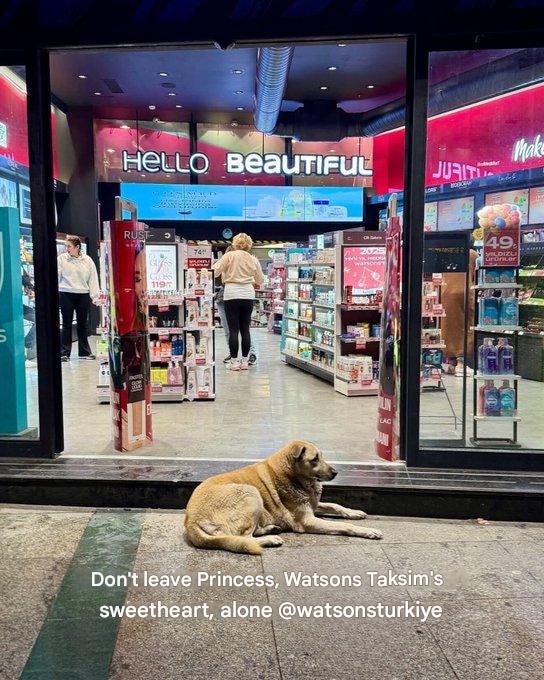
There is a photograph circulating of a dog lying quietly outside a Watsons store in Taksim Turkey
Her name is Prenses.
She is not an unknown animal. She is not hidden, aggressive, or transient. She is a familiar presence the kind of dog people recognise, step around, and in many cases, quietly care for. The kind of dog who exists in that delicate space between street and belonging.
And yet, within a matter of hours, she became the centre of a public dispute.
The Reality Behind the Image
What appears calm on the surface often sits on unstable ground.
Reports suggest that complaints were made about Prenses being present around the store. That alone is enough, in the current climate, to trigger intervention. Not necessarily because the dog has done anything wrong but because her presence becomes inconvenient to someone.
From there, the pattern is familiar:
A complaint is raised
Removal becomes a possibility
A decision is made quickly
The dog’s future shifts overnight
Prenses’ situation escalated not because she changed but because perception did.
A Measured Response Matters
In this case, public attention arrived quickly.
And importantly, so did a response from Watsons Türkiye.
Their statement did not dismiss concern. It did not escalate tension. It indicated that Prenses is being cared for and is not abandoned, and that steps have been taken with her welfare in mind.
That matters.
It is easy, in moments like this, for businesses to retreat behind policy or silence. Instead, Watsons acknowledged the situation and signalled responsibility. For a company operating in a complex and often polarised environment around stray dogs, that is not insignificant.
It is also worth recognising that many businesses including Watsons have a quiet, consistent history of tolerance and care toward street animals, often without public attention.
This is not a case of indifference. It is a case of navigating pressure.
The Fragility of Community Dogs
Prenses’ story highlights something deeper.
The concept of the community dog is often spoken about as if it offers security. In reality, it can sometimes be one of the most fragile positions an animal can occupy.
A dog may be:
fed daily
known by name
tolerated by a business
accepted by regular visitors
And still be one complaint away from removal.
There is no formal protection in that status. No guaranteed continuity. No safeguard against sudden change.
What looks like stability is often temporary permission.
Where Responsibility Sits
It would be easy to frame this as a failure of a single business.
It is not.
Situations like this emerge from a wider environment:
unclear frameworks around street dogs
pressure from complaints framed as hygiene or safety concerns
limited structured alternatives for dogs who cannot simply disappear
Businesses, municipalities, and individuals are all operating within that system often making decisions under pressure, and not always with full control over outcomes.
That does not remove responsibility.
But it does mean responsibility is shared.
What Should Happen Next
The most important question is not who is to blame.
It is what stability looks like for dogs like Prenses.
That means:
clarity on where she is and who is responsible for her care
ensuring she is not moved repeatedly in response to complaints
recognising that visible, calm, non-aggressive dogs are not the problem
And more broadly building systems where dogs are not displaced simply because they are seen