

In social media comment sections, replies, and direct messages, individuals sometimes position themselves as authorities often claiming to be a vets in order to criticise, discredit, or belittle others.
This behaviour is about manufactured authority. And its a worry.
The Use of Expertise as a Weapon
Claiming to be a veterinarian carries weight. It signals education, clinical experience, and responsibility. Most people will instinctively defer to that. That is precisely why it is misused.
When someone falsely presents themselves as a vet, it allows them to:
Shut down discussion without evidence
Intimidate individuals who are acting in good faith
Create doubt around legitimate care or decisions
Position themselves as superior without accountability
It is not about animal welfare. It is about control of the narrative.
The Reality: Most Claims Go Unchecked
Online, there is no immediate verification. Anyone can:
Add “vet” to a username
State “as a trained professional”
Make clinical-sounding assertions
Very few people will stop and ask:
Where are they registered?
With which governing body?
In which country are they licensed to practise?
In the UK, Verification Is Simple and Misrepresentation Is Illegal
In the UK, this is not ambiguous.
Veterinary surgeons must be registered with the Royal College of Veterinary Surgeons (RCVS). The register is public and easily searchable. It takes seconds to check whether someone is legitimately qualified and licensed to practise.
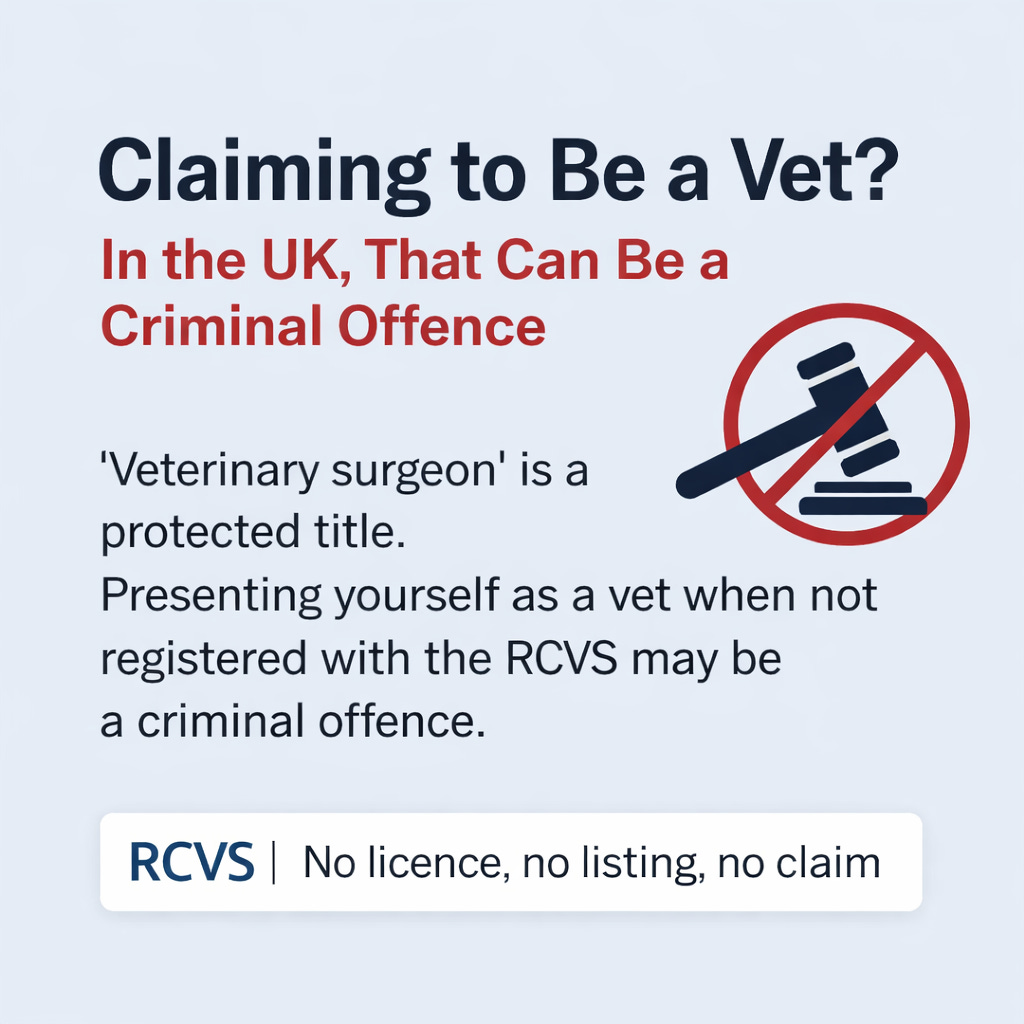
More importantly, the title veterinary surgeon is legally protected.
It is illegal in the UK to falsely claim to be a veterinary surgeon or to carry out acts of veterinary surgery without being registered. This is a criminal offence under the Veterinary Surgeons Act 1966 and can lead to prosecution and financial penalties.
This is a matter of law.
How to Check the RCVS Register in 10 Seconds
If someone claims to be a vet in the UK, you can verify it immediately.
Step 1: Search RCVS Find a Vet (official Royal College of Veterinary Surgeons register)
Step 2: Enter their name
Step 3: Check the result
You are looking for:
A matching full name
Active registration status
UK-based licence to practise
No result = not a registered UK veterinary surgeon
There is no reason to rely on unverified claims when the official register is public.
The Link to Scamming and Manipulation
There is also a more concerning layer.
Some of these false identities are not just about ego they are part of broader online manipulation tactics. Accounts originating from organised scam networks have been known to adopt professional identities (including veterinary roles) to:
Build credibility quickly
Gain trust
Undermine others who challenge them
Create confusion in emotionally charged discussions
The tactic is simple: appear authoritative, speak confidently, and most people will not question it.
Why This Matters for Animal Welfare
Misinformation dressed as expertise is dangerous.
When false “professionals”:
Claim harm without evidence
Misrepresent normal handling or treatment
Spread fear about routine care
it distracts from real welfare issues and undermines those actually doing the work. It also creates a hostile environment where genuine discussion becomes difficult.
A Simple Standard: Evidence Over Identity
There is a straightforward way to deal with this. Do not focus on what someone claims to be. Focus on what they can show.
Ask:
What is the evidence?
Is the claim specific and accurate?
Can it be independently verified?
If someone relies solely on I’m a vet as their argument, without providing clear, factual reasoning, that is not expertise it is a shortcut.
Professionalism Is Verifiable
Real veterinary professionals:
Are registered with recognised bodies
Can be checked against official registers
Do not need to assert superiority to make a point
Communicate clearly, responsibly, and with accountability
They do not appear anonymously to undermine others.
Closing Note
The internet has made it easy to claim authority. It has not made it easier to earn it. Animal welfare depends on accuracy, transparency, and accountability not on unverified titles used to silence others.
If someone claims to be a vet, they should be able to prove it. If they cannot, their opinion should be treated as exactly that, an opinion.
And in the UK, falsely presenting yourself as a veterinary surgeon is not just misleading, it is illegal.