

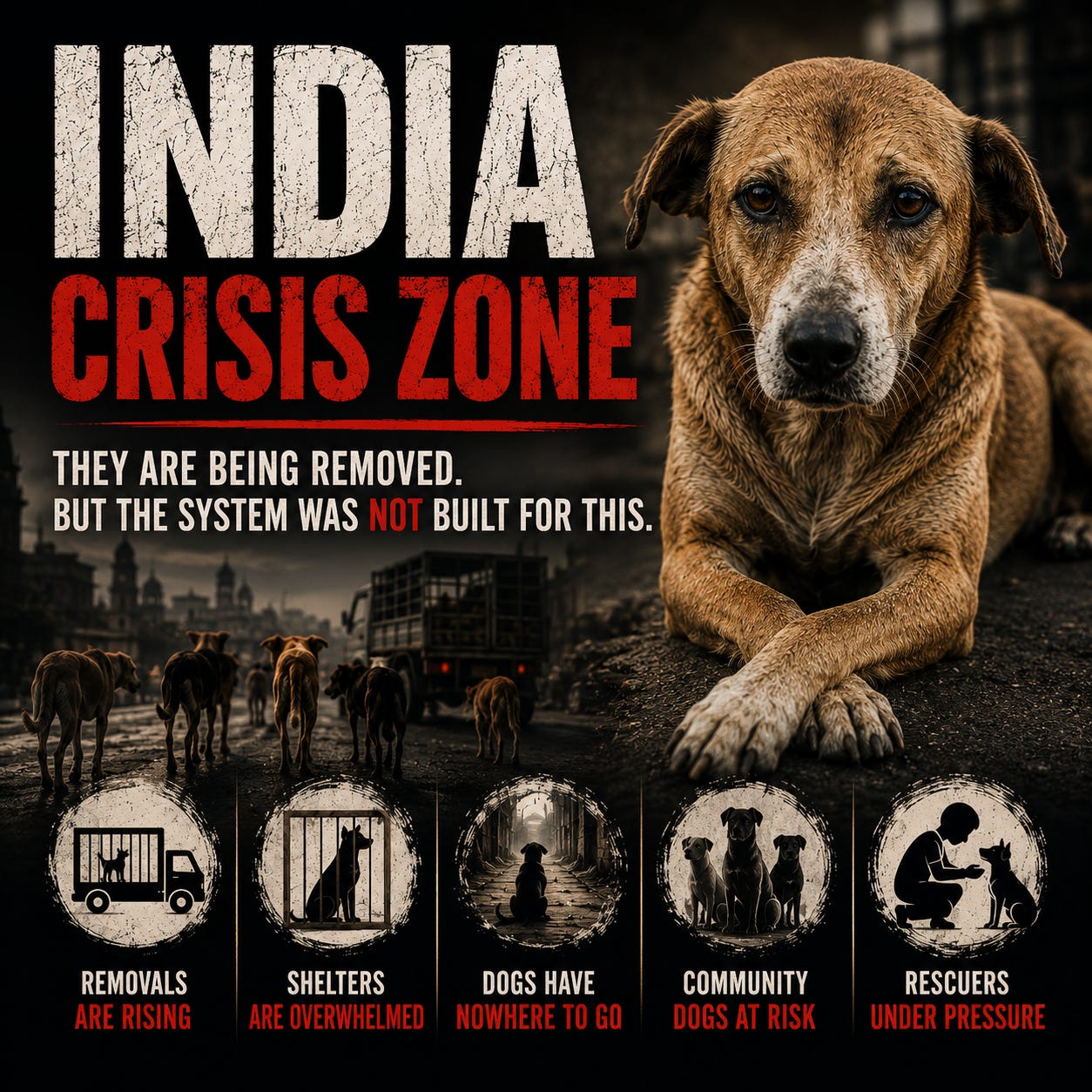
For years, India’s street dog debate has existed in a tense balance between public safety concerns and animal welfare protections. That balance now appears to be shifting.
In May 2026, the Supreme Court of India issued one of the most significant stray dog rulings the country has seen in years. The ruling upheld sterilisation and vaccination programmes under India’s Animal Birth Control (ABC) Rules, but it also directed authorities to remove dogs from areas such as schools, hospitals, bus stations, railway stations and other high-footfall public spaces. In some cases, dogs are now expected to be permanently relocated to shelters rather than returned to the streets.
At the same time, the court confirmed that euthanasia may legally be used for rabid dogs, incurably ill dogs, or animals proven to be dangerously aggressive under veterinary protocols.
On paper, these directions may sound structured and controlled. The real question is whether India has the infrastructure to carry them out humanely. That is where the situation begins to resemble the warning signs seen in other crisis regions.
Across multiple states, authorities are already acknowledging major shortages in shelter capacity, sterilisation infrastructure, trained veterinary staff, quarantine facilities and long-term funding.
The Supreme Court itself recognised that implementation would require enormous infrastructure expansion and coordination between local authorities, shelters and welfare groups. Yet public pressure is escalating faster than capacity is being built.
In Kerala, authorities are reportedly struggling to comply with existing court directives to clear dogs from sensitive public areas because there are simply not enough facilities to house them.
In Punjab, officials have announced plans to intensify removals following the Supreme Court’s latest ruling.
In Bhopal, new government shelters are now being developed specifically to hold dogs removed from no dog zones.
This is the core issue now facing India, what happens when a country begins removing very large numbers of dogs without an equivalent expansion in humane long term care?
Animal welfare groups fear overcrowded shelters, disease outbreaks, neglect and rising mortality inside containment systems. Some activists argue the country is moving toward a model of mass confinement that could become unmanageable at scale.
Others insist stronger intervention is unavoidable because public confidence in existing street dog management has collapsed after repeated reports of attacks and rabies fears.
This is what makes India’s situation more than a stray dog debate. The country is entering a period of growing policy instability, where pressure is shifting away from coexistence and toward control. The discussion is no longer only about sterilisation and vaccination. It is increasingly becoming a debate about removing dogs from public spaces, expanding confinement systems, legal responsibility after attacks, who has the right to shared urban spaces, the growing role of the courts and whether existing systems can realistically support humane coexistence in densely populated cities.
At the centre of it all are the dogs themselves caught between rising public pressure and systems that may not be prepared for the consequences of large scale removal.
The Supreme Court has even directed High Courts across India to monitor compliance with stray dog management orders, signalling that this issue is now being treated as a national governance challenge rather than a local nuisance complaint.
Meanwhile, welfare organisations continue warning that reactive policies implemented without infrastructure can rapidly create suffering on a massive scale.
India has not formally adopted a nationwide extermination policy. But the country is undeniably entering a new phase in its relationship with free-roaming dogs, one defined by rising pressure, legal intervention, public fear, and growing uncertainty over what humane management will actually look like in practice.
For rescuers and street dog advocates, that uncertainty is becoming increasingly difficult to ignore.