
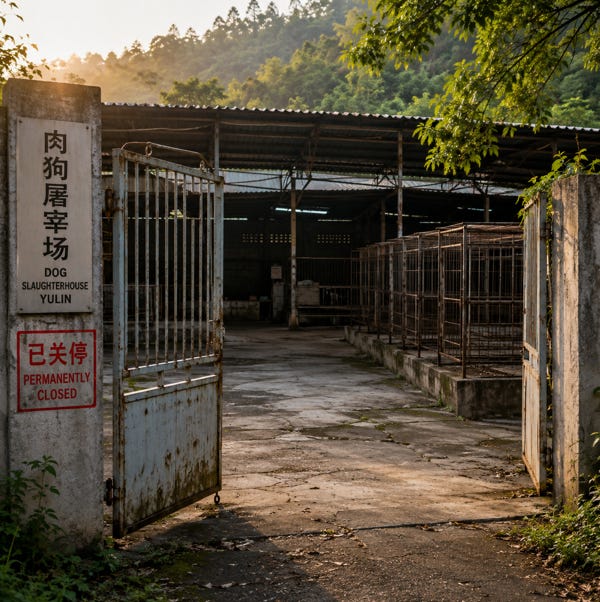
There are moments in animal welfare that pass almost unnoticed, quietly overshadowed by the endless stream of cruelty, neglect and suffering that fills the headlines. Then there are moments that deserve to be paused over because they represent something genuinely different. The permanent closure of a dog slaughterhouse linked to China’s Yulin dog meat trade is one of those moments.
For almost two decades, the slaughterhouse operated approximately 30 kilometres south of Yulin in Guangxi Province. It is estimated to have slaughtered around 15 dogs every week and, during the weeks leading up to the annual Yulin Lychee and Dog Meat Festival, business intensified as demand increased. Campaigners estimate that since opening in 2007, more than 15,000 dogs passed through its gates. Fifteen thousand lives ended inside a single facility. That number is difficult to comprehend, yet it serves as a stark reminder that behind every statistic was an individual dog capable of fear, companionship, loyalty and trust.
Unlike many reports surrounding the dog meat trade, this story does not begin with an undercover investigation or a dramatic rescue. Instead, it begins with an unusual conversation. Rather than focusing solely on protest or enforcement, animal welfare organisations approached the owner with an alternative. Could he leave the trade altogether? Could he build a different future without continuing to profit from the suffering of dogs? The answer, remarkably, was yes.
The owner, publicly identified only by the pseudonym Mr Huang, had spent almost twenty years working in the dog meat trade. According to those involved in the transition, he admitted that it was not a life he wished to continue. He reportedly described it as a dirty business and spoke openly about wanting a quieter, more peaceful life. Demand for dog meat has also declined in many parts of China as attitudes towards companion animals continue to evolve, particularly among younger generations, making the trade less attractive economically than it once was. Rather than remaining in the industry, Mr Huang agreed to leave it permanently and begin a completely different business preparing and selling breakfast foods.
That agreement may sound straightforward, but its significance should not be underestimated. Animal welfare organisations have spent years campaigning against the dog meat trade through public awareness, rescue operations, education and political pressure. This time they demonstrated another route to change. Instead of simply closing one slaughterhouse, they sought to remove one more participant from the industry altogether.
When campaigners entered the slaughterhouse following the agreement, they found nine dogs waiting to be killed. Those nine dogs would become the final animals ever to enter the facility.
Among them were three dogs still wearing collars.
It is a small detail, but one that speaks volumes. For years, campaigners have argued that the dog meat trade is supplied not only by free roaming dogs but also by stolen companion animals. While proving the origin of every individual dog is impossible, the discovery of collared animals continues to raise deeply troubling questions about where many dogs entering the trade actually come from. A collar does not prove ownership beyond doubt, but it does suggest that somewhere, someone may once have loved that dog.
Three of the rescued dogs have since become familiar faces. A Labrador was named An An, a Beagle became Moli, and a Poodle was given the name Lian. Together with the remaining six rescued dogs, they received veterinary treatment, vaccinations, parasite control and rehabilitation before beginning entirely new lives. Their story could easily have ended inside the slaughterhouse. Instead, they became living symbols of what intervention at the right moment can achieve.
The slaughterhouse itself had operated largely out of public view. Reports indicate that around 70 per cent of its annual income was generated during the period surrounding the Yulin Lychee and Dog Meat Festival each June, a time when the city attracts intense international attention. Contrary to popular belief, the festival is not an ancient Chinese tradition stretching back centuries. It emerged only around 2010 and is widely understood to have been promoted by traders seeking to increase dog meat sales. Over time it became an international symbol of the wider dog meat trade, drawing criticism from animal welfare organisations, governments and members of the public across the world.
Yulin has become so closely associated with the trade that it is easy to forget the wider picture. China is a vast country with enormously diverse cultures, traditions and attitudes. The overwhelming majority of Chinese people do not regularly consume dog meat, and public opinion has changed dramatically over recent years. Pet ownership has grown rapidly, particularly in urban areas, with millions of dogs now regarded as much loved members of the family. Cities including Shenzhen and Zhuhai have introduced bans on the consumption of dog and cat meat, reflecting changing social attitudes and increasing recognition of companion animals within Chinese society.
That changing relationship between people and animals forms an important backdrop to this story. Economic realities are changing alongside public opinion. Campaigners involved in the closure have suggested that declining demand also influenced Mr Huang’s decision to leave the trade. If fewer customers are buying dog meat and alternative livelihoods become financially viable, more traders may eventually conclude that leaving the industry is simply the better option.
This approach is sometimes referred to as a livelihood transition programme. Rather than viewing every trader solely as an adversary, the programme recognises that many entered the trade because it provided an income. By helping them establish different businesses, the hope is that fewer dogs will enter the supply chain in the future. Similar programmes have already been used in countries including South Korea, Indonesia and Vietnam, where a number of dog meat farmers and traders have transitioned into entirely different occupations.
Of course, one closure does not erase what happened within those walls. More than 15,000 dogs are estimated to have been slaughtered there since 2007. Nothing can undo that suffering.
What this closure does provide is something that animal welfare campaigns do not always receive, evidence that progress is possible. Not theoretical progress, not promises for the future, but the permanent closure of a facility that had contributed to the suffering of thousands of dogs.
Perhaps the most encouraging aspect of this story is that it offers a model that could be repeated. If one slaughterhouse owner can leave the trade permanently and build a different future, there is every reason to explore whether others might follow. No single strategy will end the suffering experienced by dogs caught up in the meat trade. Education, stronger legislation, public awareness, rescue work and enforcement all remain essential. Yet this closure demonstrates that creating opportunities can sometimes achieve what confrontation alone cannot.
Animal welfare is often measured in the lives we save, but it should also be measured in the suffering we prevent. Every slaughterhouse that closes represents dogs that will never make that final journey. Every trader who leaves the industry represents fewer animals entering the supply chain. Every successful transition provides another example that change is not only possible, but practical.
For the nine dogs who walked out alive & went to rescue, that change came just in time. For the thousands who never left, it came too late.
For the future of animal welfare in China, however, this may prove to be one of the most important closures in the history of the campaign against the dog meat trade.


