


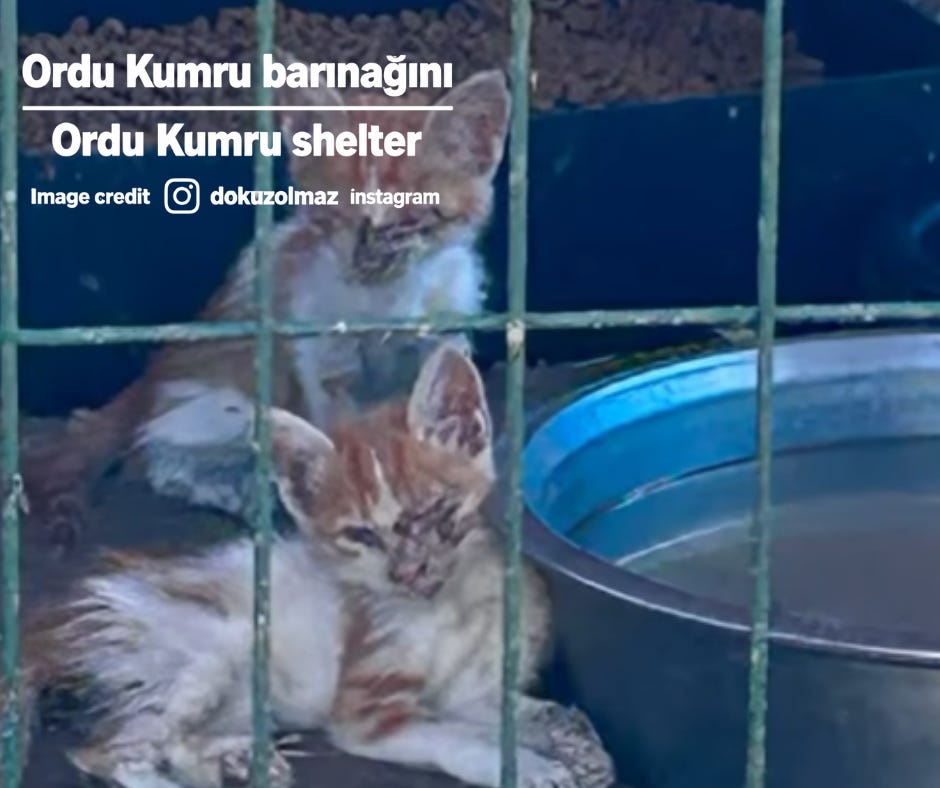
Distressing footage published by Turkish animal advocate Alper Karamış, who works online as DokuzOlmaz, has raised serious concerns about the treatment and condition of animals in İskenderun.
But the conditions documented in the footage are only part of the story. There was an intervention. Animals were helped. And subsequent reporting provides important information about what happened afterwards.
Dog Desk Animal Action has examined the available Turkish reporting to document both the concerns raised and, importantly, what happened to the animals.
The footage
Karamış identified the case as İskenderun. His video shows a dog within an enclosure together with a number of kittens and cats in visibly concerning conditions, raising serious concerns about neglect and the standard of care being provided.
In a follow-up published on 24 August, Karamış said that the images had been recorded several days previously and provided further information about what happened afterwards.
He reported that the old İskenderun shelter had been demolished and its animals transferred to Antakya. He also said that a new shelter, announced approximately a year and a half earlier and under construction for around a year, had not yet opened.
Dog Desk Animal Action has not identified an official municipal statement independently confirming the reported demolition or transfer, so we are recording these developments as Karamış’s account.
What happened to the animals?
This is perhaps the most important part of the story.
Local news platform Hatay Olay subsequently published an account attributed to a visitor to the shelter, providing considerably more information about the animals and the intervention that followed.
The visitor described finding kittens in urgent need of help. They reported animals that were collapsed or struggling to breathe, kittens with serious health problems and injuries, and a very young motherless kitten in a severely weakened condition.
The visitor also described serious concerns in the dog area, including a dog they said was chained and a puppy they reported had died.
But the visitor did more than document what they found.
According to the account published by Hatay Olay, the cats were removed and taken for emergency veterinary treatment.
Two cats began treatment. Sadly, one subsequently died. The other cats were transferred to volunteer groups in Antakya, where their treatment and care could continue.
We therefore know that animals identified as needing urgent help received intervention and veterinary care.
There had already been plans to replace the old shelter
The condition and future of İskenderun’s existing municipal shelter had been under discussion well before these events.
In April 2025, local reporting quoted İskenderun Mayor Mehmet Dönmez describing the existing facility as having basic or primitive conditions and announcing plans for a new animal care facility with capacity for approximately 1,000 animals.
The following month, reporting said that the existing shelter in Meydan Mahallesi had operated since 2009 and had capacity for approximately 280 animals. The municipality planned an integrated facility capable of accommodating around 1,000 animals, including operating rooms, observation rooms, quarantine facilities and adoption areas. The mayor said at the time that the project was expected to be completed within approximately four months.
Earlier municipal records had also identified the need to rebuild the ageing shelter so that animals could be cared for in healthier and more modern conditions.
Concerns about the adequacy of the old facility therefore did not begin in August 2026. The need to replace it had already been publicly acknowledged.
In his August 2026 account, Karamış said that the new shelter had been announced approximately a year and a half earlier and that work had been underway for around a year, but that it had not yet opened.
That broadly corresponds with the publicly documented redevelopment programme, although Dog Desk Animal Action has not independently established the current construction or opening status of the new facility.
Timeline
April 2025 A new shelter is announced
İskenderun Mayor Mehmet Dönmez describes the existing shelter as having basic or primitive conditions and announces plans for a new facility capable of accommodating around 1,000 animals.
May 2025 Plans for the replacement facility are detailed
Reporting says that the existing Meydan Mahallesi shelter has operated since 2009 and has capacity for approximately 280 animals. Plans for the new facility include treatment, observation, quarantine and adoption areas, with completion anticipated within approximately four months.
August 2026 Concerning conditions are documented
Alper Karamış/DokuzOlmaz publishes footage he identifies as relating to İskenderun, showing animals in visibly concerning circumstances.
Karamış later says that the images had been recorded several days before his 24 August post.
Animals receive help
An account subsequently published by Hatay Olay describes cats requiring urgent assistance being removed and taken for emergency veterinary treatment.
Two cats begin treatment. One sadly dies. Other cats are transferred to volunteer groups in Antakya so that their treatment and care can continue.
24 August 2026 Karamış reports the old shelter has been demolished
Karamış reports that the old İskenderun shelter had been demolished and its animals transferred to Antakya.
He also reports that the new shelter, which had been under construction for around a year, had not yet opened.
Dog Desk Animal Action has not independently confirmed the reported demolition or transfer through an official municipal source.
31 August 2026 Further local reporting emerges
Hatay Olay reports on the case, publishing further footage alongside the visitor's account and providing important information about what happened to some of the animals afterwards.
The story did not end with the footage
There is a tendency for disturbing footage involving animals to travel much further than the information that follows it. In this case, that risks leaving people with the impression that animals were filmed suffering and nothing happened.
That is not the complete story.
Cats identified as needing urgent help were removed. Veterinary treatment was provided. Other cats were transferred into the care of volunteers in Antakya. Sadly, one cat did not survive.
Separately, Alper Karamış reported that İskenderun’s old shelter was demolished and the animals housed there were transferred to Antakya. That reported demolition and transfer has not yet been independently confirmed through an official municipal source.
There are still questions. We want to know what happened to the animals reportedly transferred from the old shelter, whether those requiring treatment were assessed and treated, and what has happened with the new İskenderun facility announced in 2025.
Those are questions we will continue to follow. But they should not obscure an important part of what happened after these conditions were documented.
The work of advocates such as Alper Karamış is important. Visiting facilities, documenting what is found and continuing to follow what happens afterwards helps create a public record that might otherwise not exist. It also means that attention does not have to end with a piece of distressing footage; we can begin to understand what happened next.
We are grateful to Alper for the work he does and for continuing to document conditions affecting animals in Türkiye.
People intervened. Animals received help. And the story did not end with the footage.