
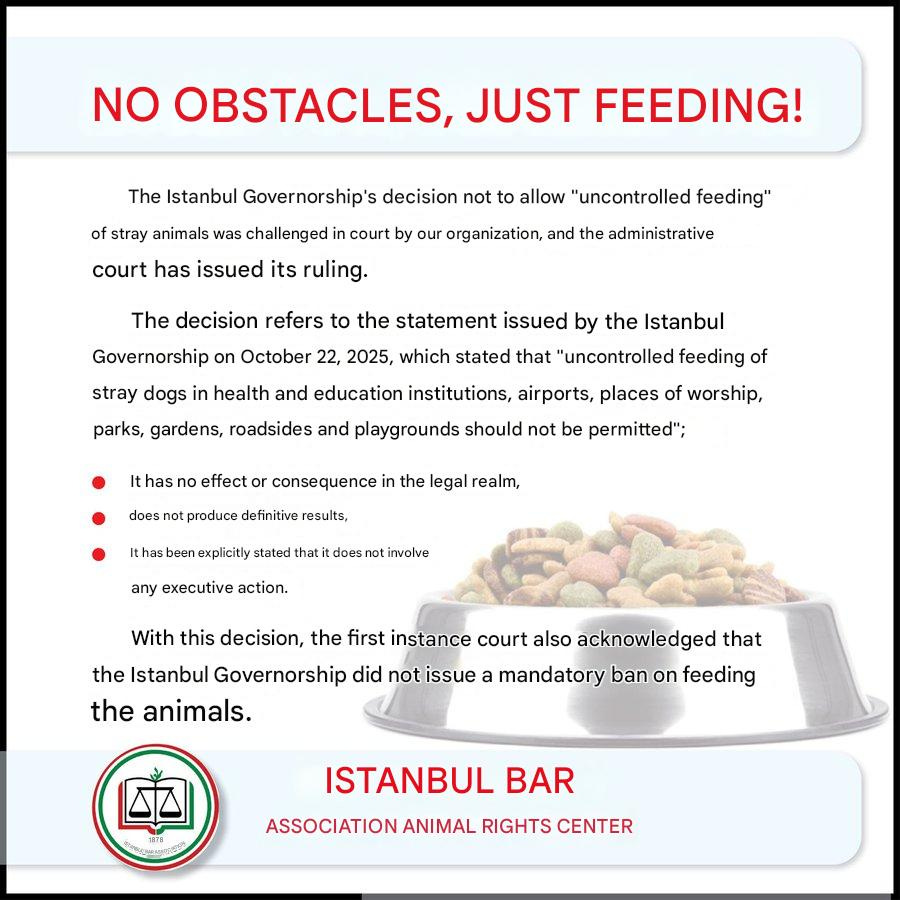
In a significant development for animal welfare, the judiciary has overturned the circular that had been used to justify restrictions on feeding stray animals in Turkey.
The controversial regulation often referred to as the Stray and Dangerous Animals circular empowered authorities to limit or prevent the feeding of street dogs and to impose wide-ranging controls on how stray animals were managed. For caregivers and animal rights organisations, it was seen as a direct threat to the survival of animals who depend entirely on community care.
Now, the Council of State (Danıştay) has ruled that this circular was unlawful and has annulled it.
The court found that the regulation went beyond the authority granted by existing animal protection laws and attempted to introduce binding rules without a proper legal basis. In simple terms: it was an administrative overreach, and it has been struck down.
This decision matters profoundly.
Feeding bans do not exist in a vacuum. In cities where shelters are overcrowded, under-resourced, or unsafe, community feeding is not a lifestyle choice — it is the difference between life and slow starvation. Criminalising or restricting those who provide food does not solve population management, disease control, or public safety. It only creates suffering.
In our earlier blog, A Crisis for Stray Dog Welfare in Istanbul, we warned that attempts to ban or restrict feeding would:
Push animals into hunger and conflict,
Force caregivers into fear and silence,
Undermine the very principles of Turkey’s Animal Protection Law No. 5199, which recognises community responsibility for stray animals.
The court’s decision now reinforces that argument with legal authority.
By cancelling the circular, the judiciary has affirmed that animals’ right to life and care cannot be curtailed by administrative shortcuts. It has also strengthened the position of citizens, volunteers and lawyers who insist that compassion is not a crime, and that protecting vulnerable beings is a legal and moral duty.
This is not the end of the struggle. Local directives and political pressure can still attempt to return under different names and justifications. But this ruling sends an unmistakable message:
Stray animals are not disposable.
Feeding them is not illegal.
And policies that threaten their survival will not go unchallenged.
For everyone who stands on cold pavements filling bowls, for every volunteer who refuses to turn away from hunger, and for every animal whose life depends on that kindness this is a moment of hope, and a reminder that the law, when pushed, can still stand on the side of the voiceless.


