


An official inspection by the İzmir Governorship Provincial Directorate of Agriculture and Forestry, dated 2 February 2026, examined ketamine containing medicines held by İzmir Metropolitan Municipality’s Veterinary Affairs Directorate.
One part of that inspection concerned 1,680 units of KETA-CONTROL, a veterinary medicine containing ketamine.
The report records that those 1,680 units had been obtained from Asya F Medikal against an invoice dated 8 May 2025, without the required prior permission from the Provincial Directorate. Unlike another drug discrepancy which we will come to later, these medicines were physically received and entered into stock.
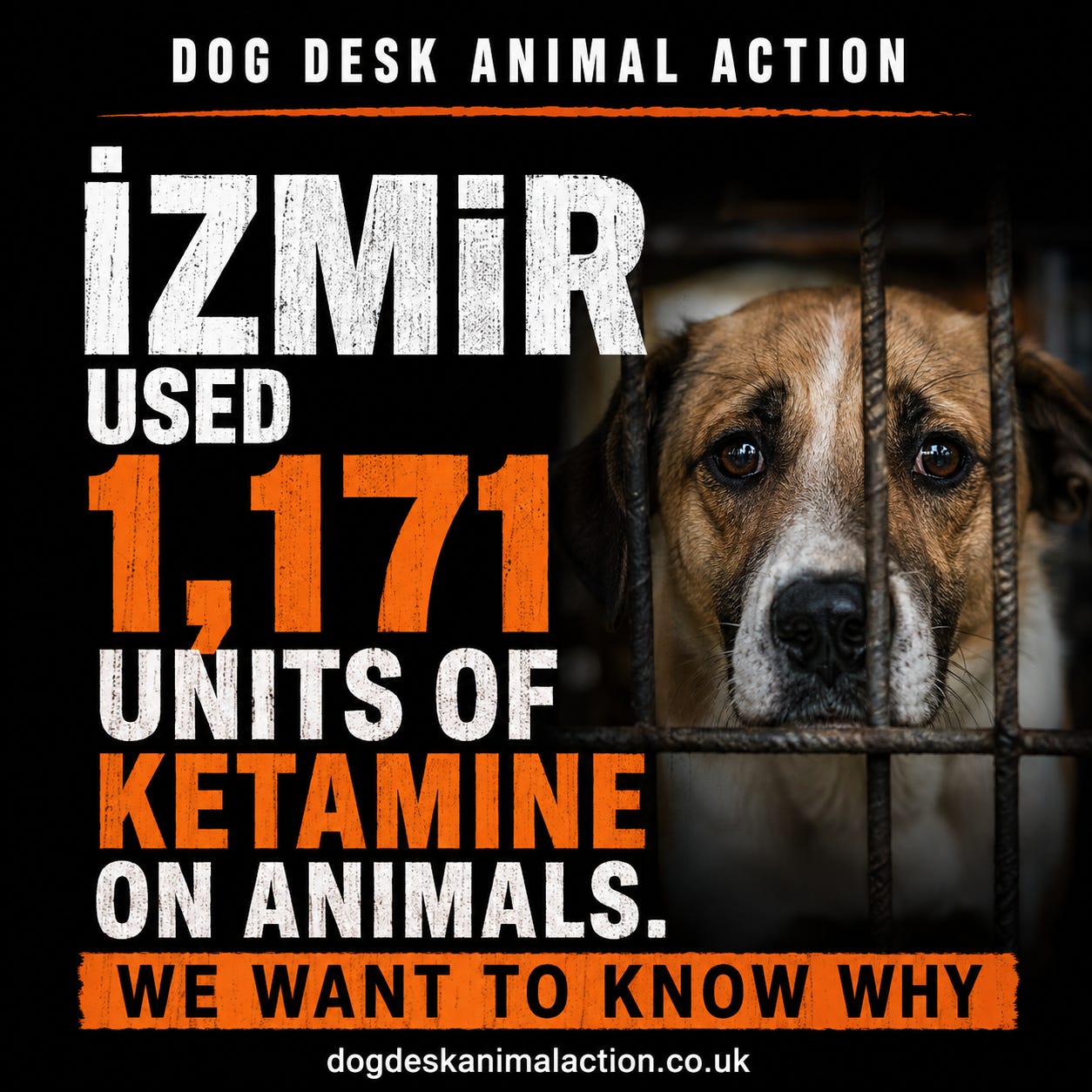
When officials checked the records on 2 February 2026, 1,171 units had been used.
The remaining 509 were accounted for. Inspectors recorded 396 at the Zeytinlik Additional Service Building, 17 at Işıkkent Dog Care Home, one at Pako Street Animals Social Life Campus, 30 at İzmir Natural Life Park and 65 at the Veterinary Affairs Directorate’s Konak branch.
The figures are clear. 1,680 units were obtained. 509 remained. 1,171 had been used.
But the Turkish Ministry of Agriculture and Forestry has its own system specifically designed to take us further than that.
Türkiye introduced its electronic veterinary prescription system and Veterinary Drug Tracking System nationally in 2018. The Ministry says the purpose is to make veterinary medicines traceable from production or import right through to their final use. (Tarım Orman Bakanlığı)
More importantly for the dogs in İzmir, the Ministry says the systems allow authorities to determine which medicine was administered to which animal, when it was administered and how it was administered. It also says veterinary treatments are recorded through the system. (Tarım Orman Bakanlığı)
That changes the question considerably. If 1,171 units of KETA-CONTROL were recorded as used, we should not have to stop at the word used. There should be records behind that figure.
Ketamine is an anaesthetic used legitimately in veterinary medicine. The question is not why a veterinary department possesses anaesthetic. Of course animals sometimes require anaesthesia. The question is what veterinary activity accounts for the use of 1,171 units and which animals that activity involved.
How many animals received the drug? How many were dogs? How many were street dogs collected by the municipality? What procedures were carried out? When and where did those procedures take place? How was the drug administered? And what happened to those animals afterwards?
The Ministry itself says its electronic systems make it possible to follow medicine use to the animal, including when and how it was administered. (Tarım Orman Bakanlığı)
So follow it.
The government now claims that 97% of the country’s unowned street animals have been collected and wants the remainder removed by the end of October. Dogs are disappearing from the streets and communities where people once knew them, fed them and saw them every day.
Once a dog enters a municipal system, that public visibility can disappear. We are then asked to rely upon the system’s records to tell us what happened next.
That is why we have repeatedly said that counting dogs collected is not enough. There must be an auditable trail through the entire process. Where was the dog collected? Where was it taken? Was it sterilised? Was it treated? Was it transferred? Was it adopted? Is it still alive in municipal care? Did it die?
Medicine records form part of that same trail.
The Ministry says its tracking systems were created precisely to record veterinary treatments and make the use of medicines traceable. It has subsequently said those systems make the stages of veterinary medicines including storage, transportation and administration traceable. (artvin.tarimorman.gov.tr)
And ketamine is not an ordinary unrestricted product.
Türkiye’s Law No. 5996 places psychotropic and narcotic veterinary medicinal products under additional controls. It states that such products may only be administered by veterinarians and cannot be transferred or sold without Ministry permission. (Tarım Orman Bakanlığı)
So when an official inspection tells us that 1,171 units of a ketamine containing veterinary product were used, the next question is not unreasonable and it is not speculative. What do the treatment records show?
There is another part of the İzmir story which makes proper traceability even more important.
A separate 1,625 controlled veterinary products appeared against İzmir Metropolitan Municipality within the Drug Tracking System. They consisted of 1,250 KETA-CONTROL and 375 CONTROL products.
The municipality says it never purchased them, never ordered them, never procured them and never physically received them.
It says its staff discovered the entries and attempted to reject the products electronically, but because the medicines had never physically arrived it was technically impossible to return them through the system. The municipality says it documented the situation and notified the İzmir Provincial Directorate of Agriculture and Forestry on 17 September 2025.
According to the municipality, the Ministry subsequently changed the system in December 2025 so that stock acceptance required SMS approval.
There is also an investigation concerning the pharmaceutical company being conducted by the Malatya Chief Public Prosecutor’s Office. İzmir Metropolitan Municipality says it supplied information and documents to prosecutors on 17 March 2026.
TEMİZELLER has asked some important questions about that discrepancy, including when the 1,625 product movement was created within the system, which user created it, when the municipality actually became aware of it and who initiated the investigation in Malatya.
Those 1,625 products need to be traced. But they are separate from the 1,680 KETA-CONTROL units which the February inspection confirms were physically received.
One trail needs to establish where controlled medicines went when İzmir says they never arrived. The other needs to establish what happened after controlled medicines did arrive and were used.
For Dog Desk Animal Action, that second trail leads directly to the animals.
Türkiye’s Interior Ministry has announced inspections of shelters across the country from the end of August. Those inspections are expected to examine collection, sterilisation, treatment, animal welfare and compliance with the law.
İzmir shows exactly why those inspections need to be forensic. Don’t simply count the dogs standing inside a shelter on inspection day. Take the number of animals collected and reconcile it against admissions. Reconcile admissions against animals currently present, transfers, adoptions and deaths.
Then look at the veterinary records.
If thousands of dogs have been sterilised, the veterinary records should demonstrate that. If animals have undergone treatment or surgery, the records should demonstrate that too. And if controlled veterinary medicines have been administered, those records should connect the medicine to the veterinary treatment.
This is how you establish what happened to dogs after they disappeared from the streets. In İzmir we already have one piece of that trail. An official government inspection tells us that 1,171 units of KETA-CONTROL were used.
The Ministry tells us its own systems are designed to establish which medicines were administered to which animals, when and how. (Tarım Orman Bakanlığı)
So those records should exist. Now use them. Requesting those records is not unusual; where controlled veterinary medicines are concerned, maintaining a traceable record of their use is part of the normal system of veterinary oversight and accountability.
Reconcile the 1,171 units against the treatment records. Tell us how many animals received ketamine, what it was used for and what happened to those animals.
Because Türkiye is asking the public to accept that almost its entire street animal population has been collected into a system operating largely beyond public view.
At that scale, assurances are not enough. The records must account for the dogs.
TEMİZELLER has been investigating the controlled-drug records within İzmir Metropolitan Municipality’s Veterinary Affairs Directorate and has published the documents, the municipality’s response and the questions it says remain unanswered.
You can read the TEMİZELLER investigation and examine the reporting behind this story here:
Read the TEMİZELLER investigation