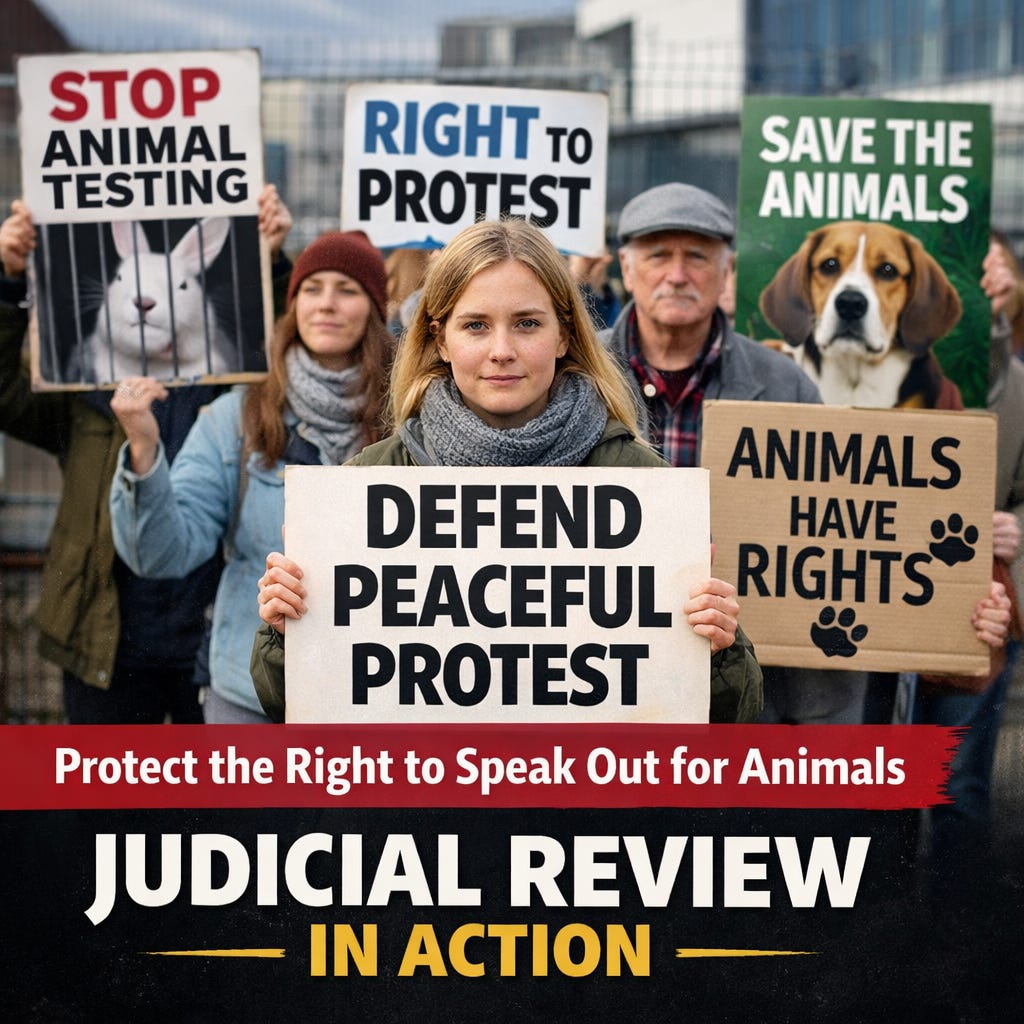
Peaceful protest has played a significant role in advancing animal welfare protections. Many practices that once remained hidden, from laboratory conditions to commercial exploitation of animals only entered public debate because individuals were willing to speak out and demonstrate peacefully.
That right is now the subject of legal challenge.
A Judicial Review has been launched over amendments connected to the Public Order Act 2023, which campaigners argue could restrict peaceful protest outside facilities associated with animal testing. The case will ask the court to examine whether these changes extend protest restrictions beyond what Parliament originally intended.
The legal challenge follows recent changes to protest law that broadens police powers and alters how disruption during demonstrations is defined. Critics argue that these amendments risk placing peaceful animal advocacy within the scope of criminal enforcement.
The Judicial Review does not determine whether people agree or disagree with animal testing itself. Instead, it examines a more fundamental question:
Should citizens retain the right to peacefully protest on matters of animal welfare and ethical concern?
For many animal protection campaigns, peaceful protest has historically been the only mechanism capable of bringing hidden suffering into public view. From laboratory oversight to wider welfare reforms, public scrutiny has often followed sustained civic engagement.
The outcome of this Judicial Review may therefore have implications beyond a single law. It will help clarify how the right to peaceful protest can be exercised in the context of animal advocacy.
Sign the Petition
We are calling for the protection of peaceful protest for animals.
If you believe people must retain the right to peacefully raise concerns about animal welfare, please add your name to the petition.
https://dogdeskanimalaction.com/defend-peaceful-protest-for-animals/
Your signature helps demonstrate that public support exists for protecting peaceful advocacy for animals.
Animals cannot speak in public debate. The ability to peacefully advocate on their behalf matters.
What the Judicial Review is about
A Judicial Review asks the High Court to decide whether the government acted lawfully when it introduced new regulations expanding police powers over protests.
The claim argues that the government went beyond what Parliament originally authorised in the Public Order Act when it extended these powers.
If the court agrees, it could quash the regulations entirely.
The amendment being challenged
The dispute relates to changes connected to the Public Order Act and related protest regulations that:
Expand police powers to restrict protests
Lower the threshold for intervention from serious disruption to more than minor disruption
Allow police to impose conditions or stop protests more easily.
Critics say this dramatically broadens police discretion and could allow protests to be limited for relatively small disruptions.
Why campaigners say it is unlawful
Those bringing the Judicial Review argue several points:
1. The government bypassed Parliament
Parliament previously rejected similar wording.
Ministers allegedly reintroduced it via secondary legislation, which receives far less scrutiny.
2. The threshold was improperly lowered
The original law referred to serious disruption.
The regulation allows action where disruption is more than minor.
3. It undermines the right to protest
Campaigners argue it interferes with freedom of expression and assembly protected under human rights law.
Context: earlier court rulings
This is not the first legal challenge.
In 2024 the High Court ruled similar anti-protest regulations unlawful after a challenge from civil liberties group Liberty.
The court said the government had expanded police powers beyond what Parliament authorised.
The new judicial review is part of a continuing legal battle over protest laws in the UK.
The specific trigger for the new challenge
The latest dispute is also linked to an amendment expanding protest restrictions around animal-testing facilities and related infrastructure, which activists say could criminalise peaceful demonstrations near those sites.
Campaigners argue the change effectively creates new protest-restriction zones without proper parliamentary scrutiny.
What happens next
The judicial review process usually goes through these stages:
Permission stage – the High Court decides if the case can proceed.
Full hearing – judges examine whether the government acted lawfully.
Possible outcomes:
Regulations quashed
Regulations upheld
Government required to rewrite the law
Why This Matters
At its core, this case concerns the balance between state authority and the public’s right to peaceful protest.
The court is being asked to determine whether ministers expanded policing powers in a way that goes beyond what Parliament originally intended when the legislation was passed.
The outcome will help clarify the limits of executive power and whether the right to protest can be restricted through regulatory changes rather than full parliamentary scrutiny.

