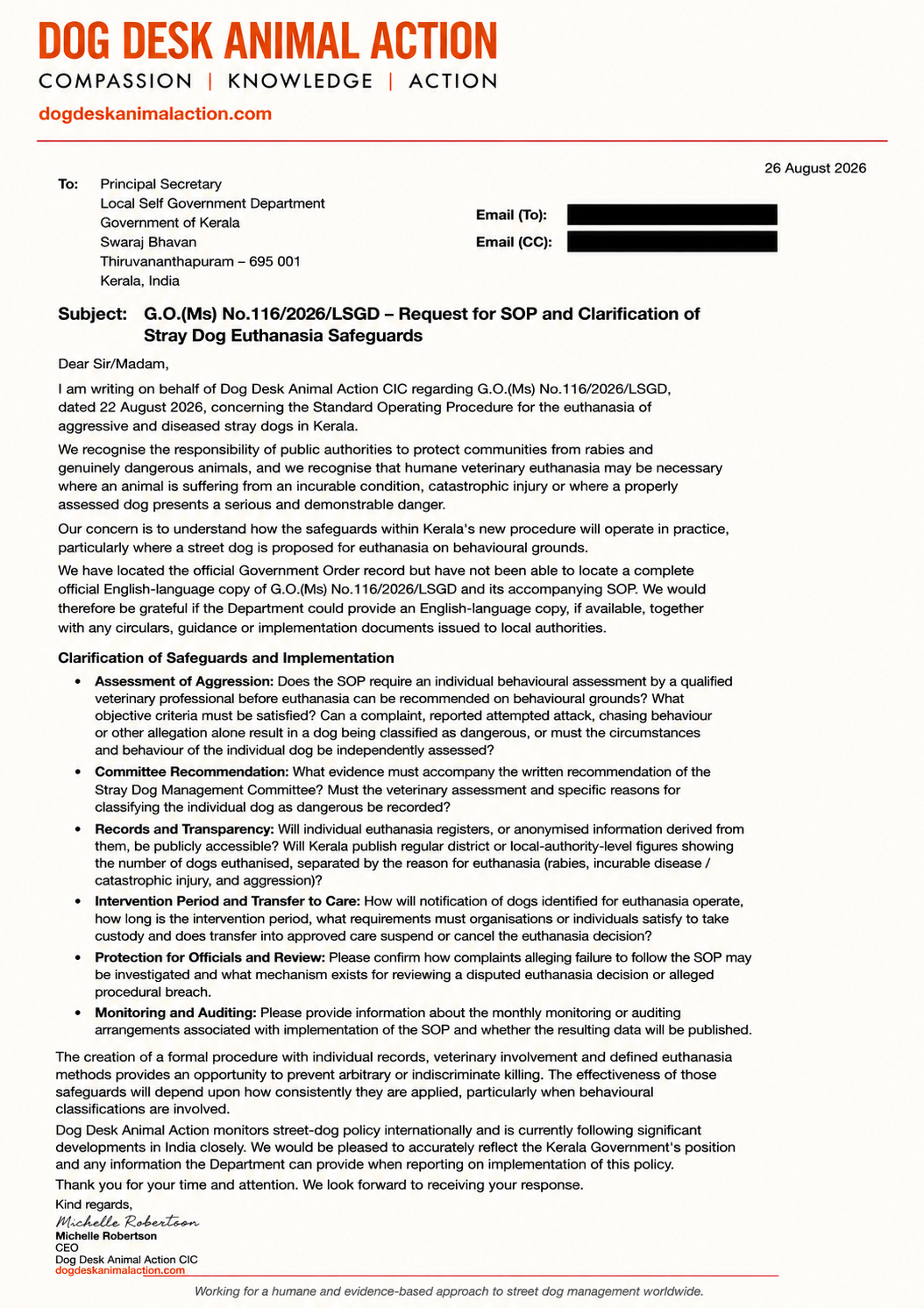


Kerala has introduced a new Standard Operating Procedure governing the euthanasia of street dogs considered aggressive or seriously diseased. The Government Order, G.O.(Ms) No.116/2026/LSGD, was issued by the Local Self Government Department on 22 August 2026.
There is an important distinction to make at the outset. This is not a policy authorising indiscriminate killing of street dogs, and it should not be reported as one. Humane euthanasia can be necessary where a dog is suffering from an incurable condition or catastrophic injury, and rabies presents an obvious and serious public-health concern. The new procedure also contains safeguards intended to prevent arbitrary killing.
The difficult part lies elsewhere. What happens when the reason for killing a dog is its behaviour?
Under the new procedure, dogs falling within categories including incurable disease, mortal injury, rabies and dangerous or aggressive behaviour may be considered for euthanasia. Local Stray Dog Management Committees are expected to make written recommendations and veterinary professionals are responsible for carrying out euthanasia using prescribed methods.
On paper, introducing a formal decision making process is preferable to dogs being poisoned, shot or killed without records. Kerala’s earlier work on the SOP was itself prompted by concerns about uncertainty and arbitrary euthanasia, with the Animal Husbandry Department seeking clearer criteria for determining when a dog could properly be regarded as aggressive.
But creating a procedure does not remove the central difficulty. Aggression is not a simple label.
A dog can bite because it is frightened. A mother can defend her puppies. A dog being cornered or captured may react defensively. Territorial behaviour can include barking and chasing. Pain can alter behaviour. A frightened street dog surrounded by unfamiliar people may behave very differently from the same animal in ordinary circumstances.
None of those possibilities means genuinely dangerous dogs do not exist. The question is how authorities distinguish between them.
A dog that has repeatedly carried out serious, unprovoked attacks presents a very different situation from a dog accused of chasing somebody down a road. Yet once both can potentially sit beneath a broad description such as aggressive, violent or ferocious, the quality of the assessment becomes critical.
That is why Dog Desk Animal Action has written to Kerala’s Local Self Government Department. We have asked for the complete official English language version of G.O.(Ms) No.116/2026/LSGD and its accompanying SOP. The Government Order can be identified through Kerala’s official records, but we have not been able to locate a complete official English language version publicly available to allow the detailed provisions to be examined directly.
More importantly, we have asked what evidence will actually be required before an individual dog can be condemned on behavioural grounds. Can a complaint be enough? Can an allegation that a dog attempted to attack somebody be enough? Does chasing qualify? Must the circumstances surrounding an incident be investigated? Is an individual behavioural assessment required from a qualified veterinary professional? How are fear, pain, maternal behaviour, territorial behaviour and reactions during capture distinguished from a dog presenting a persistent and serious danger?
These are not minor procedural questions. They could determine whether the behavioural category remains a narrow provision for genuinely dangerous animals or gradually becomes a much wider route through which unwanted street dogs can be removed.
There are elements of Kerala’s approach that deserve recognition. Individual euthanasia records are reportedly required. Information including the dog’s identification, capture location, photograph or identification tag and the reason for euthanasia is expected to be recorded. That creates something Dog Desk Animal Action repeatedly looks for when examining street dog management systems: individual traceability.
If a dog is killed by a public authority, there should be a record showing which dog it was and why the decision was taken. But the existence of a register is only the beginning. The next question is whether anybody outside the authority will be able to see what it contains. We have therefore asked whether Kerala will publish euthanasia information at local authority or district level and, crucially, whether the reason for euthanasia will be recorded in the published figures.
A single total would tell us very little. If 1,000 dogs were euthanised, it would matter enormously whether 900 were suffering from confirmed rabies or catastrophic injuries and 100 were assessed as dangerously aggressive, or whether the proportions were reversed.
The categories need to remain visible.
There is another safeguard within the new procedure that deserves close attention. Reporting indicates that dogs selected for euthanasia are to spend a short period in an isolation kennel, ABC facility or shelter, during which recognised animal welfare organisations or interested individuals may be able to take them into care.
In principle, that creates an opportunity to save a dog where appropriate. In practice, a period of only a few days could be extremely difficult to use. An organisation may need to discover that the dog has been listed, assess the circumstances, locate appropriate accommodation, arrange transport and take responsibility for an animal already classified by authorities as dangerous.
That is why we have asked how notification will work, how long organisations will actually have to intervene and whether taking a dog into approved care cancels the euthanasia decision.
The procedure also reportedly provides protection for officials carrying out their duties. That needs to be understood accurately. Protection for officials acting lawfully and in good faith is not the same thing as immunity from accountability where procedures are ignored or authority is abused.
The important question is therefore what happens when somebody believes the safeguards have failed.
If the wrong dog is captured, if an assessment is inadequate, if the required evidence does not exist or if somebody alleges that a dog has been killed outside the permitted procedure, there must be a meaningful route through which that decision can be examined.
We have asked Kerala what that route is. None of these questions requires opposition to humane euthanasia. A dog dying painfully from an incurable condition should not be kept alive simply to improve a statistic. A dog with confirmed rabies presents an entirely different welfare and public health situation from a healthy community dog. There may also be exceptional cases in which careful professional assessment concludes that an individual dog’s behaviour presents a serious danger that cannot safely be managed.
The danger comes when exceptional circumstances become elastic categories.
India is already going through a profound change in the way street dogs are managed. Courts, states and municipalities are trying to reconcile human safety, rabies prevention, sterilisation, vaccination, institutional removals, shelter capacity and animal welfare law. Decisions being made now could shape the treatment of enormous numbers of dogs for years.
Kerala has chosen to create a formal process rather than leave euthanasia decisions without structure. That gives the state an opportunity to demonstrate that such decisions can be individually evidenced, professionally assessed, recorded and scrutinised. It also gives the public something against which implementation can be measured.
The most important figures will therefore come after the policy begins operating. How many dogs are euthanised? Where were they collected? Why were they killed? How many were classified as aggressive? How many were suffering from rabies or incurable disease? How many proposed euthanasia cases were instead taken into care? How many decisions were challenged? How consistently were the safeguards followed? Those figures will tell us considerably more than the existence of the SOP itself.
For now, one question sits at the centre of Kerala’s new approach. When the state decides that a street dog is too dangerous to live, what evidence will it require before making that decision?
Dog Desk Animal Action has asked Kerala’s Local Self Government Department. We will publish its response.