Russia’s approach to street dogs is becoming increasingly fragmented. Regional governments now have considerable influence over what happens to a dog after capture, meaning their future may depend upon where in the country they are found.
Krasnoyarsk Krai has now reportedly brought detailed procedures governing the capture, temporary detention, return and euthanasia of ownerless animals into operation. The procedures introduce requirements intended to improve identification, transportation and record-keeping, but they also place dogs assessed as aggressive within a system that can end with their death.
According to a report published on 25 September, animal-control contractors must regularly patrol the areas covered by their contracts and respond to reports of roaming animals within 24 hours.
Dogs displaying identification tags should not be captured. The same protection reportedly applies to non-aggressive dogs wearing collars containing their owners’ contact details. Lost dogs may be returned once ownership has been confirmed and the owner has reimbursed the costs associated with capture, vaccination and sterilisation.
Permitted capture methods reportedly include food lures, specialist cages and veterinary capture drugs. Capture should not take place in front of children unless the animals present an immediate threat. Captured dogs must be transported to a temporary holding facility within 12 hours and entered into an electronic database.
These provisions could improve traceability and reduce the risk of identifiable dogs disappearing into the municipal system without a record. Capture, however, is only the beginning of the process.
Following veterinary examination and quarantine, only dogs assessed as healthy, socialised and non-aggressive may be returned to their former territory. The regional framework also provides for vaccination, sterilisation, identification, attempts to locate an owner and the possibility of transfer to a new owner or animal shelter.
Individual records must be maintained on paper and electronically. Existing rules also require video evidence of capture and return to be retained for three years.
Those safeguards are important, but they do not answer every question. Municipalities may designate locations to which ownerless animals cannot be returned. The available information does not clearly establish what ultimately happens to a healthy, non-aggressive dog when return is prohibited and no adopter or shelter place is available.
The euthanasia power itself is not new. The September procedures appear to implement Krasnoyarsk’s existing legal framework rather than create a completely new authority to kill dogs.
Regional Government Resolution No. 1070‑p previously authorised euthanasia in temporary holding facilities when an animal is experiencing intolerable suffering caused by a serious incurable illness, has an incurable traumatic injury incompatible with life, has been individually linked to a documented attack on a person, displays what the legislation calls unmotivated aggression, or has a particularly dangerous disease.
A July 2026 amendment subsequently authorised the regional executive body to establish the detailed procedures governing capture, transportation, behavioural assessment and return. The newly reported rules appear to complete that process.
Krasnoyarsk did not suddenly authorise euthanasia on 25 September. The killing power already existed. What has changed is that the procedures governing how dogs enter, move through and potentially die within the system have now reportedly been formalised.
One of the greatest concerns is the use of unmotivated aggression as a ground for euthanasia.
A frightened dog may growl, bark, retreat, freeze or attempt to defend itself during capture, transportation or confinement. None of those responses automatically proves that the dog presents a continuing danger.
An assessment conducted shortly after capture can also be distorted by pain, fear, illness, unfamiliar handling and the conditions inside a holding facility. Without a robust and transparent assessment process, a subjective behavioural label could become a route to killing dogs that are frightened, poorly handled or simply difficult to place.
The authorities should publish the complete behavioural-assessment protocol. The public needs to know who is qualified to conduct an assessment, how long each dog is observed, whether pain and capture-related fear must be excluded and whether more than one assessment is required.
It should also be clear whether an independent review is available, how a reported attack is linked to the correct individual dog and whether recognised animal-welfare organisations can inspect the records.
Shelter and holding capacity will be equally important. If a municipality prohibits the return of dogs to particular locations, the authorities must have somewhere suitable for those animals to go. Temporary holding facilities cannot become an invisible substitute for properly funded shelters, rehabilitation and adoption programmes.
Existing provisions also allow some dogs assessed as aggressive before March 2026 to be transferred from shelters into temporary holding for reassessment. Those dogs may then be returned or euthanised. The public should be told how many dogs enter that process and what happens to every one of them.
Krasnoyarsk should publish monthly figures showing how many dogs are captured, admitted to temporary holding, reclaimed, sterilised, vaccinated, returned, transferred, adopted, assessed as aggressive, recorded as dying in custody and euthanised.
Every euthanasia should be supported by an individual record identifying the legal ground, assessment evidence, veterinary involvement, method used and person who authorised it. Aggregate figures would then allow the public to determine whether euthanasia is being used exceptionally or has become a routine population-management measure.
This development is significant enough to justify a substantive update to our monitoring of Russia. It does not, by itself, establish that healthy dogs are being killed indiscriminately across Krasnoyarsk Krai. The framework also contains identification, quarantine, vaccination, sterilisation and record-keeping requirements.
It does, however, give the authorities a legal route to kill dogs following behavioural classification, including dogs described as displaying unmotivated aggression.
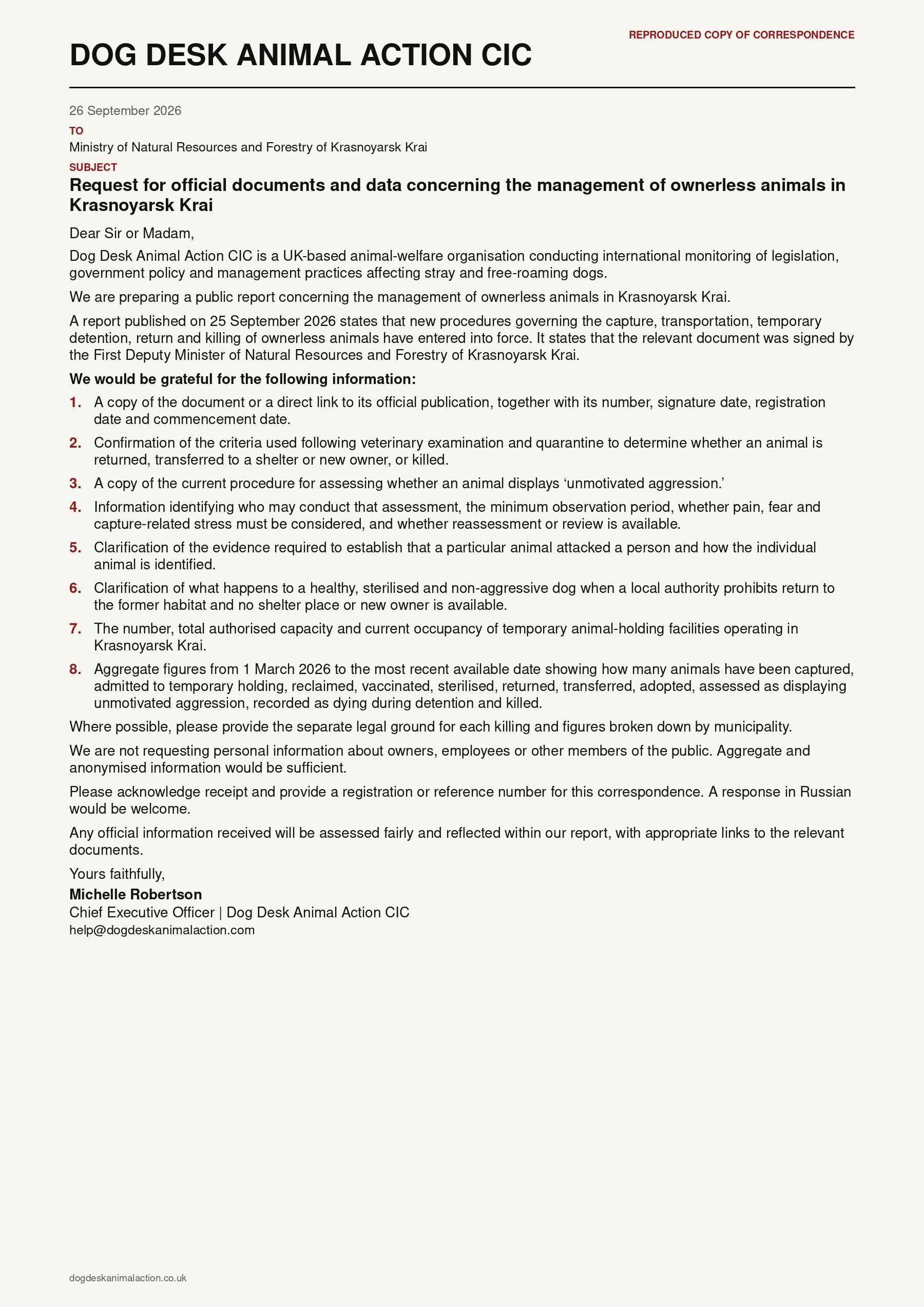
The signed ministerial order and its registration number have not yet been located in the official legal database. Until the complete document is available, some details remain dependent upon local reporting.
Dog Desk Animal Action will therefore treat this as a regional implementation concern within Russia’s fragmented street-dog system. We are not recommending a new national classification solely on the evidence currently available.