


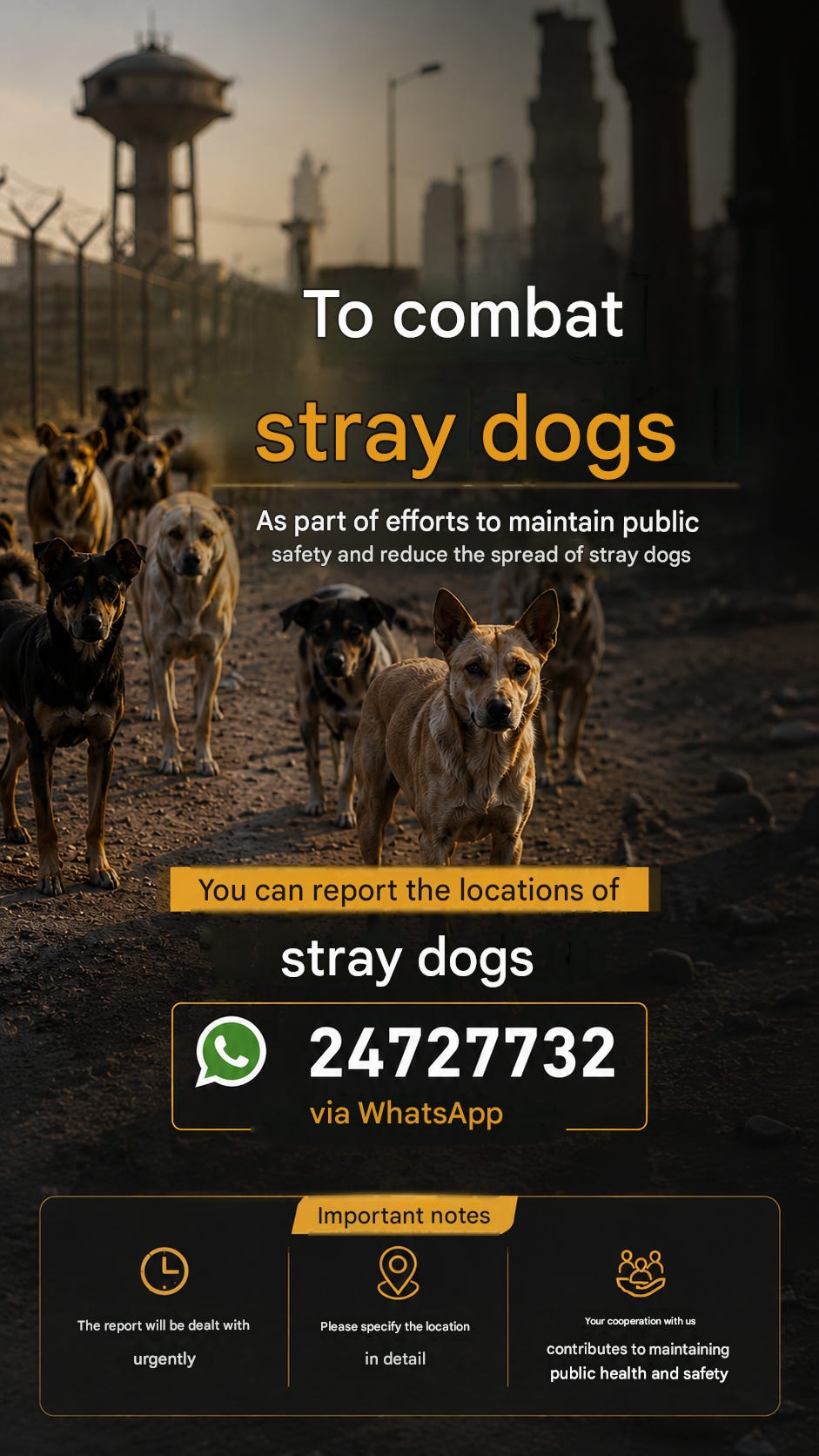
Across Kuwait, stray dogs are increasingly being treated as a public problem that needs to disappear from view.
Over recent months, Arabic-language reporting has focused heavily on public complaints, removal campaigns, and fears surrounding dogs living in industrial and residential areas. Residents are now encouraged to report stray dogs directly through WhatsApp systems and municipal hotlines, while field teams are dispatched to remove animals from public spaces.
The language surrounding the issue has changed noticeably. Dogs are no longer being discussed primarily as abandoned animals or as part of a wider welfare failure. Instead, the conversation is increasingly framed around public safety, control campaigns, sanitation, and urban order.
But behind the growing focus on removal lies a far more uncomfortable question. What actually happens to the dogs afterwards?
Many of these dogs did not simply appear overnight. Some were born on the streets after years of uncontrolled breeding and abandonment. Others were once owned animals themselves. Gulf rescue groups have repeatedly documented dogs abandoned in desert areas, left behind during relocations, or discarded when they became inconvenient. The same society that created the stray dog population is now demanding that it disappears.
The public sees the dogs while they are on the streets. They see reports on social media. They see WhatsApp numbers encouraging complaints. They hear discussions about packs near industrial areas and fears over attacks. What the public rarely sees is the system that exists after removal.
Kuwait still does not appear to have a large transparent government-run stray dog shelter infrastructure capable of absorbing large numbers of animals. Independent rescuers and private volunteers continue to carry much of the burden themselves, often caring for significant numbers of dogs in difficult conditions with limited support. Yet removal campaigns continue to expand.
This creates a troubling gap between the visible part of the system and the invisible one. If more dogs are being reported, captured and removed, where exactly are they going?
In countries operating large-scale humane management systems, authorities often publish shelter statistics, sterilisation numbers, adoption outcomes and rehabilitation programmes. In Kuwait, public discussion remains overwhelmingly focused on reporting, collection and removal. Long-term welfare outcomes are far less visible.
That absence of transparency fuels growing concern among rescuers and observers across the region. For years, animal advocates in Gulf countries have raised fears about dogs being relocated to remote desert areas, abandoned far from urban centres, or disappearing into systems the public rarely sees. Whether every allegation is accurate or not, the concern itself reflects a deeper problem, the public can clearly see dogs being removed, but cannot clearly see what happens afterwards.
This is not simply a story about stray dogs. It is also a story about how societies respond to problems they helped create. These dogs did not fail people. People failed them long before removal campaigns began. They were failed through abandonment, uncontrolled breeding, lack of sterilisation, and the absence of long-term humane planning. Now many are disappearing from the streets entirely, while the systems surrounding their fate remain largely hidden from public scrutiny.
The streets may become quieter. But silence does not necessarily mean the problem has been solved.